
In this guide Show sections
General guidance, not a professional assessment. Confirm site-specific advice and current requirements before work.
Planning tree work in Bedford or nearby?
Start with the postcode, the work you have in mind and any access considerations.
Prepare your enquiryNo obligation. A site assessment may be needed to confirm the work and price.
Before you make arrangements
Keep away from obvious hanging material, unstable features or another immediate concern and use the appropriate reporting route where needed. For the wider project, collect purchase documents and ask what is known about earlier tree work. Our buying a home with mature trees guide helps separate the property enquiries from a later garden-work brief.
Make a first record before clearing
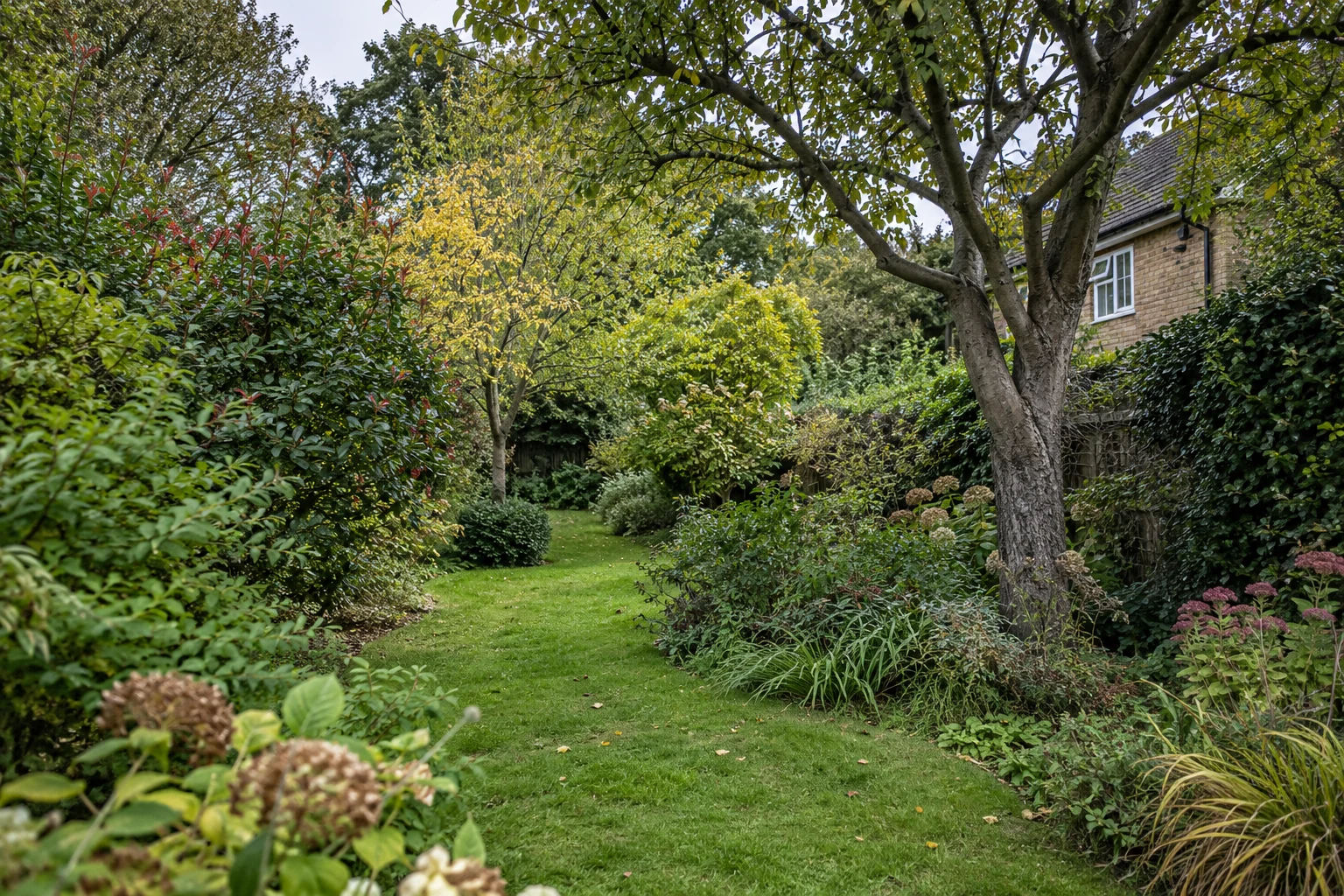
Photograph the overall garden from safe, accessible positions and identify the main trees, hedges, paths and buildings on a simple plan. Record areas you cannot safely reach. Do not clear dense growth simply to complete the plan if it may conceal hazards or habitat.
Use tree-location plans to connect labels with the eventual work brief. The record does not need to look like a professional survey to be useful, provided its limitations are clear. It preserves the starting context while you gather advice and helps several contractors understand that a photograph showing the same tree from another angle is not an additional tree to price.
Separate concern from cosmetic preference
Write different lists for observed concerns, access needs and the changes you would like for appearance or light. A broken hanging branch belongs in a different conversation from a hedge that feels too broad. Tell the assessor if a feature is new, longstanding or simply unfamiliar because you have recently moved in.
Our assessment-signs guide helps describe concerns without diagnosing them. Avoid labelling every old, hollow or ivy-covered tree unsafe. The ivy guide explains why appearance alone can mislead. An appropriate assessment should help establish priorities rather than begin with the assumption that every untidy feature needs the same operation.
Identify before choosing a reduction
Find out what the main trees and hedge plants are before requesting a major change. Species and earlier management affect which options are suitable. A hedge that looks like a single green boundary may contain several kinds of plant with different responses to cutting.
Read mixed boundary hedges and overgrown Leylandii options where relevant. A photograph of a neatly reduced hedge elsewhere is not a specification for yours. Ask the professional which sections can reasonably achieve your desired result and whether retention, staged work or replacement needs discussion. The answer should follow identification and site assessment, not simply a target height selected from the window.
Check ownership and protected status early
Establish which trees or hedge sections belong to the property and where access would cross other land. A fence and a canopy outline do not settle the legal boundary. If purchase documents leave uncertainty, obtain the relevant advice rather than asking a contractor to decide ownership by appearance.
Use Bedford TPO checks and conservation-area guidance for the tree-control starting points. The correct authority depends on the actual property, not only its postal town. Being the new owner does not itself authorise every proposed operation. Resolve the records early so a later plan can distinguish work ready to be specified from work that needs additional checks.
Treat wildlife features as part of the garden
Dense hedges, old trees, log piles and rough corners may have habitat value. Do not assume that an apparently quiet area is empty or that moving material into one large pile is a neutral preparation step. Explain the proposed clearance and seek advice where protected species or active nests may be relevant.
The Natural England bird-protection guidance provides the official starting point for nesting questions. Our garden ponds and habitats guide and suspected bat-features guide help describe other features. A preferred date does not settle all wildlife considerations, and a general garden-clearance quotation should not conceal unresolved habitat work.
Plan access before arranging combined jobs
A neglected route may have narrow gates, hidden changes of level or shared access. Tell businesses what is known and what has not been checked. Do not undertake hazardous clearance to create machine access before the professional has assessed the route and proposed operation.
Use narrow garden access and work through the house to prepare useful questions. If the project combines trees, hedges and later landscaping, identify the order and responsibilities. A single visit may be convenient but should not force unsuitable work into the same programme. Ask which tasks can be combined without losing the separate advice, permissions and finished scope each needs.
Set priorities around decisions and dependencies
Once advice is available, organise the project by what needs action, what needs another decision and what can be planned for later. Keep any immediate access precautions separate from routine budget staging. Do not interpret a lower cosmetic priority as a professional conclusion about a tree’s safety.
Our combined tree and hedge work guide helps compare the practical sequence. Some decisions should precede others: the tree’s future may affect a proposed patio, while stump treatment depends on the final ground use. Ask the adviser to explain these links. A sensible first phase may be a limited, well-defined operation rather than the most visible transformation.
Specify the result and material handling
For each agreed phase, identify the trees or hedge sections, intended operation, permission responsibilities, access and waste arrangements. Decide which timber or chippings you genuinely want to keep and where they can be left. Material should not be retained simply because no destination was discussed.
The quotation checklist and waste scope guide help compare proposals. Keep stump work and reinstatement explicit. A quote for removing vegetation is not automatically a quote for level ground, new turf or planting. If different businesses carry out those stages, define the handover so the second team is not priced on an assumed finish the first never agreed.
Leave room for the garden’s future
Before removing a valued tree or opening a boundary, consider the effect on privacy, shade, habitat and the space you want to use. The plan does not have to preserve everything, but the choices should be informed rather than driven by the first dramatic before-and-after photograph.
Use replacement trees for small gardens and long-term care planning to connect early work with the eventual garden. Retain advice and completed-work records for future maintenance. A newly manageable garden should leave you with clear next steps and suitable retained features, not an undocumented clearance that makes every subsequent decision more uncertain.
Your next step
Begin with a safe record, identification and the relevant property checks, then ask for advice that separates concerns from cosmetic aims. Plan the work in clear phases with realistic access and waste arrangements. Use the Bedford tree-work checklist to organise the brief before committing to a broad clearance instruction.
Turn the advice into a useful project brief.
Start with the postcode, the work you have in mind and any access considerations.
Prepare your enquiryNo obligation. A site assessment may be needed to confirm the work and price.
Sources & further reading
- RHS: trees and shrubs declining in health
- Natural England: wild birds, protection and licences
- Bedford Borough Council: protected trees
Sources checked 31 October 2026. How we prepare guidance.