
In this guide Show sections
General guidance, not a professional assessment. Confirm site-specific advice and current requirements before work.
Planning tree work in Bedford or nearby?
Start with the postcode, the work you have in mind and any access considerations.
Prepare your enquiryNo obligation. A site assessment may be needed to confirm the work and price.
What to check
The usual notification period is six weeks, subject to exceptions. A conservation-area notice and a TPO consent application are different processes.
Separate the permission checks
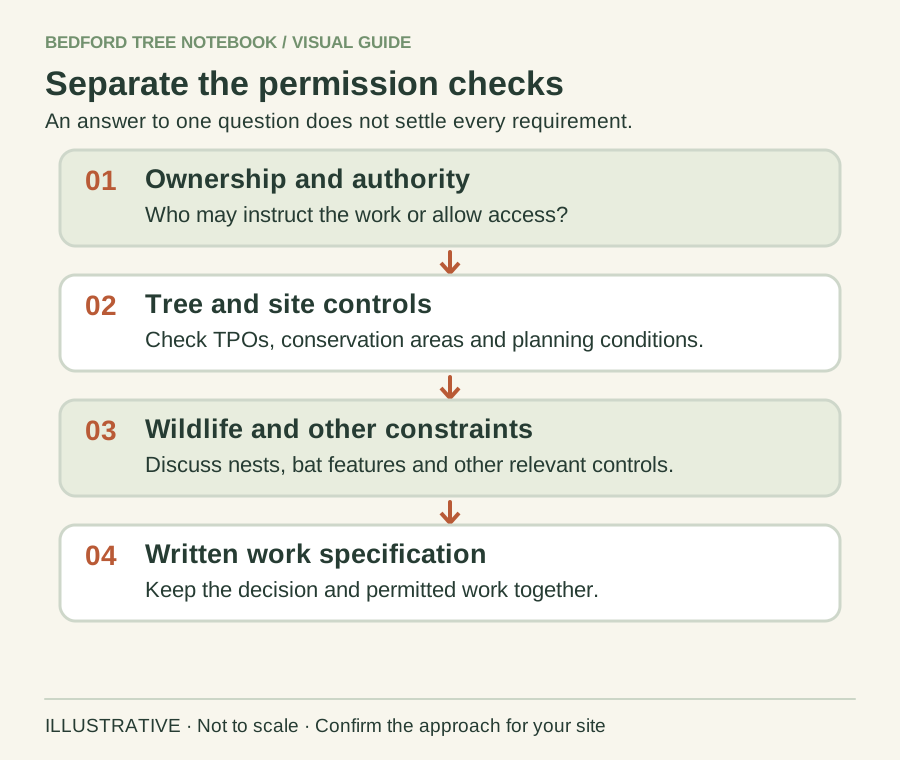
- Check every relevant control, not only the presence of a TPO.
- Keep written decisions with the exact proposal.
Background sources: GOV.UK guidance
Check the exact property
A familiar village or street name is not a substitute for the mapped boundary. Properties near a boundary need particular care. Use the official resources and ask for clarification where the map or address is ambiguous.
Describe each tree consistently
Use a simple location plan and labels such as T1 and T2 in your own project notes. Keep the labels consistent across the proposal, contractor quotation and any documents submitted to the council. This reduces confusion when there are several similar trees close together.
Plan around the process
Discuss the likely programme with the contractor before booking a fixed work date. Keep the authority’s response and any relevant conditions with the job records. If the intended pruning or removal changes, do not assume the earlier description covers the revised work.
Keep wildlife checks separate
Resolving the conservation-area process does not establish that every other issue has been cleared. Ask the contractor what site checks and other permissions are relevant. Our guide explains where to start; it is not a substitute for advice on the proposed work.
Locate the boundary carefully
Start with the property's precise position on the council resources, not an assumption about a familiar neighbourhood name. A house can be close to a conservation-area edge, and an extensive garden can make the relationship harder to interpret. Keep the address, plan reference and the tree's position together. If the boundary cannot be read confidently, ask the authority to clarify the position of the relevant tree before you arrange the operation.
Our Bedford tree-protection map guide explains why an online search is a working aid rather than a personalised decision. Ask about the record that matters to your location instead of sending a screenshot with no context. Where you are checking a village address, establish the correct council first. Similar-looking historic streets do not necessarily have identical planning status, and a local description is not a substitute for the mapped information.
Keep the notice distinct from the work specification
Before sending documents, establish what operation is being proposed. Identify each tree and describe the intended work clearly enough for another person to understand the outcome. A phrase such as 'cut back branches' can conceal uncertainty about the tree, affected area and amount of pruning. Ask the contractor to explain its recommendation and use consistent identifiers in the plan, photographs and quotation.
The protected-tree application guide covers preparation of a defined proposal, but a conservation-area notice and an application under an existing order should not be treated as the same procedure. National guidance describes the usual notice framework; the authority can clarify which route applies to the particular tree. Keep its written response and the actual submitted specification together rather than relying on an informal statement that someone has 'notified planning' without a copy.
Hypothetical example: the intended work changes
Imagine a homeowner sends a description of limited pruning, then a site visit produces a recommendation to remove the tree instead. The homeowner should not assume that waiting out a period following the first description automatically resolves the changed operation. The revised proposal needs to be discussed with the appropriate authority, and the commercial quotation should be updated so that everyone is considering the same result.
Our guide to changing approved tree work helps prepare that enquiry. Include the original reference, explain the proposed difference and ask what further process is required. This is an illustrative example, not a judgement about whether a particular notice was valid or whether felling should be allowed. Its purpose is to stop a timetable being mistaken for a permission to carry out a different job from the one that was described in the first place.
Make room in the programme for unresolved questions
Speak to the contractor early enough to allow the necessary records and responses to be gathered before work. Ask which dates are provisional and what the business needs before confirming attendance. If access requires another garden, a shared drive or arrangements for a public route, coordinate those matters too. A planned visit should not depend on several separate assumptions being resolved informally on the morning.
Read parking and shared access where the site has common entrances. If a practical constraint changes, let the contractor and relevant authority know rather than assuming it affects only the price. The homeowner's role is to provide accurate information and retain the agreed documents; the professional should explain the working plan. Do not try to settle arboricultural or legal uncertainty by choosing a convenient date and asking everyone else to make the paperwork fit it.
Check what remains relevant on the day
Give the attending business the final specification and the authority correspondence, not an early draft or only an application number. Ask who is responsible for confirming that the instructions match the documents. If wildlife or another site issue changes what can proceed, record the revised plan and clarify any further action before extending the operation. Planning paperwork is one part of the project rather than a guarantee that every site issue has been resolved.
Our active bird-nest guide explains why a calendar date alone is not a clearance. At completion, retain the quotation, invoice and any follow-up advice with the planning record. These notes help explain what was commissioned and what happened, especially if future maintenance is proposed. They do not replace expert interpretation, but they make subsequent conversations more accurate than reconstructing the project from memory.
Does using the same contractor remove the need for a new check?
A business familiar with the garden may hold useful information, but the new proposal still needs to be understood on its own terms. Ask which tree, documents and operation it is relying on this time. A previous visit does not automatically cover a different tree or a more extensive cut. Keep the current proposal visible so that familiarity with the property helps communication without replacing the relevant process.
Your next step
Confirm the requirements for the specific tree with the council and keep the proposed work consistent with the notice or consent.
If the property also contains a historic building, use tree work near a listed building to keep the separate checks clear.
Turn the advice into a useful project brief.
Start with the postcode, the work you have in mind and any access considerations.
Prepare your enquiryNo obligation. A site assessment may be needed to confirm the work and price.
Sources & further reading
- GOV.UK: Tree Preservation Orders and conservation areas
- Bedford Borough Council: protected trees
- GOV.UK: planning applications affecting trees and woodland
Sources checked 31 October 2026. How we prepare guidance.