
In this guide Show sections
General guidance, not a professional assessment. Confirm site-specific advice and current requirements before work.
Planning tree work in Bedford or nearby?
Start with the postcode, the work you have in mind and any access considerations.
Prepare your enquiryNo obligation. A site assessment may be needed to confirm the work and price.
Before you start
Use the full property postcode in GOV.UK’s council finder, then confirm the location on the relevant authority’s information. If a large plot, boundary tree or outlying site makes the result unclear, ask the authority to clarify. Do not treat a nearby house’s result as confirmation for land elsewhere.
Find the correct council
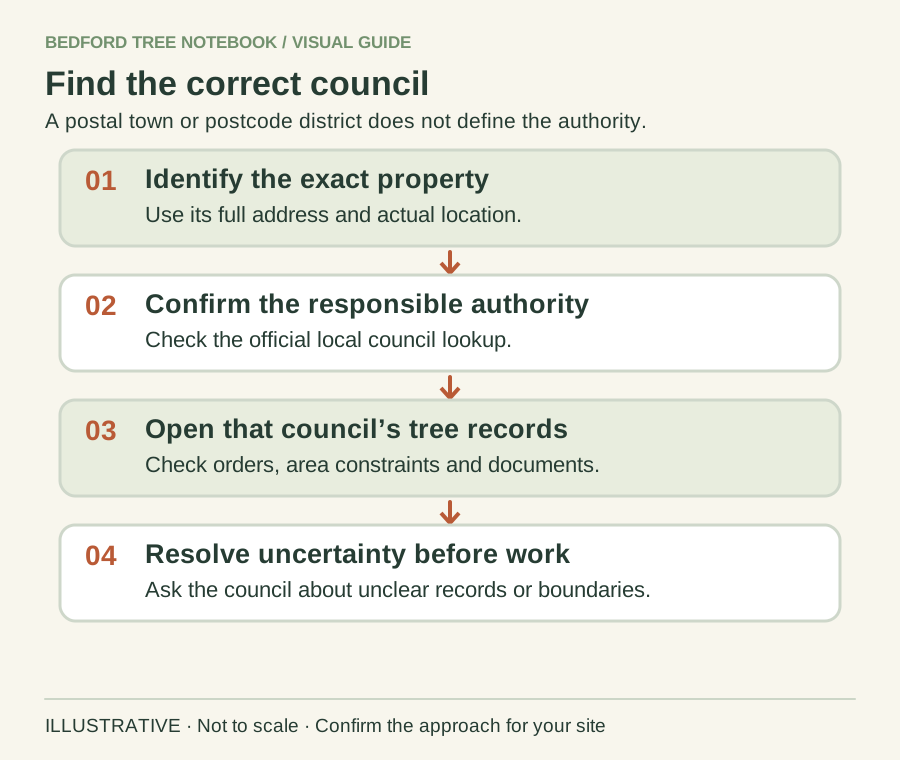
- Postcode districts and council boundaries are not interchangeable.
- Use the exact property to find the responsible authority.
Background sources: GOV.UK guidance
Start with the tree, not the business’s service area
A contractor may work across several council areas. Its postcode screen or travel radius tells you about its proposed service territory, not the planning authority for a particular tree. Our own area page makes the same distinction: partner coverage needs confirmation and does not establish jurisdiction.
Write down where the tree stands. If you are asking about a neighbour’s tree, a field edge or a separate parcel, make that clear rather than entering your own home address and assuming the answers apply.
Use each authority’s own protection resources
For a Bedford Borough location, start with the council’s protected-trees page. For Central Bedfordshire, use its TPO search and conservation-area information.
Keep the origin of any document clear. A screenshot is easier to use later if you know which authority supplied it and which property or tree you searched for. Do not blend two map results into a supposed clearance for the job.
Ask a precise question if the location is awkward
For land close to a boundary, prepare a simple plan showing the tree and the nearby property. Explain the location uncertainty in the question. Ask which authority should receive the enquiry about that tree rather than asking a general question about the whole village.
This can matter for gardens extending away from the address point or work involving more than one parcel. It is a reason to resolve the location, not a reason to guess that no control applies because you cannot find the expected result.
Distinguish permission, ownership and maintenance
The body responsible for a planning or protection enquiry is not necessarily the owner of the land. A school, housing association, private owner or another organisation may manage the tree. The appropriate first contact depends on what you are trying to do.
For example, a request to inspect a concern with an organisation’s tree is different from a proposal to work on a tree subject to protection. Read the Bedford public-tree reporting guide where relevant, and keep the ownership question separate from your map search.
Do not convert an enquiry into permission
Finding the correct council is only the first step. A request for information, an application, a notification and a written decision are different things. Tell the authority the actual proposal and ask what process applies, particularly if documents or boundaries are unclear.
A contractor can help describe the work, but availability does not resolve the permission question. Keep any professional recommendation and authority correspondence together so that the people pricing and doing the work understand the same scope.
What to put in your project notes
Keep a small location record: - The address or land description used. - A plan or safe wide photograph identifying the tree. - The authority found and the date of the check. - Any record references and unanswered location questions. - Who is responsible for the next enquiry or application.
Use these notes with the Bedford tree-work checklist. They help prevent duplicated searches and mistaken assumptions without claiming that this website has checked an individual tree’s legal status.
Use a location pack for awkward addresses
A house name, postal town and postcode may still leave the exact tree position unclear. For a larger plot, prepare a simple plan showing the entrance, buildings, boundaries and the tree label. Explain if the tree stands outside the residential garden or across a lane from the postal address. The authority needs to understand the actual location, not only where letters are delivered.
Our rural Bedfordshire enquiry guide helps describe sites with more than one entrance. Keep the location description consistent when talking to a contractor, council or landowner, so apparently conflicting replies are not actually referring to different trees or sections of the property.
Ask the right question within the right council
After identifying the authority, identify the issue. A proposed operation on a protected tree, a concern about a council-owned tree and an obstruction beside a public route may involve different teams or processes. Explain the tree position and what you are trying to find out, then ask for the appropriate route if necessary.
Do not send a maintenance request and assume it starts a permission process. Equally, an answer about tree protection does not decide a private boundary disagreement. The council-tree reporting guide covers the maintenance enquiry in more detail, while the protected-tree application guide addresses a proposed operation.
A hypothetical boundary-check problem
Suppose a homeowner searches a map using the name Bedford and finds guidance from one authority, while the full property postcode points to another. The sensible next step is to verify the site through official council resources and clarify the actual tree position. It is not to choose the process that appears quicker or more favourable.
Save the official page used and the date of the check. If the tree lies close to an administrative boundary, state that openly in the enquiry. This hypothetical example illustrates why postal descriptions and service areas should not become legal conclusions; it does not identify a particular village or property as belonging to either authority.
Keep contractor coverage out of the permission conclusion
A contractor may work across several council areas, but its service coverage does not determine which authority’s tree controls apply. Ask the business to confirm that it covers your address and separately confirm the relevant planning or ownership route. Both answers matter, but they answer different questions.
Before accepting a date, connect the agreed tree specification with any written authority response and the correct site address. If the work changes, revisit the question using changing a proposal after permission. A clear record of who was asked and what they answered is more useful than a general note saying council checked, with no tree identifier or document reference.
Putting it into practice
Record the authority, the location used and the links you checked. Give that information to the contractor or adviser helping with the proposal. If your question concerns a public tree rather than planned work on your own property, use the appropriate land-manager reporting route instead of assuming the planning team manages the tree.
The village protection guide applies that council check to rural and village addresses.
Turn the advice into a useful project brief.
Start with the postcode, the work you have in mind and any access considerations.
Prepare your enquiryNo obligation. A site assessment may be needed to confirm the work and price.
Sources & further reading
- GOV.UK: find your local council
- Bedford Borough Council: protected trees
- Central Bedfordshire: search for Tree Preservation Orders
- Central Bedfordshire: conservation-area maps
Sources checked 31 October 2026. How we prepare guidance.