
In this guide Show sections
General guidance, not a professional assessment. Confirm site-specific advice and current requirements before work.
Planning tree work in Bedford or nearby?
Start with the postcode, the work you have in mind and any access considerations.
Prepare your enquiryNo obligation. A site assessment may be needed to confirm the work and price.
Before you start
Keep a short project note with the address, tree positions, photographs and your main objective. If the issue involves a new split, hanging branch or a sudden change, seek appropriate advice promptly rather than treating it as routine maintenance. Our enquiry service is for planned work and is not an emergency response channel.
A useful ground-level photo brief
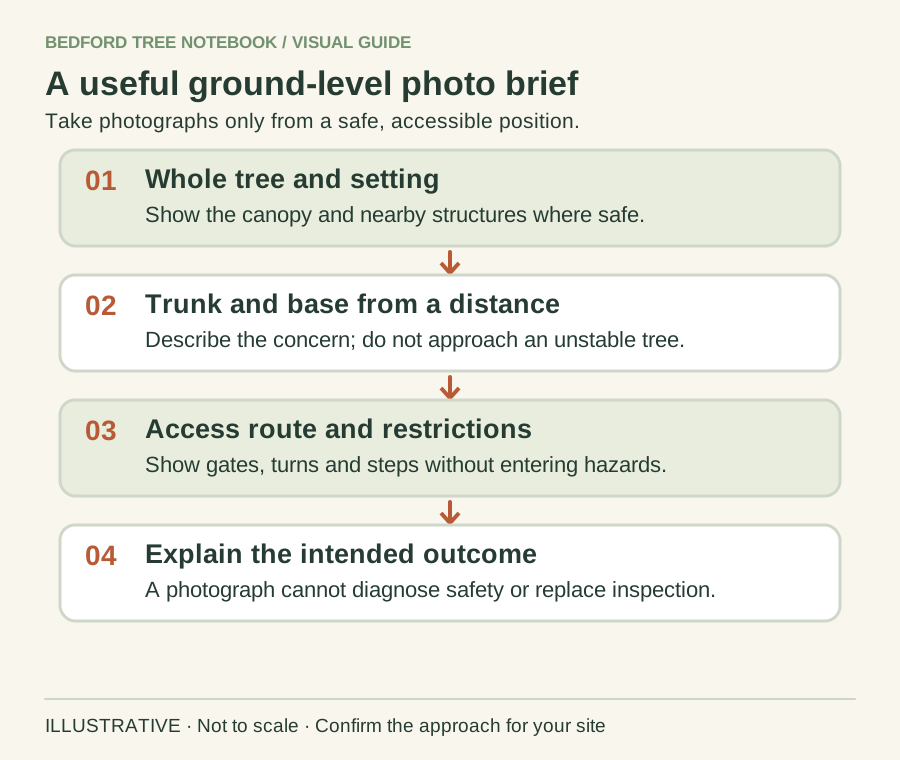
- Stay on safe, accessible ground.
- Do not climb or enter a potentially dangerous area for a better picture.
- Describe what you want to achieve, not an assumed diagnosis.
Start with the result you want
Write one sentence explaining the problem: a branch is close to a roof, the crown shades a seating area, a hedge has outgrown its width, or a stump blocks the proposed lawn. The professional can then consider a suitable operation. Asking for a drastic reduction before an assessment may steer the conversation away from a simpler answer.
List separate trees as T1, T2 and so on in your notes. Keep those labels on the photographs and quotation. If you want to retain a tree wherever reasonable, say that explicitly.
Check ownership and the council area
Confirm that you can commission the work and arrange access. A tree beyond the boundary, a shared garden or a rented property may need someone else’s involvement. Do not describe a neighbour’s agreement as settled if you have not obtained it.
A Bedford postal address is not a complete jurisdiction check. Use the council-area guide to identify the relevant authority for the tree’s location, particularly where the land or garden crosses an administrative boundary.
Keep protection checks with the project
Use official council resources to investigate tree protection and ask the authority about unclear records. The Bedford map walkthrough explains the research process; it cannot grant clearance for a job.
Save the relevant documents and describe the actual proposed work when seeking advice. Do not assume that an old permission, a nearby felling job or the absence of a visible map marker settles your own proposal. Wildlife considerations need their own discussion.
Describe the complete access route
Record the narrowest opening, awkward turns, steps, soft ground and any route through the house. Explain where equipment could arrive and how material could leave. Mention shared drives, restricted parking and surfaces or planting you want retained.
There is no need to select a machine. Give the contractor the facts and ask them to assess suitability. Our narrow-access guide shows what measurements are useful without turning a homeowner’s note into a safety plan.
Make the finished result explicit
A request to remove a tree can leave several unanswered questions. Will the timber leave the site? Does the stump remain? Are grindings being removed, and is reinstatement included? A hedge project also needs agreed finished dimensions and clarity about which sides are covered.
- Identify every tree, hedge section or stump in the job.
- Say what should remain and what should leave.
- Describe the intended use of any cleared ground.
- Ask for exclusions and unresolved assumptions in writing.
Read what a quotation should include before comparing totals.
Photograph safely and choose the next conversation
A wide garden view, a closer view from a safe position and a photograph of the access route can make an enquiry easier to understand. Do not go under a suspect limb or climb for a better image. Avoid including people, vehicle registrations or unrelated private documents.
Send the same brief when comparing businesses. Ask whether the first visit is a quotation visit, a condition assessment or something more specialist. Those are different services, and a routine quote should not be presented as a formal tree report.
Turn the checklist into one manageable document
Use a single project note rather than a string of disconnected messages. Give each tree a simple label, such as the tree beside the shed or the front-garden tree, and use that description consistently in photographs and emails. List your preferred result beside it, then mark anything you do not yet know. An honest question is more useful than a guessed species, height or legal status.
Keep a separate list of practical restrictions: when the shared drive is busy, which gate is normally locked and whether the house is the only access route. This makes it easier to update one detail without accidentally changing the whole brief or losing a contractor’s earlier advice.
A hypothetical Bedford garden brief
Imagine a homeowner wants more room beneath a rear-garden tree and also wants an old stump removed before laying grass. A useful brief describes these as two outcomes, with separate photographs and a plan showing the side passage. It does not assume both tasks use the same equipment or can be priced from the same view.
The contractor can then explain whether a visit is needed, propose suitable tree work and discuss the stump finish. Our crown-lifting guide and turf-after-stump-work guide help keep those conversations distinct. This is an illustrative planning example, not a report of a Bedford job or a promise about the appropriate work.
Decide which uncertainty should be resolved first
Some unknowns affect everything that follows. If you cannot establish who owns the tree, resolve authority to commission work before arranging access. If a cable crosses the site, tell the contractor before treating any method or date as settled. If planning documents appear relevant, ask which information is needed before the business finalises its specification.
Other details can wait until after a visit, such as the precise description of a suitable pruning operation. Put these in an open-questions section rather than forcing an early answer. The purpose of the checklist is to make professional assessment easier, not to replace it or make you responsible for designing the work.
Use the brief again when the job is complete
A good brief becomes a useful completion record. Keep the final quotation beside it and note any agreed changes with their dates. After the contractor releases the working area, compare the completed tasks with those documents and ask about anything you do not understand. Do not enter an active work area to inspect progress or attempt your own condition assessment.
The end-of-visit checklist covers the handover conversation. Store any aftercare notes, invoice and photographs in the same folder. This leaves a clearer record if you later plan another stage, sell the property or need to explain what was previously agreed.
Turn the checklist into a useful enquiry
Use the checklist to prepare an enquiry, then keep the contractor’s written recommendation alongside the final scope and price. You can transfer the practical details through our project planner. Confirm actual postcode coverage with the named contractor; this guide does not establish that a partner is available for every Bedford-area address.
For a rural site, add the details in preparing a Bedfordshire property enquiry.
Turn the advice into a useful project brief.
Start with the postcode, the work you have in mind and any access considerations.
Prepare your enquiryNo obligation. A site assessment may be needed to confirm the work and price.
Sources & further reading
Sources checked 31 October 2026. How we prepare guidance.