
In this guide Show sections
General guidance, not a professional assessment. Confirm site-specific advice and current requirements before work.
Planning tree work in Bedford or nearby?
Start with the postcode, the work you have in mind and any access considerations.
Prepare your enquiryNo obligation. A site assessment may be needed to confirm the work and price.
Before you arrange the work
Provide the postcode, property name and the entrance to use. Say if navigation commonly directs visitors to the wrong gate. Share photographs from safe positions and confirm actual contractor coverage for the address.
Measure the whole access route
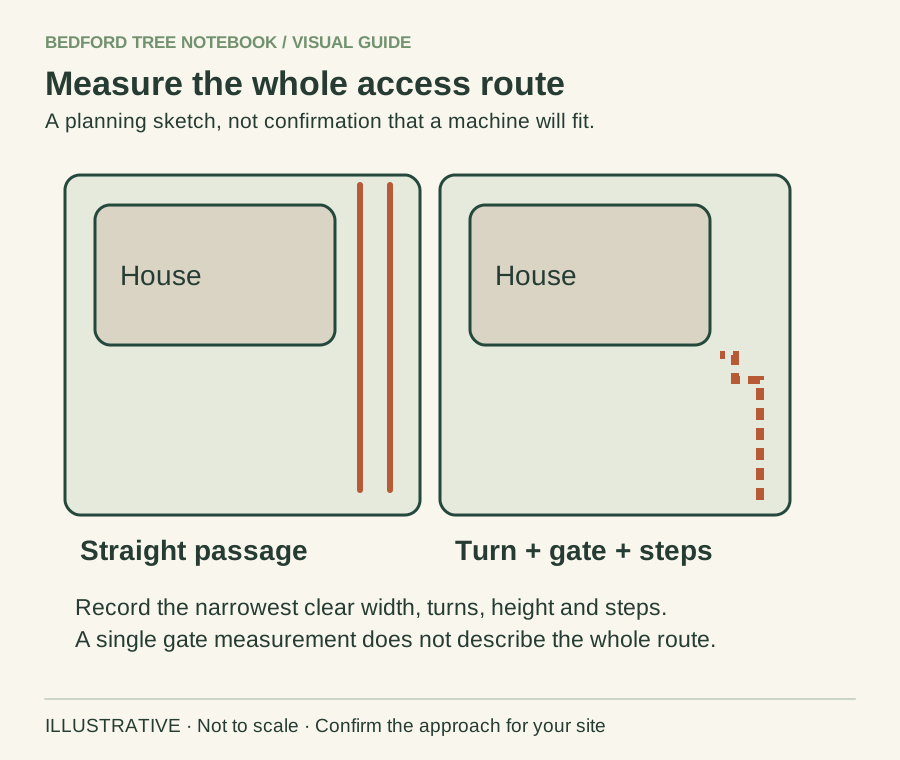
- Measure the narrowest clear width and overhead clearance from a safe position.
- Note corners, steps, slopes and the route through the house where applicable.
- The contractor must assess the actual equipment route.
Show the whole route
Describe the approach from the road, any turning space, gates and the route to the work area. Mention steep sections, soft ground, bridges, low branches and overhead lines. Give measured widths where you can do so safely, but let the contractor judge suitability.
Our narrow-access guide helps you record the narrowest usable point rather than just the width of the first gate. Do not enter an unsafe building or climb to obtain a measurement.
Explain how the land is used
Tell the business about livestock, pets, deliveries, shared routes and times when access must remain available. Identify buildings, fences, water features and crops close to the proposed work. Agree who will move animals or secure adjoining areas before the team arrives.
If there are cables nearby, read overhead lines and tree-work enquiries before planning the visit. Do not assume a line is harmless because it appears insulated or serves only one building.
Check permissions beyond the address
Confirm ownership and the correct local planning authority. A rural setting does not remove tree-protection, wildlife or other applicable controls. Work involving woodland or larger-scale felling may need specialist consideration beyond ordinary garden maintenance.
Use village tree-protection checks to prepare the council enquiry. Where a public path runs beside the site, flag it from the outset rather than assuming it can be closed for the day.
Prepare directions that identify one entrance
Explain the final approach from the public road, including the entrance a visiting business should use and where it can safely wait if the gate is closed. Use a clear description of permanent features rather than relying only on a temporary vehicle or bin. Say if the postal entrance differs from the practical access to the tree area.
If you use a location pin, check it against the entrance before sending it. Do not provide alarm codes, unrelated security information or private access details beyond what is needed for the visit. Ask how the contractor prefers to receive directions and whether photographs of the approach will help. The visitor still needs to assess vehicle suitability; a route that accommodates a car does not establish that larger equipment can pass. Our narrow-access guide helps record gates and turns without turning a homeowner’s measurements into a guarantee of machine clearance.
Describe the property as separate work areas
For a larger site, give each proposed work area a simple identifier: house garden, orchard edge or rear boundary. Match those names to photographs and indicate which tasks are essential and which are possibilities for discussion. This helps a contractor understand whether the enquiry concerns one ordinary garden job or several different kinds of work.
Do not ask for an undifferentiated price for “all the trees” unless the business has had a suitable opportunity to assess what that means. The areas may have different ownership, access, wildlife or planning considerations. If a recommendation is needed before an operation can be specified, state that openly. Ask whether an assessment visit or another professional would be more appropriate than an immediate work quotation. The purpose of the first enquiry is to identify the service needed, not to turn uncertain photographs into a complete management plan for an entire holding.
Coordinate animals and normal site activity
Tell the contractor about livestock, horses, pets, visitors and deliveries that may affect the route or work area. Explain where animals are normally kept and who can move or secure them when appropriate. Leave the technical work-site controls to the professional; ask what household or land-management arrangements are needed before it arrives.
Include practical constraints that may not be visible in photographs, such as a gate that must remain secured or a route used by another occupier. If another person controls that area, obtain their agreement rather than promising access on their behalf. Where a public route passes the property, flag it separately and use the public-footpath guide. Normal visitors should not be directed through an active working area as a substitute for planning access. Keep a named contact available to resolve an unexpected delivery or site-use issue without entering the exclusion area.
Think about ground and weather before dates
A dry photograph may not show how a route behaves after rainfall. Mention known soft patches, drainage difficulties, changes of level and surfaces whose condition varies during the year. Ask the contractor which details require a visit before it can judge access. Do not drive equipment over a questionable route yourself to test whether it will take the load.
If weather changes the ground conditions, explain the change before the team travels. Ask how postponement, alternative access or protection would be considered and what effect that may have on the quotation. A willingness to rearrange is more useful than assuming every rural site is accessible in every season. The lawn-protection guide covers recording the condition of garden surfaces. For fields or yards, identify the actual intended finish and any restrictions on rutting, material storage or later reinstatement so the quotation can address those expectations.
Specify the fate of timber across a larger site
A rural property may have space to retain timber, but that does not mean leaving it anywhere is acceptable or practical. Identify the proposed stacking area and discuss how material would reach it. Ask whether the quotation includes processing, moving or removing the wood and whether further handling would be your responsibility.
Distinguish material from different work areas if it will have different destinations. For example, retaining logs near an outbuilding and removing hedge arisings can be separate scope items. Avoid assuming that a contractor can move timber across land it has not assessed or been authorised to use. Record any route that passes under overhead services or near buried infrastructure, without trying to assess safe clearances yourself. A short schedule of work area, operation, access and material destination gives the contractor a much more useful enquiry than the size of the property alone, and makes the final quotation easier to check.
Your next step
Send one concise project brief with location, photographs and access limitations. Ask which details require an inspection and keep any provisional assumptions visible in the eventual quotation.
Turn the advice into a useful project brief.
Start with the postcode, the work you have in mind and any access considerations.
Prepare your enquiryNo obligation. A site assessment may be needed to confirm the work and price.
Sources & further reading
- GOV.UK: find your local council
- HSE: tree-work safety topics
- GOV.UK: planning applications affecting trees and woodland
Sources checked 31 October 2026. How we prepare guidance.