
In this guide Show sections
General guidance, not a professional assessment. Confirm site-specific advice and current requirements before work.
Planning tree work in Bedford or nearby?
Start with the postcode, the work you have in mind and any access considerations.
Prepare your enquiryNo obligation. A site assessment may be needed to confirm the work and price.
Before you arrange the work
Tell the contractor about soft areas, drainage problems, recent turf, irrigation and buried services. Photographs can show the layout, but they do not establish whether ground is suitable for a particular machine or load.
Coordinate the whole project
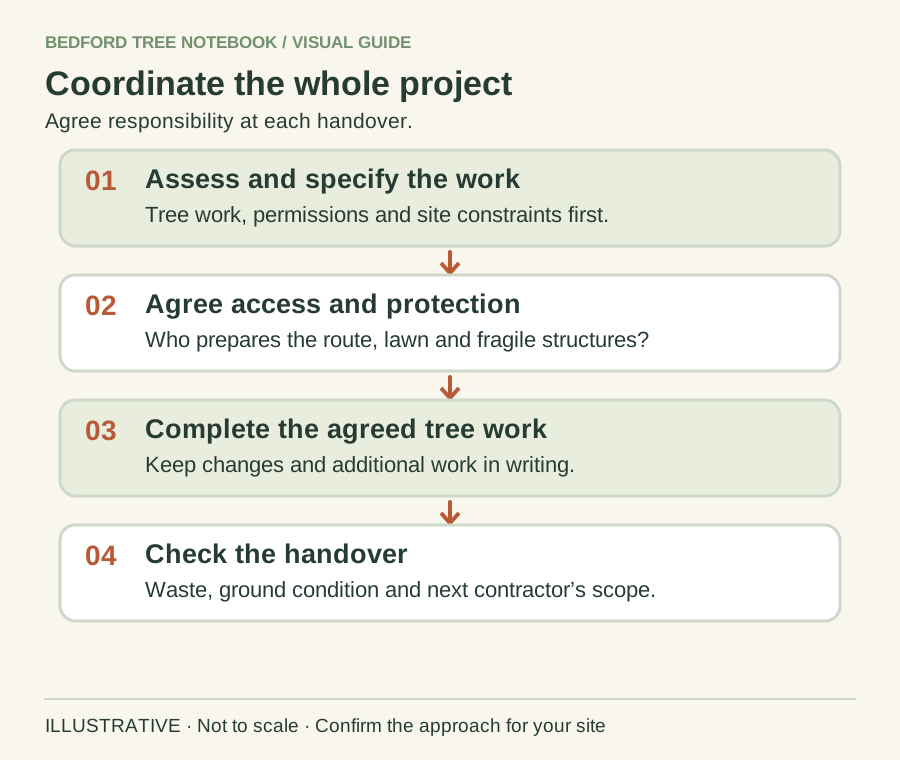
- Set the order and responsibility for each phase.
- Do not carry out hazardous preparation yourself.
- Check ground preparation separately before follow-on landscaping.
Identify the route and sensitive areas
Show the team where it could travel and which planted areas, edges and covers need protection. Include the loading route, not just the ground directly beneath the tree. Ask whether ground protection is proposed and what it is intended to achieve.
Our garden preparation guide helps separate items you can move from features that need an agreed method. Avoid lifting heavy ornaments or moving a structure solely to make a guessed route work.
Discuss weather and practical limits
Wet ground may change the practical plan. Ask how the business will decide whether to proceed, alter access or rearrange. Ground protection should not be understood as a promise of no marking under all conditions. A clear discussion is more useful than a vague assurance to be careful.
If stump work is included, read preparing for turf after grinding. Surface clean-up and preparing a lasting lawn base are separate parts of the job.
Record the finishing agreement
Agree whether the quote includes removing debris, filling depressions, bringing in soil or turfing. Identify who will handle later settlement or repairs if those are outside the tree contractor’s scope. Record the existing surface with dated photographs and keep the final quotation.
For buried cables, pipes or irrigation, use underground services and stump work to prepare information for the contractor. Do not uncover a suspected service yourself to help the visit.
Describe the lawn as a route and a finished surface
Mark the area beneath the tree, the route to the gate and any place proposed for loading or temporary material storage. Those can affect different parts of the lawn. Tell the contractor if a lawn section is recently laid, regularly waterlogged or used for a particular purpose that changes your expectations of the finish.
Explain known irrigation, drainage or inspection covers without trying to locate unknown services by digging. If plans are available, share the relevant information and say whether it is current. A photograph should show the path from the entrance rather than concentrate only on an attractive view of the tree. Our underground-services guide helps prepare the information for ground-related work. Keep the route assessment with the tree-work enquiry so the lawn is not treated as an unlimited open space simply because it appears unobstructed in a summer photograph.
Ask what protection can reasonably achieve
Ask the business what surface protection it proposes, where it would be placed and what limits remain. Ground conditions, load and the intended operation matter, so a product name alone is not a useful guarantee. The contractor should assess whether its proposal is suitable; a homeowner should not specify boards or mats as a substitute for that assessment.
Record whether protection is included in the quotation and whether the price assumes particular weather or ground conditions. If the business expects you to prepare anything, establish what that means and whether you can safely do it. Avoid asking family members to carry heavy protection into place to save time without an agreed plan. A clear discussion may reveal that another route, a different sequence or postponement is preferable. The aim is to understand the proposed protection and its limitations, rather than obtain an absolute promise that grass cannot be marked during a working visit.
Set a realistic reinstatement boundary
Distinguish clearing loose debris from restoring the lawn. Ask whether the quote includes filling depressions, removing woody material, supplying soil, reseeding or turfing. If those services are not included, establish what condition the contractor expects to leave and who will assess the next stage.
This is particularly important where stump work forms part of the visit. A ground surface can be cleared of obvious debris while still requiring preparation for a lasting lawn. Our turf after stump work guide covers that handover. Ask the next contractor to explain its requirements before accepting the preceding scope, rather than discovering afterwards that each business assumed the other would finish the base. Keep any later settlement or maintenance responsibilities explicit. A tree-work invoice should not be treated as evidence that a separate landscaping specification has been met when that outcome was never included in the agreed job.
A hypothetical wet-weather decision
Suppose the assessment visit takes place during a dry period and the planned route crosses the lawn. Before the booked day, sustained rain changes the ground conditions. The homeowner should tell the contractor what has changed and ask how the plan will be reviewed, rather than assuming the earlier access assessment remains sufficient.
Possible next discussions include timing, another authorised route or revised protection, but this example does not prescribe which option is suitable. The business needs to make that judgement for the site and operation. Ask how any rearrangement affects the booking and price, and keep the revised understanding in writing. Do not test the route by driving over it or move the equipment yourself to help the team proceed. Recording an actual change in ground conditions is a useful homeowner contribution; making a technical load assessment from the appearance of the grass is not.
Use a focused before-and-after record
Take a few dated photographs that show existing marks, edges, covers and the intended route. Repeat comparable views after the business says the area is safe, rather than trying to inspect the lawn during active work. Keep photographs proportionate and avoid including unrelated people or private details.
At handover, ask about any retained material, deferred clearing or agreed follow-up. If a concern appears later, describe where it is and when you noticed it, then contact the business using the quotation and record. Do not automatically attribute every change to the visit; equally, do not leave a specific concern undocumented while memories fade. The end-of-visit checklist helps organise the conversation. Where the issue needs a horticultural or ground assessment beyond the tree contractor’s scope, establish who is suitably placed to advise. Keep the finishing question connected to what was actually agreed for that part of the garden.
Your next step
Confirm the route and surface expectations before work. Review any changed ground conditions on the day from outside the work area, and use the completion checklist after the contractor releases the site.
Where roots already show through the grass, read visible tree roots in a lawn before including ground changes in the project.
Turn the advice into a useful project brief.
Start with the postcode, the work you have in mind and any access considerations.
Prepare your enquiryNo obligation. A site assessment may be needed to confirm the work and price.
Sources & further reading
Sources checked 31 October 2026. How we prepare guidance.