
In this guide Show sections
General guidance, not a professional assessment. Confirm site-specific advice and current requirements before work.
Planning tree work in Bedford or nearby?
Start with the postcode, the work you have in mind and any access considerations.
Prepare your enquiryNo obligation. A site assessment may be needed to confirm the work and price.
Before you start
Do not dig trial holes, probe around a stump or try to uncover a service to help prepare the quote. If there is a suspected damaged service or an immediate hazard, keep clear and use the appropriate emergency route. A general stump enquiry must not be used to decide that work near a cable or pipe is safe.
Hidden services change the job
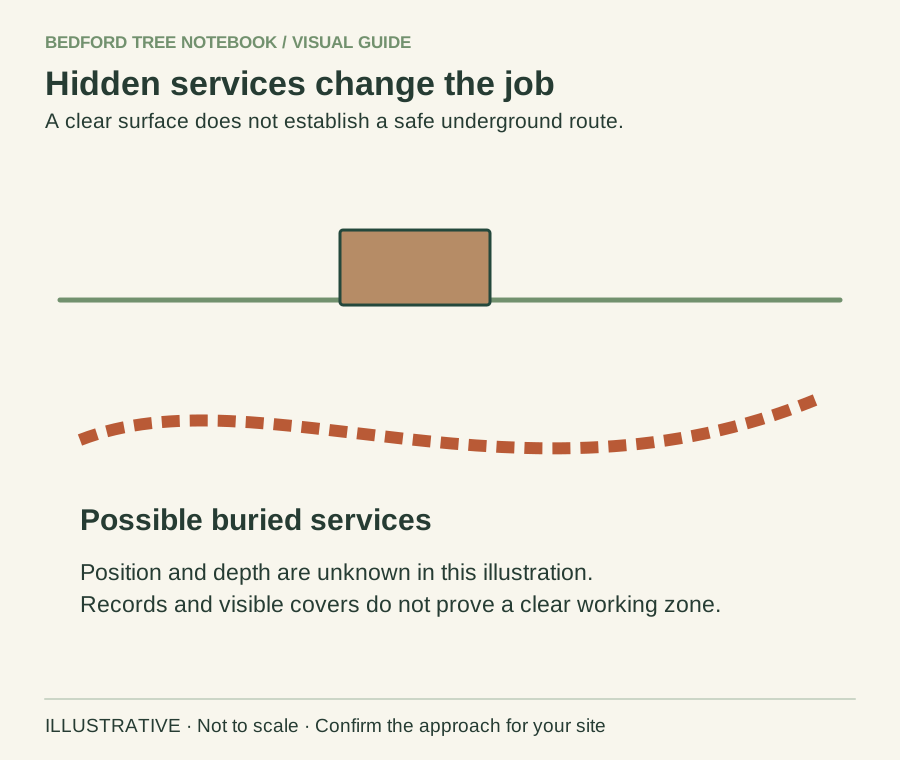
- Tell the contractor about known services, covers and past works.
- Do not use this diagram to infer clearance distances or safe digging.
Collect information you already hold
Look for relevant records from earlier works, utility correspondence or the people managing the property. Note known meter positions, service entries and garden features without inferring an exact underground route between them. State the date and origin of a drawing where possible.
Explain what is uncertain. A note saying that a cable may cross the garden is more useful than a confident but unsupported statement that all services run along the boundary. Do not alter the site merely to make the information appear complete.
Ask about a safe planning process
HSE’s HSG47 guidance describes planning, locating and identifying buried services, and safe excavation as elements of managing underground-service risk. It is professional guidance, not a homeowner’s recipe for testing a garden with tools.
Ask the contractor how they will address the risk for the actual operation. Providing a plan does not transfer the whole assessment to you, and the use of detection equipment should not be presented as a universal guarantee about every object below ground.
Describe the entire area of intended work
Identify whether the proposal concerns only the visible stump, surface roots, a wider excavation or later landscaping. Show nearby walls, drainage covers, garden lighting and other relevant features in a safe wide photograph. Explain where equipment would travel as well as where it would operate.
The grinding-depth guide helps define the intended finish. A request for deeper work can change the questions; it should not be treated as a harmless amendment to an already agreed surface operation.
Make the future project part of the brief
If the stump is being removed for a fence, path, planting position or construction work, tell the relevant professionals. The contractor dealing with the stump and the person designing the next project need compatible instructions. Neither should assume the other has established all ground conditions.
Ask who determines the ground preparation needed for the finished project. Removing visible timber does not establish a location as suitable for foundations, a drain run or another engineered installation.
Allow for an unresolved finding
Ask what happens if the available information is incomplete or a concern appears during preparation. The responsible response may be to pause and obtain further advice rather than continue to meet the original date. Agree who will explain the issue and seek your approval for any changed scope or price.
Keep the revised information with the quotation. Read what a quotation should include so that access, investigation and reinstatement assumptions are not hidden behind a single stump-removal total.
Keep the homeowner’s role clear
Your useful contribution is to disclose known information, provide access for agreed assessments and avoid introducing new work without discussion. It is not to declare the ground service-free or supervise a technical procedure you are not qualified to judge.
Before the visit, confirm: - Which records and uncertainties have been shared. - What operation and area have been agreed. - Who addresses service-location questions. - How unexpected information changes the plan.
Use the garden-preparation guide for ordinary safe preparation, keeping underground investigation out of DIY clearance tasks.
Include every ground-disturbing stage in the enquiry
A stump may be the visible reason for a project, but the next stage can involve a wider area. Explain if you intend to install edging, excavate a planting bed, build a path or alter drainage after the stump operation. Information relevant to grinding may also matter to another contractor working later.
Our stump-work-before-paving guide helps coordinate that handover. Do not assume that one person’s service check automatically covers a different method, depth or location. Ask each business to explain the scope of its planning and share existing information consistently, while leaving locating and safe working decisions to appropriately competent people.
A hypothetical conflict with an old plan
Imagine a homeowner has an old drawing showing a service route away from the stump, but a later garden alteration is not recorded on it. The useful response is to tell the contractor about the uncertainty and provide both the plan and the history. The drawing should not be presented as a guarantee that the intended work area is clear.
This example does not show how to locate a service. It shows why the reliability and limits of information matter. Avoid exploratory digging, probing or removing a cover in an attempt to settle the question yourself. An unresolved finding should change the planning conversation before work proceeds.
Ask who needs to coordinate with another specialist
If the contractor says further information or specialist input is required, ask who will obtain it and what remains provisional. Confirm whether that task is included in the quote or separately arranged. Keep any necessary permission to access another area distinct from the technical assessment of a service.
For overhead lines as well as buried infrastructure, read overhead cables and tree work. A project may have both considerations, and resolving one does not resolve the other. Make the open issue easy to find in the job brief rather than burying it in an old message whose relevance the attending team may not recognise.
Record what the next contractor is being told
After the agreed work, retain the contractor’s description of what was completed and what limitations remained. Share it with the person preparing the lawn, planting or construction, but do not convert it into an assurance that all ground work is now unrestricted. Different operations can raise different questions even in the same small garden area.
Our replanting guide explains another use of the space that should be discussed early. A clear handover names the outstanding issue, identifies who will consider it next and avoids implying that the homeowner has verified the route or safety of infrastructure merely by passing on somebody else’s notes.
Putting it into practice
Give the contractor the site information and the intended ground use, then ask for an explanation of how service questions affect the proposed scope. The stump grinding service can be used for planned-work enquiries. If the site needs a specialist investigation first, establish who arranges it before fixing a grinding date.
Where a hard surface is planned, coordinate the next stage with stump work before paving.
Where a drain problem is suspected, use trees beside drains to distinguish investigating the pipe from deciding what happens to the tree.
Turn the advice into a useful project brief.
Start with the postcode, the work you have in mind and any access considerations.
Prepare your enquiryNo obligation. A site assessment may be needed to confirm the work and price.
Sources & further reading
- HSE: avoiding danger from underground services (HSG47)
- HSE: tree-work safety topics
- RHS: removing trees and stumps
Sources checked 31 October 2026. How we prepare guidance.