
In this guide Show sections
General guidance, not a professional assessment. Confirm site-specific advice and current requirements before work.
Planning tree work in Bedford or nearby?
Start with the postcode, the work you have in mind and any access considerations.
Prepare your enquiryNo obligation. A site assessment may be needed to confirm the work and price.
Before you arrange the work
Explain what you hope to plant, where and when. Identify the old tree if known and mention any suspected disease. Ask a suitable horticultural professional about the planting position rather than assuming the exact old spot is the best choice.
The visible part is only part
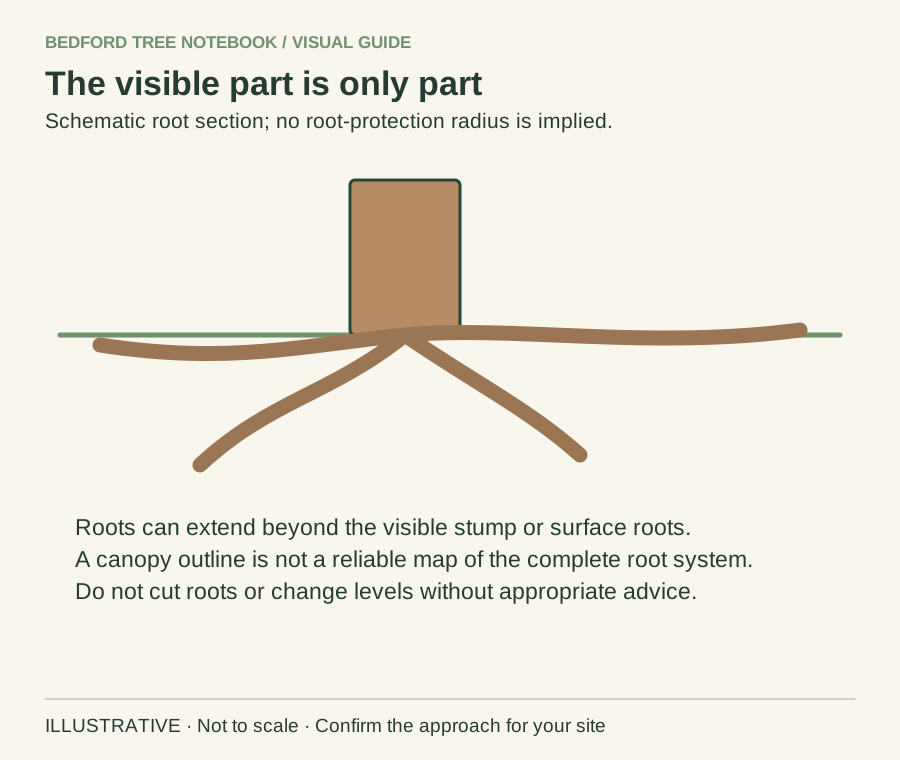
- Visible roots do not map the complete system.
- Root cutting, compaction and changes of level can affect a retained tree.
- Obtain site-specific advice before interfering with roots.
Distinguish grinding from creating a planting bed
Grinding deals with an agreed part of the stump and surrounding material. Roots or woody debris can remain outside the treated area. Ask what depth and footprint are proposed, what will be left and whether removal of grindings is included.
Read stump-grinding depth before comparing quotations. A deeper number alone does not explain the available rooting area or the condition of the soil afterwards.
Assess the future growing space
Consider the replacement plant’s eventual size, nearby structures, boundaries and maintenance needs. Ask whether a nearby new position would be preferable to planting in the old stump location. If disease may have affected the previous tree, seek advice about its relevance to the replacement.
Our large-tree small-garden guide helps connect the planting choice with how the garden will be used. Avoid repeating a size problem simply by buying a young version of another large-growing tree.
Agree soil and material handling
Ask how woody grindings will be managed and who will prepare the planting soil. The material produced by grinding is not automatically a complete planting medium. Keep the tree contractor’s scope distinct from any separately arranged planting and establishment care.
Use what happens to stump grindings for disposal and reuse questions. Check buried services before work and leave locating or excavating around suspected services to appropriate professionals.
Start with the replacement’s future role
Describe what the new planting should provide: a smaller canopy, screening, seasonal interest or a different use of the space. Consider the available garden area over time rather than only the gap left by the old tree. This gives a horticultural adviser a clearer brief and helps avoid recreating the same size conflict.
Our large-tree small-garden guide can help rank those priorities. Keep the plant-selection decision separate from choosing stump machinery. A contractor can describe the removal operation, while the person advising on the replacement should consider whether the proposed position and growing conditions suit the intended plant.
Explain why the previous tree was removed
If you know the reason for removal, provide that history to the planting adviser. A planned redesign, a suspected disease and storm damage are different pieces of information. Do not turn a casual description from a neighbour into a confirmed diagnosis, and say when the cause is uncertain.
Keep any professional report or written recommendation with the enquiry. It may help the adviser decide which questions are relevant, but its scope and date still matter. Avoid assuming that grinding eliminates every concern connected with the previous tree or that a replacement of the same species is automatically appropriate simply because the original once grew there.
A hypothetical choice of a nearby new position
Imagine a homeowner wants a smaller replacement tree exactly where a large stump currently stands. During discussion, the planting adviser suggests assessing a nearby location with a more useful growing space. The stump quotation can then be considered alongside that plan rather than selected on the assumption that the original point must become a planting hole.
This example does not mean moving the planting position is always possible or preferable. It demonstrates a question worth settling before commissioning deeper or wider ground work. A sketch showing structures, boundaries and the proposed replacement helps each business understand the same objective without the homeowner choosing a technical specification alone.
Ask about the area beyond the stump centre
A replacement plant needs consideration of the surrounding ground, not only the place where the visible trunk stood. Ask what woody material may remain outside the agreed stump operation and what the planting preparation involves. A photograph of an empty central depression does not fully describe the available growing space.
Use stump-grinding depth to clarify the removal scope. If soil work is being done by another business, ask it to state the handover it requires. Keep reference level, treated footprint, material removal and later soil preparation separate so a single depth figure is not mistaken for a complete planting plan.
Coordinate the handling of grindings
Decide whether the stump material will be removed, relocated or retained for an agreed purpose elsewhere. The choice should fit the garden sequence and available space. Ask who will supply any material needed for the next stage rather than assuming the loose contents of the worked area are suitable finished planting soil.
Our grindings guide helps identify the practical questions. If you wish to reuse material, seek advice appropriate to that use and keep it distinct from preparing the replacement’s root environment. The tree contractor and planting adviser should understand the same plan, even if they are attending on different dates.
Include infrastructure and access in the planting brief
Share known information about buried services, irrigation and nearby structures before stump or planting work is specified. Do not dig exploratory holes or probe around suspected services to help the enquiry. The appropriate professionals should explain the information and safe planning their activity needs.
The underground-services guide is relevant to both removal and later disturbance of the ground. Also describe how plants, soil and equipment will reach the position. A stump machine getting into the garden does not prove every later delivery or operation will have suitable access, so each stage should confirm its own practical requirements.
Plan establishment care before buying the plant
Ask who will plant the replacement, what ordinary care is expected and who will provide advice if it does not establish as anticipated. Record which items are included in the planting proposal and which are your responsibility. Avoid leaving those decisions until the stump work has ended and a plant has already been delivered.
Keep the chosen plant details, planting date and care advice with the earlier stump documents. This creates a useful garden history rather than a collection of disconnected invoices. A replacement decision is more complete when it covers growing space and continuing care as well as the immediate appearance of the cleared area.
Your next step
Confirm the stump scope against the planting plan before booking. Record who will supply soil, plant the replacement and manage watering or establishment afterwards; these should not be assumed inclusions.
Turn the advice into a useful project brief.
Start with the postcode, the work you have in mind and any access considerations.
Prepare your enquiryNo obligation. A site assessment may be needed to confirm the work and price.
Sources & further reading
Sources checked 31 October 2026. How we prepare guidance.