
In this guide Show sections
General guidance, not a professional assessment. Confirm site-specific advice and current requirements before work.
Planning tree work in Bedford or nearby?
Start with the postcode, the work you have in mind and any access considerations.
Prepare your enquiryNo obligation. A site assessment may be needed to confirm the work and price.
Before you arrange the work
List the concerns separately: clearance, seating-area shade, falling debris, maintenance or a possible change in condition. If there is an immediate safety concern, seek an appropriate assessment promptly rather than treating this as a routine design exercise.
Allow for the mature tree
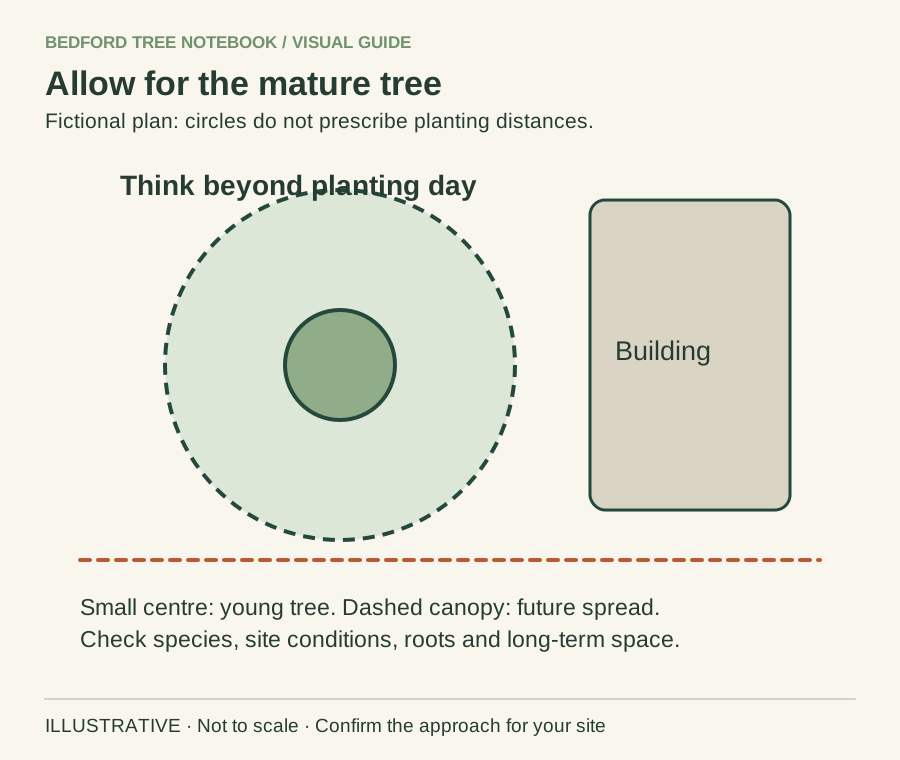
- Choose for mature size and site conditions.
- Check future conflicts with buildings, boundaries and utilities.
- Seek site-specific advice where constraints are significant.
Compare outcomes rather than labels
Ask a tree professional what can reasonably change and what is likely to remain. A proposal should connect the operation to the actual objective. For shade, the position of the tree and the area you want to use matter; for access, branch clearance may be the relevant issue.
Read a tree shading the patio and crown lifting explained for different questions to raise. Neither operation is a universal solution for a small plot.
Consider future maintenance
Ask how the tree may respond and whether the proposed work creates a recurring maintenance commitment. Avoid accepting “make it small” as a complete specification. Species, condition and previous work affect what is appropriate.
Our pollarding and topping guide explains why those terms should not be used interchangeably. A severe cut should not acquire legitimacy simply because it is called a pollard.
Keep the whole garden in the decision
Discuss privacy, summer shade, surrounding planting and the use of neighbouring gardens. If removal is recommended, ask about permissions, the stump and the space afterwards. A new smaller tree might be worth considering, but its location and eventual size need a separate planting plan.
Use removal rather than pruning to prepare that conversation, and replanting near a stump before assuming a replacement can go straight into the same spot.
List the benefits you want to retain
Before asking for a smaller tree, note what it currently contributes to the garden. You may value screening from an upstairs window, a cooler sitting area or the way planting is arranged beneath it. These preferences matter because an operation chosen for one concern may change another part of the garden experience.
Give the professional a short list of priorities rather than an unranked catalogue of every irritation. For example, safe clearance at a doorway may be the main objective while privacy remains desirable. A clear order helps the assessment focus on a suitable outcome instead of treating maximum size reduction as the only measure of success.
Distinguish a design concern from a condition concern
A tree can feel visually dominant without that observation establishing a defect. Equally, a tree that fits the garden neatly may have a separate condition issue. Explain what you have seen and what you want to change, keeping a suspected structural concern distinct from shade, debris or appearance.
The assessment-signs guide helps describe a new observation that merits professional attention. Do not ask an online photograph or a neighbour’s view to settle the tree’s condition. If a defect is being assessed, ask what the professional’s advice covers and how it relates to any proposed garden-design change.
A hypothetical trade-off around privacy
Imagine a homeowner wants more light at the patio but relies on the same tree for privacy from an overlooking window. A useful discussion considers both needs. The contractor might explain the limits of an appropriate pruning proposal while the homeowner considers a different sitting position or a longer-term planting arrangement.
The example does not recommend a particular operation. It shows why the garden objective should be described before a specification is selected. Our patio-shade guide helps record when light matters. Avoid judging a proposal solely by how much smaller the tree looks immediately afterwards if that appearance would also remove something you wanted to retain.
Ask what the next few years might involve
Discuss whether the proposed approach creates a recurring maintenance commitment and what the professional expects that commitment to involve. Ask which details are recommendations for future consideration rather than services already included in the quote. Keep the first operation and later management clearly distinguished.
Our pollarding and topping guide is useful where those terms arise. A reassuring label does not replace a tree-specific explanation. If you are considering removal partly because of maintenance, compare the complete future garden plan, including stump work and replacement planting, rather than comparing one pruning visit with an assumed permanent absence of further garden care.
Include surrounding structures in the assessment
Show sheds, fences, glazing, neighbouring roofs and the route through the garden. A small plot can contain several constraints within a short distance of the tree. These details affect the practical assessment even when the main reason for the enquiry is visual scale.
Read narrow garden access before assuming that a small tree job is simple to reach. Tell the business if access depends on another property or an indoor route. Keep ownership, tree protection and access permissions separate from the professional judgement about which operation is suitable; a practical route through the site does not establish authority to carry out work.
Think about the space after possible removal
If removal is recommended and you are considering it, ask how the visible stump and later garden preparation will be handled. Decide whether you want a lawn, planting bed or smaller replacement tree, then involve the appropriate person in planning that finish. A felled tree does not automatically leave ground ready for every use.
Our replanting guide explains why a replacement position needs its own discussion. Avoid selecting a young tree solely because it is small at purchase. Describe the long-term space and maintenance you want, and seek suitable advice about a plant that can fit that plan.
Compare recommendations using your original priorities
When you receive a proposal, read it alongside the ranked objectives from the first enquiry. Ask which concern the operation addresses, what it cannot reasonably promise and what further decisions may be needed. If two professionals suggest different approaches, ask for their reasoning instead of assuming the more dramatic option is the more complete solution.
Keep the accepted scope with the relevant permissions and any future-care advice. At handover, review the agreed result after the site is released, then record the explanation of anything that differs from your expectation. A clearer garden decision comes from understanding the trade-offs, not simply choosing the shortest description or largest amount of cutting.
Your next step
Request a written recommendation explaining the objective, operation and likely limitations. Compare that with your priorities and the necessary permissions before choosing a scope.
For a future planting choice, read choosing a replacement tree for a small Bedford garden before selecting a young tree by its present size.
If the tree is a willow, our domestic-garden willow guide considers its space, management history and future care without assuming removal.
Turn the advice into a useful project brief.
Start with the postcode, the work you have in mind and any access considerations.
Prepare your enquiryNo obligation. A site assessment may be needed to confirm the work and price.
Sources & further reading
Sources checked 31 October 2026. How we prepare guidance.