
In this guide Show sections
General guidance, not a professional assessment. Confirm site-specific advice and current requirements before work.
Planning tree work in Bedford or nearby?
Start with the postcode, the work you have in mind and any access considerations.
Prepare your enquiryNo obligation. A site assessment may be needed to confirm the work and price.
Before you make arrangements
Check whether the replacement is subject to a specific planting requirement before making your own selection. Use replacement planting after removal for the wider project. If the choice is voluntary, prepare a short site brief and seek appropriate horticultural advice about suitable species, cultivars and forms.
Allow for the mature tree
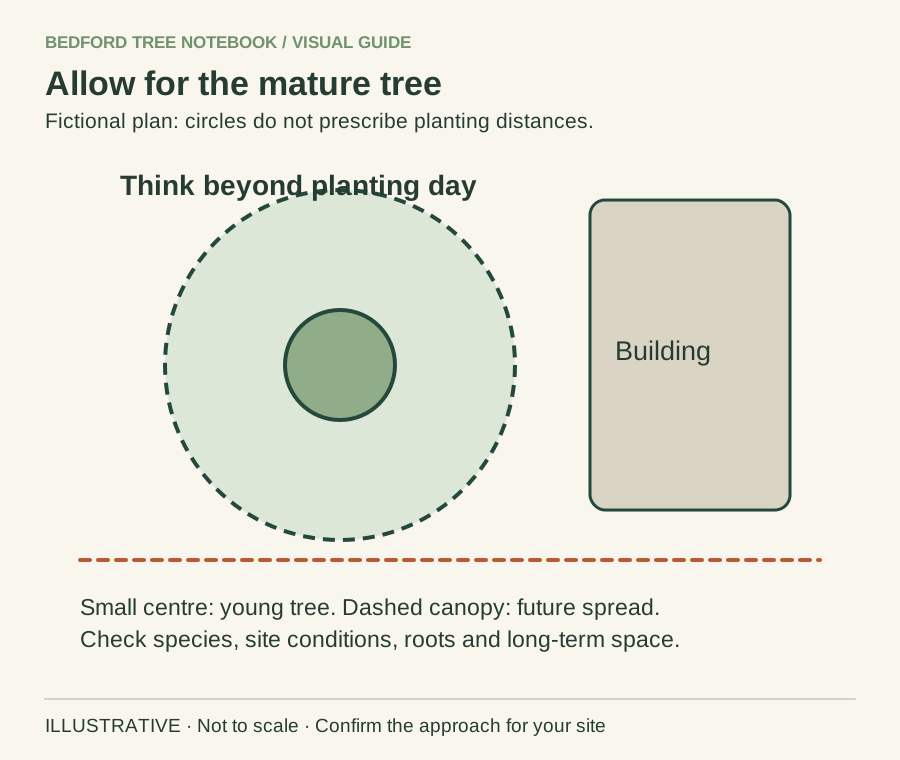
- Choose for mature size and site conditions.
- Check future conflicts with buildings, boundaries and utilities.
- Seek site-specific advice where constraints are significant.
Define what the new tree should do
Write down the main purpose: seasonal interest, a focal point, limited shade, screening or another specific benefit. Rank those aims if they conflict. A tree selected for dense screening may create different maintenance questions from one selected as a light ornamental feature.
Describe the part of the garden that matters rather than asking for a tree that does everything. If the concern is a shaded seating area, read trees and patio shade before choosing more canopy nearby. Consider what you value from the previous tree and what caused difficulty. That comparison helps an adviser understand the desired change without assuming the replacement should look like a smaller version of the old feature forever.
Look beyond the nursery size
RHS guidance encourages choosing trees that naturally fit a small garden rather than relying on repeated pruning to restrain a vigorous selection. Ask about the eventual height, spread and form of the exact plant being considered. A common name can cover options with different characteristics.
Keep the full cultivar or rootstock information where relevant, and ask how it affects the intended use. Do not treat a label such as “compact” or “dwarf” as a guarantee of permanent dimensions. Ask the adviser to explain the plant in the context of your space and maintenance expectations. The useful outcome is a considered shortlist, not a universal claim that one named tree is suitable for every small Bedford plot.
Describe the actual growing conditions
Give information about light, exposure, drainage and soil that you know from the site. Explain whether the area becomes waterlogged, dries quickly or is sheltered by buildings. If you do not know the soil conditions, say so and ask what assessment would help.
Avoid assigning a soil type from the town name alone. A raised bed, recently disturbed ground and an established lawn border can present different planting conditions within one property. RHS planting guidance provides background, but a general article cannot inspect your garden. Ask what preparation is appropriate and whether the proposed location gives the replacement a realistic opportunity to establish. Keep assumptions visible until someone with suitable knowledge has considered them.
Consider buildings, boundaries and movement
Mark the proposed position on a sketch alongside the house, neighbouring boundaries, paths and service information you already hold. Think about ordinary activities: opening a gate, hanging washing, reaching a shed or moving through the garden. Include how the tree will be watered and maintained.
Our trees near sheds and greenhouses guide helps identify practical relationships with smaller structures. Do not apply an invented universal planting distance to every tree and building. Where a structural concern exists, seek the relevant assessment. Horticultural fit and building risk are related questions, but choosing a smaller nursery plant does not by itself answer either one.
A hypothetical choice for a narrow garden
Imagine a homeowner wants autumn colour in a narrow rear garden but also needs a clear route to a garage. Several appealing nursery trees look similar in size on the day of purchase. Their eventual spread, growth habit and site preferences may be quite different.
The homeowner can give an adviser the route width, proposed position and desired seasonal feature, then compare suitable options by their longer-term form. This hypothetical example does not recommend a species or a guaranteed distance. It illustrates why the best question is not “which small tree is popular?” but “which suitable tree can provide this benefit in this specific space without conflicting with how the garden needs to work?”
Account for the old stump and ground
If the replacement is near a removed tree, ask what stump material remains and whether the exact old position is suitable. A visible gap is not automatically a prepared planting site. Tell the planting adviser about grinding, excavation and any known disease concern.
Use replanting near a previous stump to coordinate those questions. Ask who removes unsuitable material, prepares soil and confirms the planting position. If several contractors are involved, agree the handover condition before work begins. A stump contractor's completion does not necessarily mean the next person can plant immediately, and an attractive tree choice cannot compensate for an unexamined growing position.
Make maintenance expectations realistic
Ask what routine care and later attention the proposed tree is likely to need, and consider whether the household can provide it. Explain if you want to avoid frequent professional pruning or if access for future work would be difficult. A manageable establishment plan matters as much as the initial appearance.
Our young-versus-mature pruning guide helps distinguish early structural care from later interventions. Do not assume a tree should receive a severe initial cut to keep it small. Ask the adviser what, if any, formative work is appropriate and when. Record aftercare instructions and the point at which specialist help should be sought rather than trying to maintain a promised shape from memory.
Choose with enough information to review later
Keep the selected tree's full name, intended position and the reason it was chosen. A photograph of the plant label and the advice supplied can be useful in the garden record. Ask the supplier or adviser to explain any uncertainty before purchase, especially where several similar names are offered.
If the choice changes after a planning requirement was agreed, check the position with the relevant authority rather than assuming a substitution is acceptable. If it is a personal planting choice, revisit the original brief when comparing alternatives. A good shortlist should make trade-offs clear: size, form, seasonal interest, suitability and care. That is more useful than presenting one option as perfect without explaining its limitations.
Examples to research before choosing a replacement
The RHS smaller-garden tree list offers starting points rather than a universal planting prescription. Examples include Acer griseum, the paperbark maple, and Amelanchier × grandiflora ‘Ballerina’, known for its spring flowers. Prunus ‘Amanogawa’ is another named option to investigate when discussing the available space.
Compare the exact cultivar’s eventual height and spread, soil requirements and intended position with your site. A tree appearing on a small-garden list is not automatically suitable beside your wall or patio. Take two or three candidates to a knowledgeable nursery or adviser and ask which fits the measured growing space and maintenance you can provide.
Your next step
Prepare the garden brief before choosing the plant. Confirm any planting requirement, obtain site-specific advice and coordinate stump preparation and aftercare. The project planner can organise the removal or pruning enquiry, while the replacement selection should remain a deliberate horticultural decision suited to your actual Bedford garden.
For the aftercare plan, read mulching around garden trees and agree who checks the mulch and trunk clearance.
Where the planting position is beside a boundary, reviewing a tree near a fence adds future space, ownership and access to the decision.
Turn the advice into a useful project brief.
Start with the postcode, the work you have in mind and any access considerations.
Prepare your enquiryNo obligation. A site assessment may be needed to confirm the work and price.
Sources & further reading
- RHS: small garden trees
- RHS: planting trees and shrubs
- RHS: trees near buildings
- RHS: trees for smaller gardens and named examples
Sources checked 31 October 2026. How we prepare guidance.