
In this guide Show sections
General guidance, not a professional assessment. Confirm site-specific advice and current requirements before work.
Planning tree work in Bedford or nearby?
Start with the postcode, the work you have in mind and any access considerations.
Prepare your enquiryNo obligation. A site assessment may be needed to confirm the work and price.
Before you make arrangements
Keep any relevant tree-work decision or planning condition available. Ask the authority about a planting requirement you do not understand before choosing a species or moving the intended position. Our permission-records guide helps connect those documents with the contractor's scope and the later planting project.
Allow for the mature tree
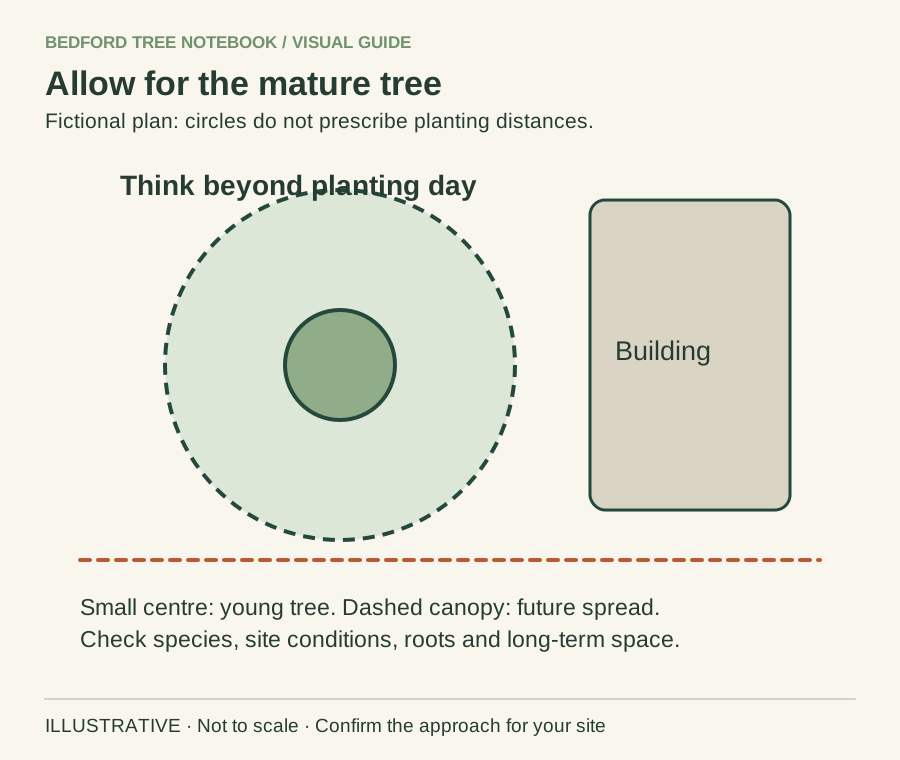
- Choose for mature size and site conditions.
- Check future conflicts with buildings, boundaries and utilities.
- Seek site-specific advice where constraints are significant.
Establish whether planting is required or voluntary
A replacement may be a personal garden choice or relate to a condition or other legal requirement. National tree-control guidance describes replacement duties and conditions in relevant circumstances, so do not assume the absence of a replacement line in a contractor's quotation settles the position.
Ask the relevant authority to clarify the actual requirement, including the species, position, size or timing where those matters are specified. Keep the written response. If planting is voluntary, state the garden objective before shopping: privacy, seasonal interest, shade, wildlife value or simply keeping a tree in the space. Distinguishing those two starting points prevents a horticultural preference being mistaken for compliance with a specific condition.
Understand the reason for the previous removal
Explain what made the old tree unsuitable or concerning. It may have outgrown the available space, conflicted with a proposed layout or required assessment for another reason. Do not assume a young replacement of a similarly vigorous type will permanently solve a size problem.
Our large-tree small-garden guide helps connect size with actual garden use. If disease or soil conditions may affect the replacement choice, ask an appropriate professional rather than applying a general planting rule. Keep structural or building concerns separate from a plant-selection conversation. The aim is to understand enough about the site to avoid repeating a known mismatch while leaving diagnosis and technical recommendations to suitable expertise.
Assess the future growing space
Consider the position in relation to buildings, boundaries, paths, services and the garden's normal use. Think about both the canopy and the area needed for establishment and maintenance. A small planting hole does not describe the whole space the tree may occupy over time.
The small-garden replacement guide helps form a shortlist. Ask about the actual cultivar or form rather than relying on a broad common name or a nursery photograph. Give the adviser details of light, drainage, exposure and soil information you already hold. Do not invent soil conditions from a Bedford postcode; gardens within the same area can present different practical circumstances.
Coordinate stump work and planting preparation
If planting is planned near the previous tree, tell the stump contractor before the quotation is agreed. Ask what area and depth are proposed, what roots or woody material may remain and who will prepare the growing medium. Grinding and creating a suitable planting position are related but separate outcomes.
Use replanting near a stump and stump-grinding depth to prepare the handover. A replacement does not necessarily have to occupy the exact old position. Seek horticultural advice about the site and respect any specified planting requirement. Keep responsibility for material removal, soil work and planting clear if different businesses will complete those stages.
A hypothetical replacement-planning choice
Imagine a homeowner removes an oversized tree after obtaining the appropriate advice and authority. The initial idea is to plant a fast-growing screen in the same place, close to a small patio. On reviewing the long-term garden objective, the homeowner realises that privacy is needed at one boundary rather than above the seating area.
A suitable professional can then discuss a more appropriate planting arrangement for the available space. This hypothetical example does not recommend a species or establish a planning outcome. It illustrates why “replace the tree” is not a complete design brief. The reason for planting, the required or chosen position and the future use of the garden should be considered together before a purchase is made.
Include establishment in the budget and schedule
Ask who will supply the plant, carry out planting and provide establishment advice. Discuss watering arrangements, access to water and who will notice if the tree needs attention. A planting project should not end at delivery if nobody has planned the period afterwards.
RHS planting guidance is useful background for discussing site preparation and planting technique with an adviser. Avoid copying a general detail into a job specification without checking the actual root system, plant size and site. Ask for relevant aftercare in a form you can keep. If the property is rented or managed by several people, identify who takes responsibility between visits so routine care is not left to an assumed but unconfirmed arrangement.
Keep wildlife and garden use in the brief
A replacement can contribute to the character and use of the garden, but avoid treating any single label as a complete choice. Explain which benefits matter and what limitations you need to respect. A tree selected for flowers may still require consideration of eventual spread, fruit drop or maintenance in the intended position.
If you want a wildlife feature as part of the wider project, discuss it alongside the planting rather than assuming retained logs or old roots automatically provide a suitable solution. Our keeping timber guide helps make that arrangement intentional. Ask about suitability where the removed tree's condition creates additional questions, and distinguish a helpful garden idea from a professional assurance about ecological outcomes.
Document the planting and future decisions
Keep the plant's full name, supplier details, planting date and relevant aftercare instructions. Where planting relates to a decision or condition, ask what evidence the authority expects and retain it with the original record. A receipt alone may not answer every requirement.
Photograph the finished position from an ordinary safe viewpoint if useful, then record any agreed follow-up. If the proposed species or position changes before planting, resolve the change with the appropriate person rather than quietly substituting another option. A clear record helps a later gardener, contractor or owner understand what was selected and why. It also makes future maintenance discussions more useful than relying on a vague description of a tree bought several years earlier.
Your next step
Settle the requirement and garden objective first, then coordinate removal, stump work, planting and establishment as distinct responsibilities. Use the project planner to describe the initial tree work and tell the contractor about the replacement intention. Obtain appropriate planting advice before committing to the new tree or its position.
Plan establishment care as well as planting: our first-summer tree guide covers observation, watering arrangements and follow-up.
Turn the advice into a useful project brief.
Start with the postcode, the work you have in mind and any access considerations.
Prepare your enquiryNo obligation. A site assessment may be needed to confirm the work and price.
Sources & further reading
- GOV.UK: Tree Preservation Orders and conservation areas
- RHS: planting trees and shrubs
- RHS: small garden trees
Sources checked 31 October 2026. How we prepare guidance.