
In this guide Show sections
General guidance, not a professional assessment. Confirm site-specific advice and current requirements before work.
Planning tree work in Bedford or nearby?
Start with the postcode, the work you have in mind and any access considerations.
Prepare your enquiryNo obligation. A site assessment may be needed to confirm the work and price.
Before you start
Tell the contractor what is planned after the stump work and what you already know about underground services or nearby structures. Do not choose a depth simply because a number appears in another quotation. The site and proposed use need to be assessed together.
Specify stump depth clearly
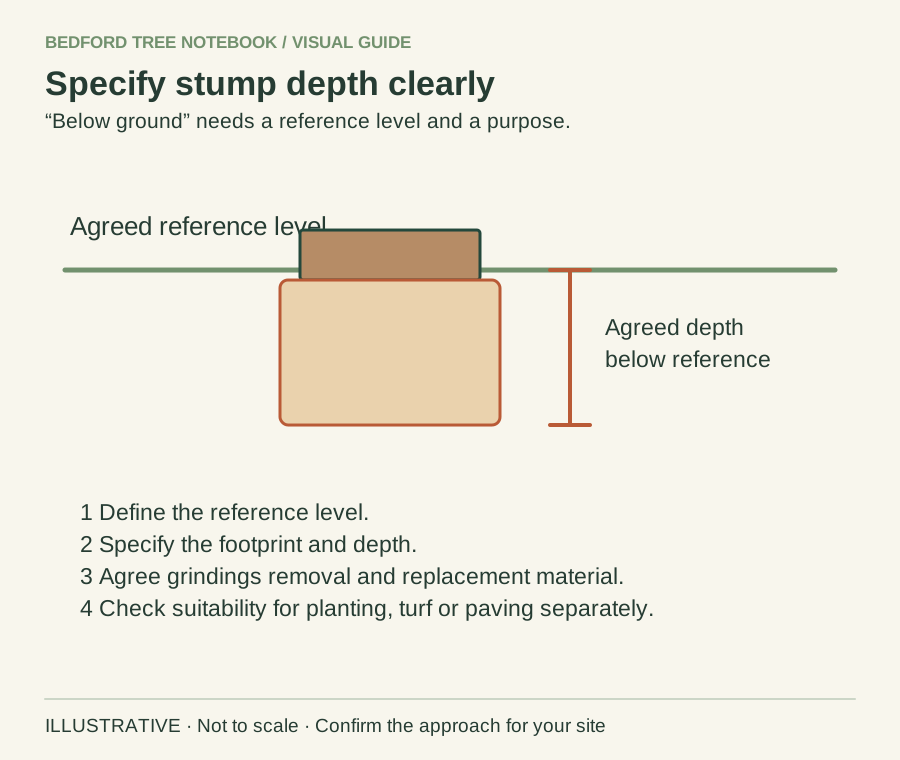
- Specify depth and treatment area in writing.
- Agree who removes grindings and reinstates the ground.
- Paving or construction preparation needs its own competent specification.
Establish where the measurement starts
Ground level can be unclear when the stump stands beside a raised bed, a sloping lawn or a surface that will later be removed. Ask the contractor to explain the reference they intend to use. A figure measured from the current surface may not describe the clearance beneath a future path.
A simple marked photograph or sketch can help both parties understand the same area. It is a communication aid, not an instruction for you to dig around the stump or expose roots before the assessment.
Use published figures as context, not a prescription
The RHS stump-removal guide gives general guidance of around 20–25 cm below ground for laying turf, with deeper grinding, at least 30 cm, for replanting or landscaping. Those are broad gardening pointers, not a guarantee of suitability for every site or an engineering standard.
Ask the relevant professional what your own project requires. There may be reasons to define a different extent or method, and a quoted depth does not establish that the ground below is clear of services or other obstructions.
Depth and width are separate
A stump has a wider form below its visible top, and roots can extend beyond the area being ground. Ask which parts are included and whether exposed surface roots are a separate item. A deep central grind should not be interpreted as removal of every root in the garden.
If a fence post, planting hole or path edge must occupy a particular position, identify that position. The contractor can then assess the relevant area rather than leaving both parties to assume that a single central measurement describes the whole project.
Tell the next contractor what will remain
A landscaper or other professional may need information about residual roots, the treated area and the material left behind. Agree who supplies that information and who prepares the next stage. The felling-and-stump guide helps keep separate operations clear.
Do not describe grinding as full excavation unless that is what has been assessed and agreed. Ordinary garden stump work does not certify ground for foundations or other engineered work.
Allow for services and access limits
Read the underground-services guide before assuming that extra depth is simply an optional upgrade. Give the contractor known information and ask how uncertainties affect the proposal.
Access also influences which equipment can reach the work. Record gates, steps and turns through the access checklist. It is the contractor’s task to assess the practical method, not the homeowner’s task to promise that the deepest option is achievable.
Make the finished scope checkable
Before accepting, agree: - The reference ground level and area being treated. - The intended depth or other clearly described extent. - Which roots or adjacent material are included. - What happens if an obstruction changes the scope. - Where grindings go and who reinstates the ground.
Use what happens to stump grindings to settle the last point. A neat-looking surface after the job is not, on its own, evidence of everything that has or has not been removed below it.
Describe the area the next job actually needs
Show the intended lawn, planting or paving footprint on a simple sketch. A depth measurement under the centre of a stump is not a full account of how much usable ground will be created. Ask the contractor how it describes the treated area and what may remain beyond it.
For planting, use replanting near a previous stump to discuss the wider growing space with a suitable adviser. For construction, the next installer should explain its ground requirements. Avoid accepting a number simply because it sounds substantial; it needs to relate to the purpose, access and actual operation being offered for the site.
A hypothetical difference between two specifications
Suppose one proposal describes grinding below the existing surface and leaving the grindings, while another describes removal of material and an agreed filling stage. Even if they mention the same nominal depth, they deliver different handover conditions. Ask each business to clarify its own scope rather than assuming the depth makes the offers equivalent.
This example does not prescribe a depth for any particular finish. Our grindings guide explains the material-handling conversation. Keep reference level, working area, debris removal and making good identifiable as separate questions, so a brief statement about depth is not expected to carry the meaning of an entire landscaping specification.
Allow for a limit discovered during assessment
Ask what would happen if a wall, service, root arrangement or other feature limits the intended work. The contractor should explain any uncertainty before a final agreement where possible. A written quote can identify an assumption without guaranteeing that every unseen condition has already been resolved.
Use the underground-services guide for information to share safely. Do not ask the operator to continue towards a suspected service simply to achieve the originally discussed number. If the specification changes, agree the practical and commercial implications and keep the revised description with the project record, including what remains for the next stage.
Ask for a handover description you can pass on
At completion, ask the contractor to describe the agreed operation and any known limitation in terms useful to the next business. That may be more helpful than a photograph of an apparently empty hole or a verbal assurance that the stump has gone. The next installer remains responsible for assessing its own requirements.
For a lawn, read preparing ground for turf before assuming the surface is ready. Keep the stump-work record together with the landscaping quote. If a later question arises, you can then identify the exact handover agreement without relying on a remembered measurement or expecting an invoice to confirm every aspect of ground preparation.
Putting it into practice
Ask for the agreed depth and extent to be recorded alongside grindings removal and reinstatement. If another professional is responsible for the next stage, confirm that their requirements and the stump contractor’s scope are compatible. Use the stump grinding service to prepare a planned-work enquiry rather than treating a general depth guide as a specification.
Match the scope to the intended finish: replanting near a stump and turf after stump work cover different next stages.
Discuss surface roots and the limits of grinding as a separate footprint question, alongside the agreed depth.
Turn the advice into a useful project brief.
Start with the postcode, the work you have in mind and any access considerations.
Prepare your enquiryNo obligation. A site assessment may be needed to confirm the work and price.
Sources & further reading
Sources checked 31 October 2026. How we prepare guidance.