
In this guide Show sections
General guidance, not a professional assessment. Confirm site-specific advice and current requirements before work.
Planning tree work in Bedford or nearby?
Start with the postcode, the work you have in mind and any access considerations.
Prepare your enquiryNo obligation. A site assessment may be needed to confirm the work and price.
Before you start
Tell the contractor what you intend to do with the space and ask what material the work is likely to leave. Do not assume that stump grindings are the same as purchased topsoil, clean bark mulch or the separate chip produced from branches. Their condition and suitability for reuse need consideration.
Three different material streams
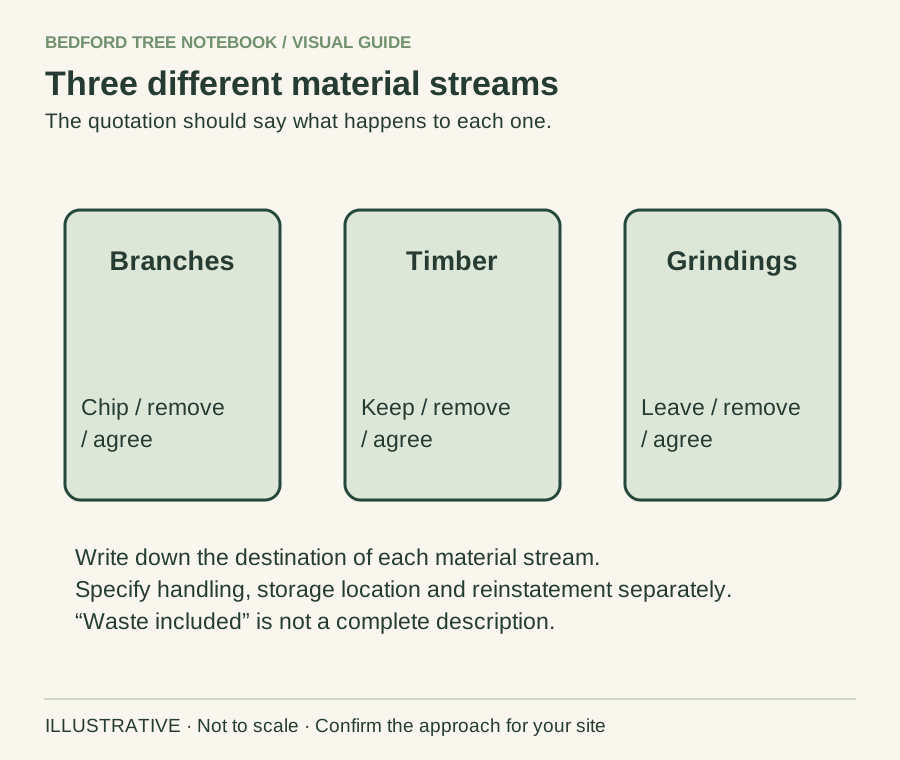
- Identify which materials are kept and which leave the site.
- Agree where retained material will be left.
- Check whether clearing and reinstatement are separate items.
Know which material you are discussing
The RHS stump-removal overview describes grinding the stump and main root plate into fine woody material. The actual material on your site may also be mixed with soil or other debris encountered in the worked area.
Ask the contractor what they expect and what they have found. Avoid promising the whole output to someone as a particular garden product before its condition is known. It is different from ordering a specified, screened material for a new bed or surface.
Three outcomes to compare in the quotation
One proposal may leave material where the stump stood. Another may move it into a heap on site. A third may remove it and include some ground reinstatement. There is no reason to assume those options have the same price or leave the same amount of work for you.
Use the quotation checklist to separate grinding, moving material, disposal and replacement ground material. If the proposal simply says removal, ask what is being removed: the stump, the grindings or both.
Discuss reuse rather than assuming it
Woody material can have garden uses, but suitability depends on its source, condition and the proposed planting or surface. The Soil Association’s woodchip guidance discusses woodchip uses; it should not be stretched into approval of every mixed pile from stump work.
Ask for advice if contamination, a suspected disease or other uncertainty is involved. Do not spread material around plants merely to avoid agreeing a disposal arrangement, and do not move potentially problematic material elsewhere without appropriate guidance.
Keep a lawn or planting project separate
If the area will become lawn, a planting bed or a new tree position, ask the person planning that work how the ground should be prepared. A surface filled to match the surrounding level is not necessarily ready for its intended use.
Organic material changes as it breaks down, so ask about the likely need for later attention instead of assuming that one levelling operation is permanent. We do not prescribe a universal mixture, fertiliser rate or waiting period for an uninspected garden.
Agree access for material leaving the site
Grinding access and removal access are related but separate questions. If the area is behind a narrow passage or reached through the house, explain how material would need to travel. Ask whether carrying and loading are included and what surfaces need protection.
Read the narrow-access guide before a visit. If you want a heap retained, agree a practical location so that it does not obstruct a shared route or a later stage of the garden work.
Record the result before moving to the next stage
Keep the agreed depth and extent of grinding with the arrangement for material left behind. If a landscaper takes over, pass on that information rather than describing the site simply as root-free. See agreeing a grinding depth for the specification questions.
Before completion, ask what remains to be done and who will do it. If removal of grindings or reinstatement was excluded, obtain a separate understood proposal rather than assuming it has become part of the original job because the ground now looks unfinished.
Estimate the practical space for retained material
If you are considering keeping grindings, show the contractor the place you have in mind and ask how the material would be moved there. Do not promise a storage area that blocks a gate, shared route or the next stage of the garden work. Discuss handling as well as the final location.
You do not need to predict an exact volume yourself. Explain the limits of the available space and ask the business how it will address them in the quotation. Our narrow-access guide helps describe the route out, which can matter separately from getting a machine to the stump.
A hypothetical reuse decision
Imagine a homeowner initially wants all grindings left for garden use, then realises the only available area is the part intended for new turf. The sensible next step is to discuss another agreed location, a removal option or a revised project sequence before the visit. A preference to reuse material should not obscure whether there is a suitable practical plan.
This is an example of arranging the job, not a recommendation that grindings suit a particular plant or soil. The turf preparation guide explains why lawn soil preparation is its own task. Seek appropriate horticultural advice where the proposed use depends on material condition or plant needs.
Make ownership of the next stage clear
If a landscaper will prepare the area after grinding, ask what material it expects to find and what it plans to remove or replace. Share that expectation with the stump contractor. Both quotes should describe the same handover instead of each business assuming the other will deal with a leftover heap.
For a planting project, read replanting near a stump before deciding to keep everything in the planting position. Clarify whether bagging, loading, carrying or removal is included, and ask how any retained material will be distinguished from waste the contractor is taking away. These ordinary details can make the completed job much easier to understand.
Check the material agreement at completion
Review the agreed locations and clearance after the contractor says the area is safe. Ask about material left for a later visit or another trade, and keep the explanation with the invoice. Do not assume a heap is abandoned waste if the quote says it is retained, or assume it was your preference if no clear agreement exists.
Use the end-of-visit checklist to record an unresolved point promptly. If you change your mind about retention after the work, ask for a new handling proposal. A later removal request can be a different task from the operation originally priced, so the responsibilities should be discussed again rather than inferred.
Putting it into practice
Put the material-handling and reinstatement arrangement in writing. If you want to reuse some material, identify the proposed location and ask whether that use is suitable. If the next step is turf, planting or paving, agree the preparation with the person responsible for that work rather than treating a heap of grindings as a finished ground specification.
For the next stage, read replanting near a previous stump or preparing ground for turf.
Turn the advice into a useful project brief.
Start with the postcode, the work you have in mind and any access considerations.
Prepare your enquiryNo obligation. A site assessment may be needed to confirm the work and price.
Sources & further reading
- RHS: removing trees and stumps
- Soil Association: using woodchip in your garden
- RHS: organic matter in the garden
Sources checked 31 October 2026. How we prepare guidance.