
In this guide Show sections
General guidance, not a professional assessment. Confirm site-specific advice and current requirements before work.
Planning tree work in Bedford or nearby?
Start with the postcode, the work you have in mind and any access considerations.
Prepare your enquiryNo obligation. A site assessment may be needed to confirm the work and price.
Before you arrange the work
Show the contractor the area you hope to turf, including slopes, edges and access. Ask what material will remain, what the quotation includes and whether a landscaper will need to assess the area before the work is agreed.
Specify stump depth clearly
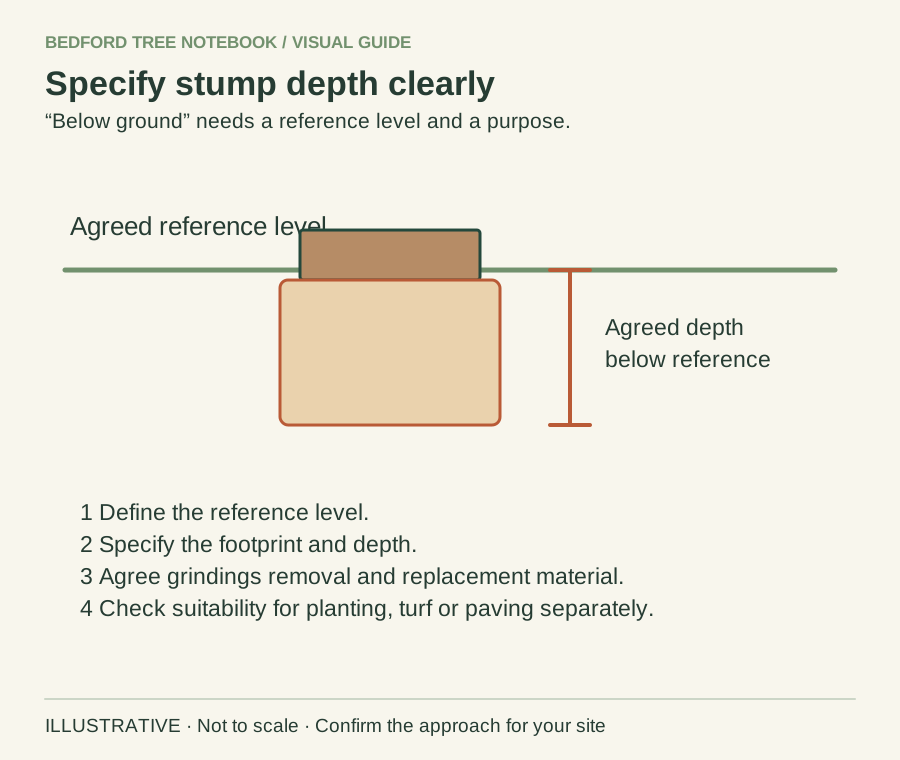
- Specify depth and treatment area in writing.
- Agree who removes grindings and reinstates the ground.
- Paving or construction preparation needs its own competent specification.
Specify the actual finish
Ask whether the job ends with grinding, removal of loose material, filling or a ready-to-turf surface. Those are different deliverables. The proposed grinding depth needs to suit the project, but a nominal depth does not guarantee that the whole area has a suitable soil profile.
Our grinding-depth guide helps frame the question. Tell the business about the lawn plan at quotation stage rather than requesting extra depth once the machine is on site.
Manage woody material deliberately
Ask how grindings and remaining roots affect the next stage. Loose woody material should not simply be mistaken for finished lawn soil. Seek appropriate advice about removal, soil replacement and preparation for the particular area.
Read what happens to stump grindings to agree handling. If the finish is being delivered by another contractor, make sure both businesses understand the handover condition before either gives a final price.
Allow for ground conditions and later care
Settlement and drainage questions should be discussed with the person preparing the lawn. Avoid promising an instant permanent level surface from a photograph. Ask when the area can be used and what follow-up may be needed.
Use protecting the lawn during tree work for the access route as well as the stump area. Buried services and irrigation should be identified in the project brief, without attempting exploratory digging yourself.
Define the size of the lawn repair
Show the intended turf area on a simple sketch, including the stump position, surrounding lawn and any edges that will remain. Explain whether you want a small repair blended into existing grass or a wider area prepared as part of another landscaping project. Those are different finish expectations.
Ask the person preparing the lawn to explain what it needs from the stump operation. It may need to see the site before giving a complete scope. Do not assume an apparently level patch in a photograph has been assessed for the intended lawn finish, drainage or later use. Your role is to describe the result, not design the ground preparation.
A hypothetical handover between two businesses
Imagine the stump contractor agrees to grind and leave the material, while the lawn installer assumes the site will arrive cleared and filled. Both may have quoted honestly, but their assumptions do not connect. The missing stage should be identified and assigned before either booking is treated as a complete solution.
Our quotation checklist helps record those inclusions. This is an illustrative coordination problem, not evidence that either business must provide every service. A useful handover says what remains, who removes it and who prepares the next surface, without requiring one ambiguous phrase such as ready for grass to stand for several separate tasks.
Agree where material will go during preparation
If grindings or other removed material will be retained temporarily, identify a location that does not obstruct the lawn work or block access. Ask how the material reaches that position and who handles any later removal. Do not leave the decision to the operator once the surrounding garden is full of equipment.
Read what happens to stump grindings for the wider material discussion. Retention, reuse and disposal are separate choices. A decision to keep material somewhere in the garden does not mean it should remain in the future lawn base, or that the next business has agreed to move it without that task appearing in its proposal.
Keep machinery routes in the finishing plan
A lawn project includes the stump area and the route used to reach it. Discuss whether equipment or repeated movement could affect grass elsewhere, and agree any proposed protection or reinstatement. Tell the business about soft ground, irrigation and surfaces that need consideration in the plan.
Our lawn-protection guide helps organise those questions. Check the sequence if the new turf would otherwise be laid before the tree work. A short garden route can still require planning, and the wish to finish everything quickly should not replace the contractor’s assessment of ground conditions or the installer’s advice about the new surface.
Ask about settlement without expecting a universal timetable
Ask the lawn professional what follow-up may be needed for the particular ground and preparation. Avoid relying on a generic promise that an area will never settle or that it can be used immediately. The recommendation should relate to the material, site and method being proposed.
Record who will address any agreed adjustment and whether that follow-up is included. Keep a stump contractor’s completed operation separate from a landscaper’s continuing responsibility, if that is how the project is arranged. A precise handover is more useful than asking one business to guarantee ground it has not prepared or another to accept an unseen base without assessment.
Separate turf aftercare from stump completion
When the new surface is laid, obtain the installer’s advice on ordinary care and use. The stump contractor’s earlier handover cannot provide every instruction for a product or preparation it did not supply. Ask who is your contact for questions about the lawn and retain the relevant details.
Our end-of-visit checklist helps close out the tree-work stage first. If different businesses attend, make the transition visible: one stage completed, another assessed and accepted, then its own aftercare. This prevents a later concern being passed around solely because nobody recorded where the first job ended and the next began.
Keep a simple before-and-after record
Photograph the area from safe, similar positions before work and after each completed stage. Link those images to the accepted quotes and handover notes. They can help explain the boundaries of a later question, especially where a small repair joins an older lawn.
A photograph does not establish the quality of unseen preparation, so use it as context rather than technical proof. If a problem appears, describe what changed, when it became apparent and which part of the area is affected. Raise the issue with the appropriate business promptly and ask for an explanation before deciding the cause from the surface appearance alone.
Your next step
Keep the stump quotation and turf preparation scope together. At handover, use the end-of-visit checklist to confirm what has been completed and what remains for the next stage.
Turn the advice into a useful project brief.
Start with the postcode, the work you have in mind and any access considerations.
Prepare your enquiryNo obligation. A site assessment may be needed to confirm the work and price.
Sources & further reading
Sources checked 31 October 2026. How we prepare guidance.