
In this guide Show sections
General guidance, not a professional assessment. Confirm site-specific advice and current requirements before work.
Planning tree work in Bedford or nearby?
Start with the postcode, the work you have in mind and any access considerations.
Prepare your enquiryNo obligation. A site assessment may be needed to confirm the work and price.
What to check
The best approach depends on access and your future use of the space. Foundations or new services may require specialist ground preparation beyond ordinary stump work.
Grinding or excavation?
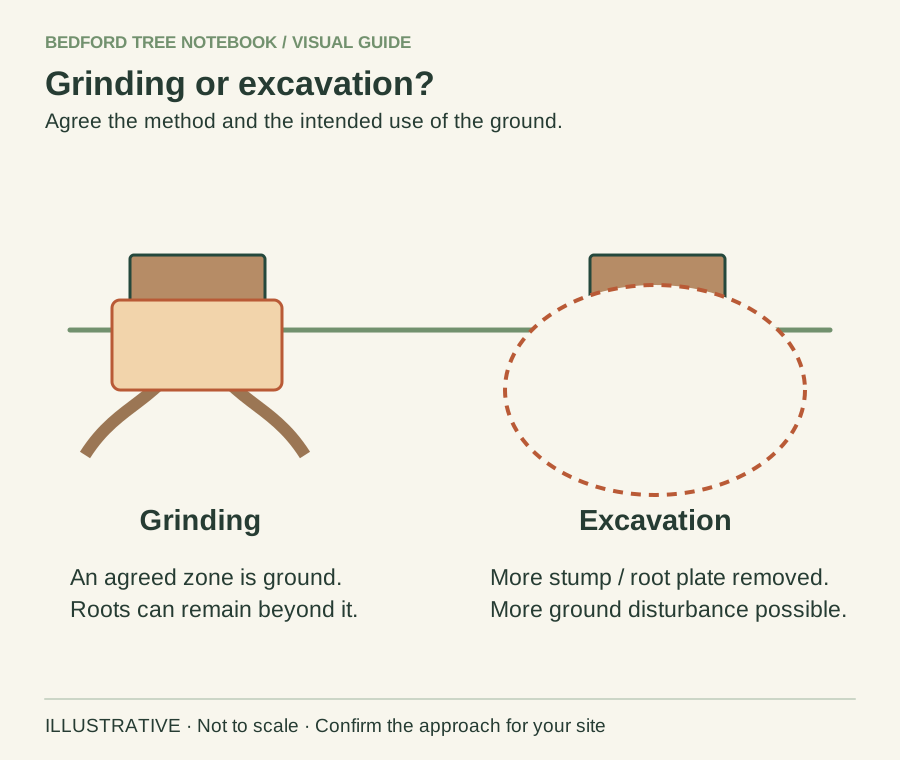
- Felling and stump treatment are separate scope items.
- Grinding does not remove the complete root system.
- Ground reinstatement and future use need separate agreement.
Start with the next use of the space
Tell the contractor whether you want a lawn, a new tree, paving or preparation for a building project. The required result may differ substantially. Stump treatment should not be assumed to make the ground suitable for foundations or other engineered work.
Consider access and disturbance
Explain gate widths, steps and what lies between the street and stump. Identify surfaces and planting you want to protect. Ask the contractor to describe the likely working area and reinstatement rather than assuming the smallest visible machine means no disturbance.
Clarify what stays below ground
Grinding has an agreed working depth and area. Roots outside that area may remain. Excavation also needs a defined scope. Ask for an explanation suited to your planned use and find out who is responsible for checking underground services and preparing the site.
Compare complete outcomes
A useful quote covers the operation, material left or removed and the finished ground. Ask whether new soil, compaction, turf or later preparation is included. Keep these items separate so a lower headline price does not conceal a different result.
Describe the next stage before choosing the operation
A stump in the way of a lawn, a replacement tree or a proposed foundation presents different project questions. Tell the tree contractor and the person responsible for the next stage what you want to achieve. Ask the next contractor what condition it needs the ground in, then ask the stump specialist what it can provide. Do not make a general website comparison the specification for engineered ground work.
Our stump work before paving guide explains one common handover. Where a building or service installation is involved, the appropriate designer or specialist should define the requirements. Grinding and excavation are methods within a wider project, not guarantees that every later use will be possible. The useful decision compares the actual outcome, disruption and responsibilities each business describes for the particular site rather than selecting the operation that sounds most complete in isolation.
Define the footprint as well as the depth
Ask the business which area around the stump is included and how any depth is referenced. A deep treatment at the centre does not necessarily describe what happens to a root crossing a wider garden area. Equally, a quotation for excavation needs to identify what will be removed rather than imply that every trace of the previous tree disappears. Request an explanation tied to your intended finish.
Use agreeing a grinding depth before comparing figures. Show walls, fences, paving and known services on the site sketch. If the business has not inspected those constraints, ask what assumptions remain open. Avoid making a larger scope your own safety measure: cutting more deeply or removing more roots is not a substitute for professional planning around structures and services. The appropriate extent needs to be established rather than guessed from the size of the visible stump.
Hypothetical example: the new planting position moves
Imagine a homeowner initially asks for complete stump removal because a replacement tree is intended for exactly the same position. A planting discussion may suggest a nearby position that better suits the new tree and the garden. The original removal request should then be reconsidered against the revised planting plan. A changed objective can change which stump outcome is useful, without implying that either method is universally preferable.
Read replanting near a previous stump before committing to a precise planting hole. This invented example does not establish suitable spacing, diagnose soil conditions or recommend leaving a particular stump untreated. It illustrates the value of coordinating the landscape decision and stump specification early. The contractor can quote for an understood job, and the homeowner can compare outcomes without paying for an assumed requirement that another part of the project has already changed.
Include access, removal and surface protection
Describe the complete route to the stump, including turns, steps and surfaces. Equipment access and removal of excavated material may involve separate practical demands. A machine fitting through an entrance is not enough to establish the whole route is workable. Let the business assess suitability and ask what protection, handling or reinstatement it has allowed for. Do not choose a working method from an equipment width listed online.
Our narrow-access guide helps prepare useful dimensions safely. If the route passes through another property, settle that arrangement before treating the quotation's assumptions as confirmed. Ask what happens if ground conditions change or an obstruction is discovered. Keep any alternative method and price change explicit. A careful comparison includes the route, working area and finish rather than evaluating only the apparent speed of the stump operation itself.
Agree who accepts the ground for its next use
Ask who removes loose material, supplies any replacement fill or soil and prepares the final surface. The tree contractor's completion and a landscaper's acceptance of the ground are different milestones. Record the handover condition and identify any follow-up needed before turf, paving or planting. If the contractor proposes leaving grindings, discuss whether that fits the next stage rather than assuming the material automatically serves as finished ground.
Use what happens to stump grindings and underground services to complete the enquiry. At the end of the visit, review the agreed result only once the work area is released. Clarify remaining work in writing before another business starts. The choice between grinding and excavation becomes more useful when it is connected to a checkable finished scope, safe planning and a clear next-stage responsibility.
Can the landscaper decide after the stump visit?
It is better to discuss the intended handover before booking either stage. If the landscaper needs a different result, discovering that afterwards can require another operation or revised preparation. Give both businesses the same description of the future use and ask them to identify any unresolved assumption. A homeowner should coordinate the information, while the relevant professionals specify their own work and confirm whether the ground is suitable for the next stage.
Your next step
Agree depth, treatment of roots, disposal and reinstatement. Locate underground services before work.
Planning a patio or path? Use stump work before paving to coordinate the handover with the installer.
Turn the advice into a useful project brief.
Start with the postcode, the work you have in mind and any access considerations.
Prepare your enquiryNo obligation. A site assessment may be needed to confirm the work and price.
Sources & further reading
- RHS: removing trees and stumps
- HSE: avoiding danger from underground services
- HSE: tree-work safety topics
Sources checked 31 October 2026. How we prepare guidance.