
In this guide Show sections
General guidance, not a professional assessment. Confirm site-specific advice and current requirements before work.
Planning tree work in Bedford or nearby?
Start with the postcode, the work you have in mind and any access considerations.
Prepare your enquiryNo obligation. A site assessment may be needed to confirm the work and price.
Before you arrange the work
Tell both contractors what will be built and share the relevant layout. Ask the paving installer what condition it needs the ground in, then ask the stump contractor what it can deliver. Do not choose a universal grinding depth from a general guide.
Specify stump depth clearly
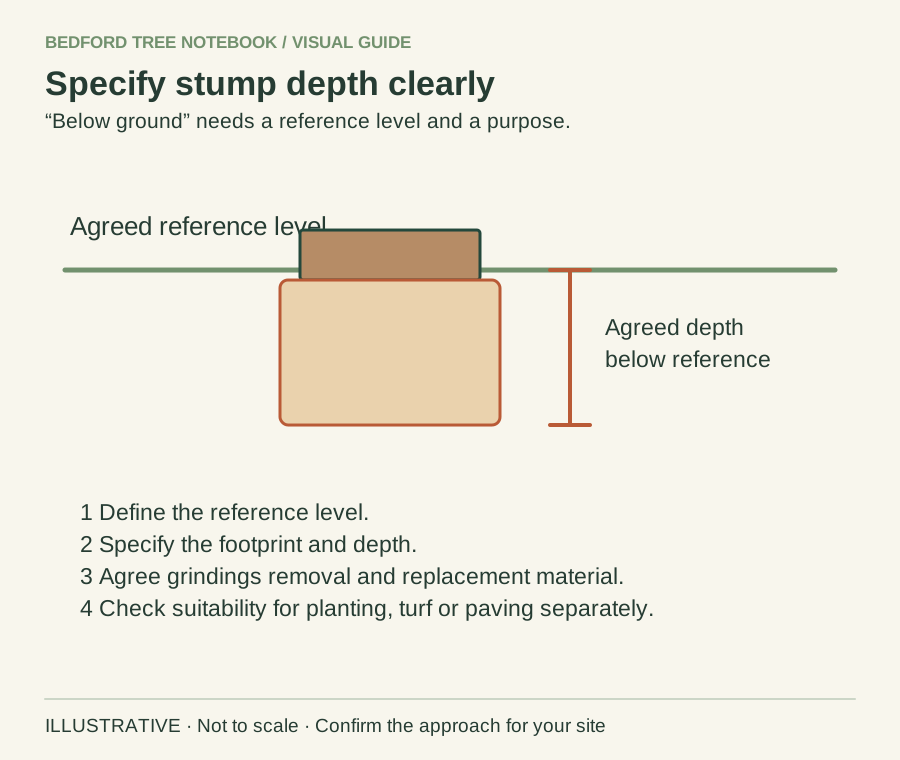
- Specify depth and treatment area in writing.
- Agree who removes grindings and reinstates the ground.
- Paving or construction preparation needs its own competent specification.
Start with the proposed construction
A path, patio and vehicle-bearing surface can have different requirements. The person responsible for the paving should assess the design and ground preparation. The stump contractor should describe the area and material it will treat, plus any access limitations.
Use stump grinding versus removal to compare the broad options, then ask for advice on the actual project. A general comparison cannot determine an engineering specification.
Resolve roots, voids and material handling
Ask what happens to remaining roots, woody debris and the space left by the operation. Confirm who removes grindings, supplies material and prepares the base. A statement that the stump is gone is not the same as acceptance of the ground for paving.
Read grinding depth explained and record the agreed handover. If the two contractors’ assumptions differ, resolve that before either stage begins.
Include services and access
Paving projects may involve drainage, cables or irrigation near the stump. Share existing plans and known service information, but leave locating and safe working arrangements to competent professionals. Do not test for services by digging or probing.
Our underground-services guide helps prepare the information. Consider whether the paving should follow the tree work so machinery does not need to cross a newly finished surface, and ask both businesses about the practical sequence.
Give both contractors the same layout
Prepare a simple plan showing the stump, existing structures and intended edge of the new paving. Include the access route and anything that cannot be disturbed. Share the same version with the stump contractor and paving installer so they are not pricing different footprints or assuming different starting conditions.
If the design changes, update both businesses. A revised patio edge can change the relevance of a remaining root or the practical sequence. The quotation checklist helps keep these assumptions visible. Avoid making a contractor responsible for a construction requirement it has never been given the opportunity to assess or include in its proposal.
A hypothetical conflict over the finished base
Imagine a stump quote promises removal of the visible obstruction, while the paving installer expects a defined prepared base suitable for its design. Those descriptions are not automatically equivalent. The gap should be discussed before work, with a clear account of who will assess and carry out the remaining preparation.
This example does not prescribe how deep a stump must be treated or what a paving base should contain. It illustrates why the construction professional’s requirements must connect with the tree contractor’s scope. A nominal grinding depth or a photograph of the cleared surface cannot replace the installer’s assessment of the ground it is being asked to build on.
Discuss roots beyond the visible stump
Ask the tree contractor what its proposed operation covers and what may remain outside that area. Then ask the paving installer how it will assess the next stage. Do not assume every visible or hidden root will be removed, or that removing more material is always the appropriate way to meet the design.
Our grinding-versus-removal guide explains the broad options without choosing one for your site. If the proposal involves excavation near other trees or structures, flag that context early. Keep the professional advice about those features distinct from the homeowner’s preference for a particular paved layout.
Make disposal and filling separate line items
Clarify who removes grindings and any other material, who supplies filling or base material and who prepares the surface for the installer’s next operation. If a task is excluded, identify the person or business expected to complete it. This can be a concise list rather than complicated paperwork.
Use stump-grindings guidance to discuss retained material without mistaking it for an agreed construction medium. A cheaper stump proposal may simply end at a different point in the sequence. Compare the complete project responsibilities before deciding that two prices describe the same finished result or that the missing stage will be inexpensive and straightforward.
Keep service information current through the project
Tell both businesses about known cables, pipes, drainage and irrigation near the work area. Share available plans and explain anything uncertain or changed since they were prepared. Information passed to the stump contractor should not be assumed to reach the paving installer unless somebody has agreed to share it.
The underground-services guide explains why plans and homeowner knowledge have limits. Do not dig or probe to prove a route. Each stage should plan its own activity appropriately, and the final handover should not imply that a completed stump operation establishes unrestricted safety for later ground disturbance elsewhere.
Arrange the sequence around access
Ask whether tree or stump equipment needs to cross the area that will become paving. Discuss loading, deliveries and any narrow route before the surface is finished. It may be practical to complete one operation first, but the businesses should assess and agree the sequence rather than the homeowner promising access that cannot be provided.
For the street end of the route, use parking and shared access. A project can have clear garden space but awkward deliveries. Keep any arrangements with neighbours or shared-drive users separate from public-route permissions, and notify the businesses if those arrangements change between the quotation and the appointment.
Confirm acceptance of the handover
After stump work, ask the paving installer to confirm whether the agreed starting condition has been reached before its construction stage begins. Keep any outstanding preparation visible in writing. A completed invoice from the tree contractor should describe its own operation, not stand in for acceptance by another trade.
Retain the final scope, photographs and relevant explanations together. If an unexpected condition appears, ask for its practical implications before authorising an extra task. This gives the project a clearer decision point than continuing under an assumption that every remaining issue must already have been included in whichever business attended first.
Your next step
Agree the sequence, handover condition and separate responsibilities in writing. Obtain confirmation from the paving installer that the next stage is ready rather than treating the tree contractor’s completion as that approval.
If the stump is close to a structure, read stump work beside a wall or fence before agreeing access and the next construction stage.
Turn the advice into a useful project brief.
Start with the postcode, the work you have in mind and any access considerations.
Prepare your enquiryNo obligation. A site assessment may be needed to confirm the work and price.
Sources & further reading
Sources checked 31 October 2026. How we prepare guidance.