
In this guide Show sections
General guidance, not a professional assessment. Confirm site-specific advice and current requirements before work.
Planning tree work in Bedford or nearby?
Start with the postcode, the work you have in mind and any access considerations.
Prepare your enquiryNo obligation. A site assessment may be needed to confirm the work and price.
Before you make arrangements
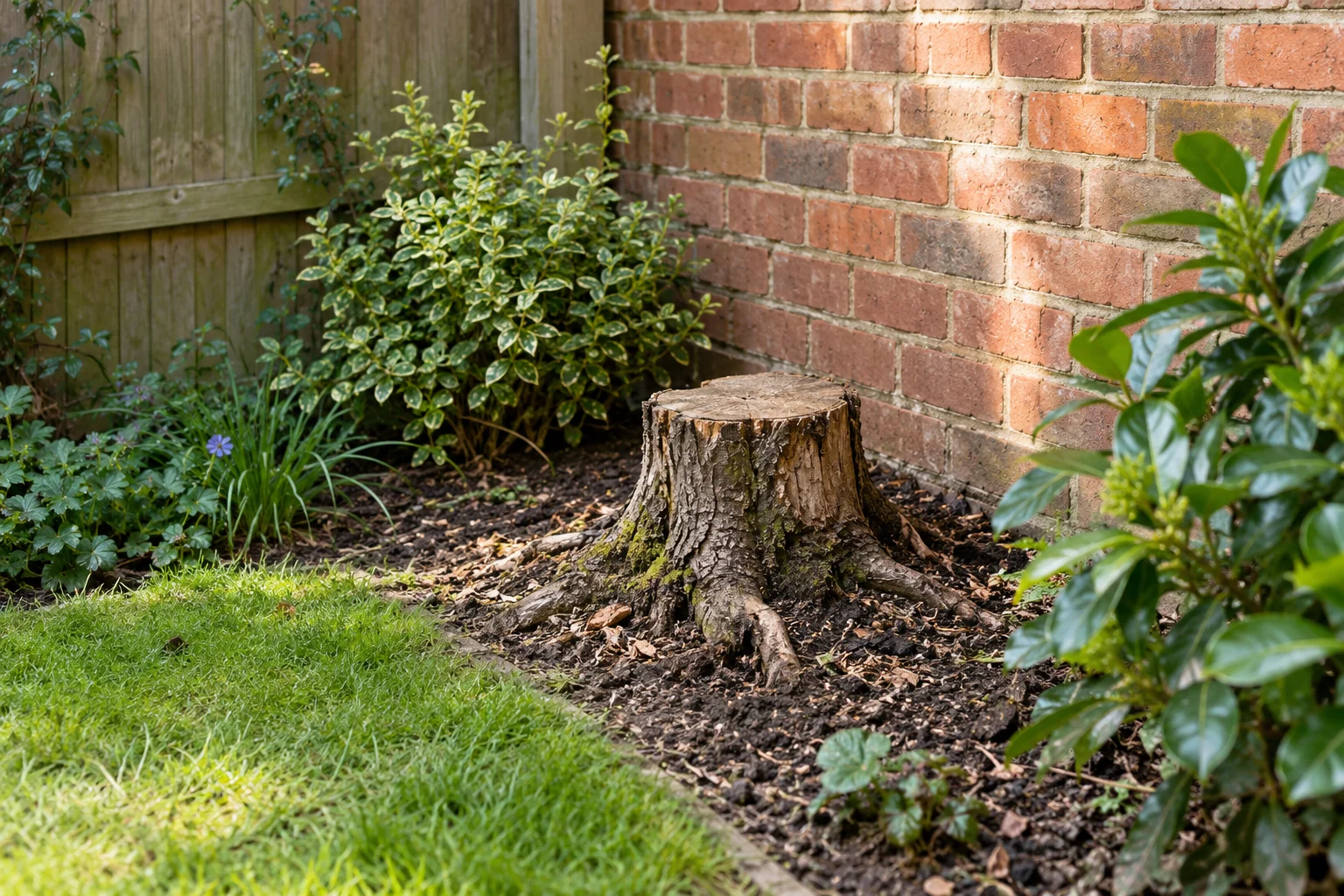
Show the stump and nearby structure in the same safe photograph, and identify the boundary position as accurately as you can. Mention known services and existing damage. Do not excavate around the stump or dismantle the wall or fence to make the enquiry easier. Use underground services and stump work for the information to gather first.
Hidden services change the job
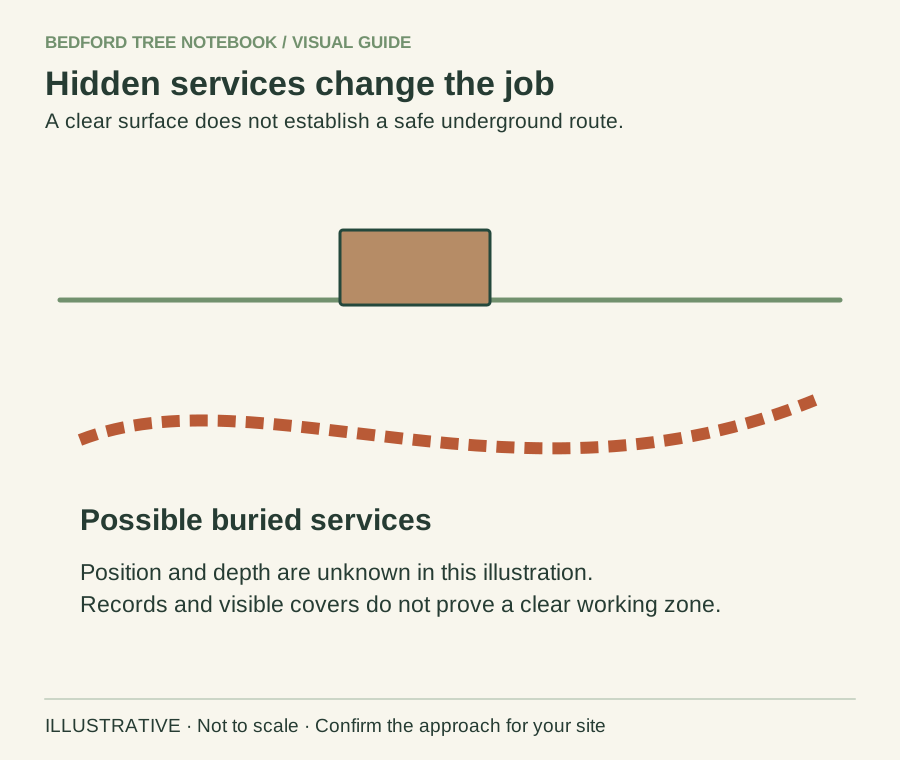
- Tell the contractor about known services, covers and past works.
- Do not use this diagram to infer clearance distances or safe digging.
Explain the relationship rather than a distance alone
A measured gap can help, but the contractor also needs to know what the structure is, how the stump sits beside it and what access exists. A lightweight fence panel, brick boundary wall and retaining structure present different questions; do not assume one photograph establishes their construction or condition.
Describe what you know and what you do not. If the wall's role or stability is uncertain, ask whether relevant structural advice is needed. A stump contractor's quotation should not be treated as an engineering assessment unless that output is explicitly within the appropriate professional scope. Keep any earlier report available so the business can understand the constraints without guessing from appearance.
Clarify the objective for the space
Tell the business why you want the stump dealt with. You may need a path cleared, space for new planting or preparation for replacing the boundary structure. The intended result affects what information the contractor and any later tradesperson need.
Read stump work before paving if a hard surface is planned. If a fence or wall is being replaced, ask that installer what handover condition it needs, then discuss with the stump contractor what can appropriately be delivered. Avoid commissioning “remove the stump completely” without understanding the method, limits and relationship with the structure. A clear project objective is more useful than a sweeping instruction whose practical meaning has not been settled.
Keep ownership and access distinct
A stump close to a boundary may raise questions about whose land is involved and who can authorise work. Do not treat a fence line or the side from which you can see the stump as definitive ownership evidence. Seek appropriate advice if the position is disputed.
Our shared-boundary guide helps organise the practical conversation. If the method requires access to neighbouring land, agree that separately with someone entitled to authorise it. Permission to remove a fence panel is another arrangement again. The contractor should receive a clear account of what access is available, what remains uncertain and who can approve any change; a neighbour's casual comment should not be stretched into authority for a different operation.
Ask about the proposed method and limitations
The professional should determine which method is suitable after considering the site. Ask it to explain the working area, intended depth or extent, equipment access and what material may remain. Do not choose equipment yourself on the basis of an online width or power figure.
Our grinding-versus-removal guide helps compare the broad options. A method that suits an open stump may not suit one beside a structure or service. If the contractor cannot confirm the scope remotely, arrange an appropriate visit and ask what the visit will establish. A realistic limitation stated before acceptance is more useful than a general promise that everything will be dealt with somehow.
A hypothetical fence-replacement project
Imagine a homeowner wants an old stump removed before a new fence is installed. The stump is beside the existing boundary, and the fence installer expects to position a post nearby. The homeowner initially asks the tree contractor to grind below the lawn without mentioning the post layout.
A clearer brief shares the intended fence plan and asks both businesses to agree the relevant handover. This hypothetical example does not specify where a post should go or authorise excavation around a boundary. It illustrates why the next construction stage needs to inform the stump enquiry. A nominal grinding depth cannot by itself confirm that a separate installer has the space and ground conditions its design requires.
Include services and unknown material
Tell the contractor about known drainage, cables, lighting, irrigation and anything else that may affect the area. Share records you already hold, but identify their date and limitations. A line absent from an old drawing is not proof that the working area is clear.
Use the underground-services guide to keep the homeowner's role clear. Do not probe, pull at embedded objects or uncover a suspected service to assist the quotation. If an unexpected feature is found during work, the plan should allow the relevant professional to stop and seek appropriate instructions. Discuss how that uncertainty affects the provisional scope and any later price change before the work date.
Agree protection, debris and reinstatement
Ask what the contractor's scope includes for the nearby structure and access route, without prescribing a method it has not assessed. Photograph existing damage from a safe position if useful. Clarify where grindings go and who makes the area ready for its next use.
Read what happens to stump grindings before assuming the remaining material is a finished base or planting medium. If a different business will repair or replace the boundary structure, keep that responsibility separate. A stump quotation should not silently acquire a wall-repair or fencing obligation that neither party has described. Written inclusions help the household understand what remains after the tree contractor's visit.
Review the result with the next stage in mind
Wait until the contractor says the area is safe, then review the agreed scope and visible condition. Ask what remains underground or outside the treated footprint and retain the explanation. Do not excavate to check the result yourself.
The completion checklist helps record an outstanding point. Ask the next installer to confirm readiness for its own work rather than treating stump completion as automatic approval of the construction stage. If the later design changes, obtain an updated assessment of the new requirement. A clear handover distinguishes a change in plans from a failure to carry out the original agreed operation and helps avoid an avoidable gap between businesses.
Your next step
Prepare a combined picture of the stump, structure, services, access and future project. Ask the relevant professionals to agree a suitable scope and handover before booking. You can start the enquiry in the project planner, but the method and limits need to be confirmed for the actual site.
A retaining wall introduces a structural question beyond the visible stump; trees near retaining walls explains the coordinated advice to seek.
Turn the advice into a useful project brief.
Start with the postcode, the work you have in mind and any access considerations.
Prepare your enquiryNo obligation. A site assessment may be needed to confirm the work and price.
Sources & further reading
- RHS: removing trees and stumps
- HSE: avoiding danger from underground services
- HSE: tree-work safety topics
Sources checked 31 October 2026. How we prepare guidance.