
In this guide Show sections
General guidance, not a professional assessment. Confirm site-specific advice and current requirements before work.
Planning tree work in Bedford or nearby?
Start with the postcode, the work you have in mind and any access considerations.
Prepare your enquiryNo obligation. A site assessment may be needed to confirm the work and price.
Before you make arrangements
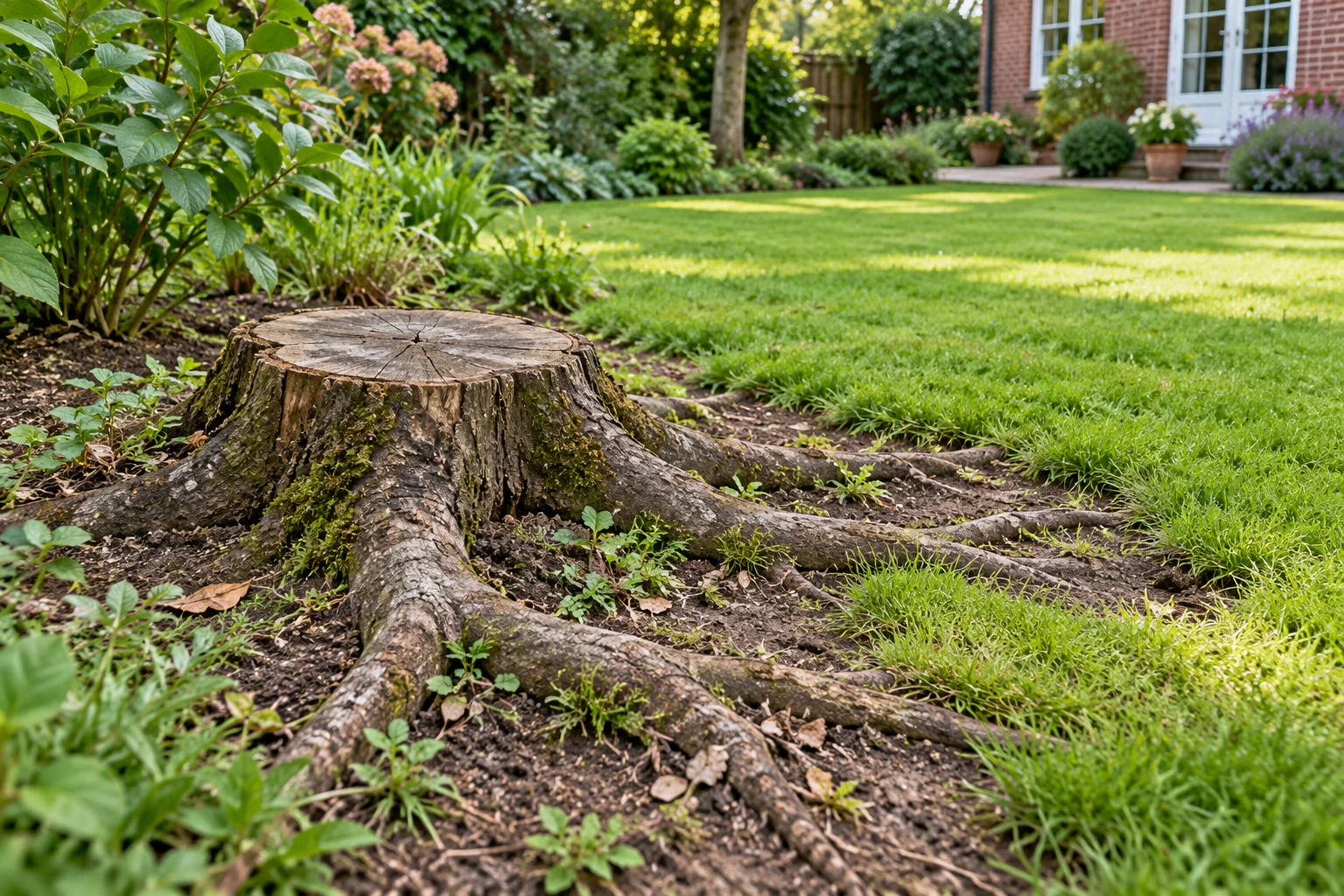
Identify whether the roots are associated with a removed tree, a retained tree or an uncertain source. Do not cut, grind or excavate to find out. Our visible-roots guide covers concerns around a standing tree; this guide focuses on defining a stump-work scope and the limits of the finished result.
Grinding or excavation?
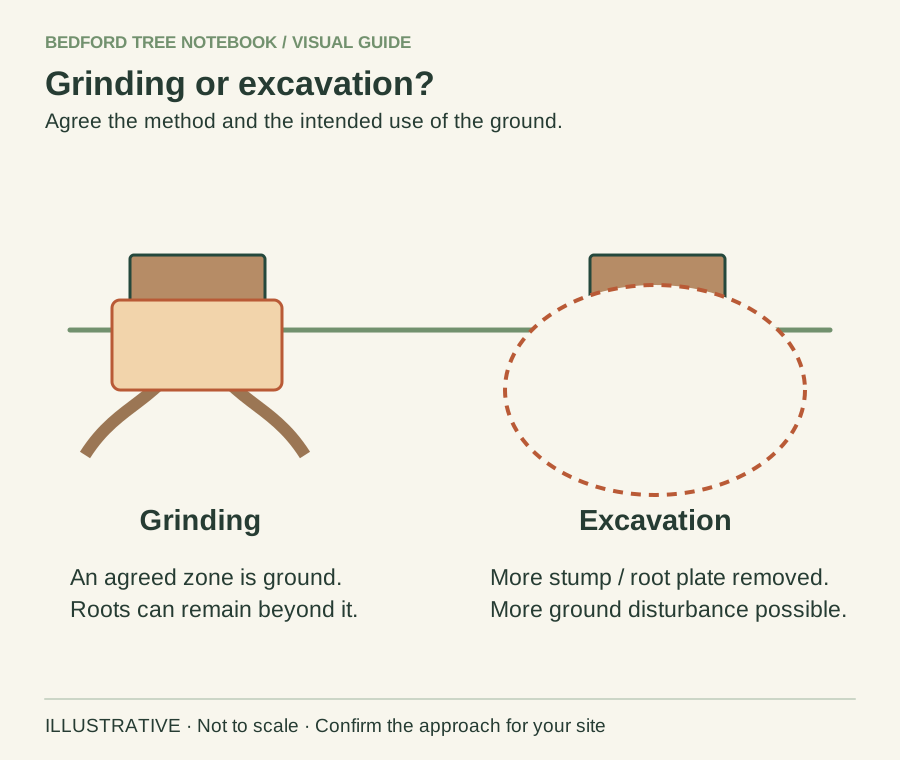
- Felling and stump treatment are separate scope items.
- Grinding does not remove the complete root system.
- Ground reinstatement and future use need separate agreement.
Describe the stump and the wider area separately
Show the visible stump and any roots or raised woody areas you want considered. Mark them on a simple sketch with paths, boundaries and the future project area. A close-up diameter measurement may help describe one feature, but it does not define the whole ground operation.
The grinding-depth guide explains why depth and footprint need separate agreement. Ask the contractor what area its price covers and what will remain outside it. Avoid a general instruction to “grind everything” where roots run beyond the visible stump or towards structures. The business needs an assessable scope, and another professional may need to advise before certain material can appropriately be disturbed.
Understand what a grinding quotation promises
Ask the contractor to describe the intended depth from a stated reference level and the extent of material to be treated. A quotation should not be read as a guarantee that every underground root will disappear unless the business has explicitly specified an appropriate operation that delivers that result.
Our grinding-versus-removal guide introduces the broader distinction between methods. Do not choose solely by the deepest number offered. Access, services, nearby structures and the next use of the ground all affect the useful scope. The question is whether the proposed operation is suitable for your project and clearly described, rather than whether one method sounds more thorough in the abstract.
Keep retained trees out of a blanket instruction
A root near a stump is not automatically material that can be removed without further assessment. Tell the contractor about nearby standing trees, boundaries and any uncertainty about the source. A site-specific professional may need to identify the relevant relationships before work is agreed.
Forest Research discusses risks associated with root disturbance. Use that as a reason to seek assessment, not as a basis for a homeowner deciding a safe cutting distance. If the concern involves a retained tree, read tree surgeon or consultant to identify the output you need. A ground-finishing objective should not silently become permission to damage a different tree or to decide ownership questions underground.
Explain the next use of the ground
A lawn, planting bed and paved surface can require different preparation and handover. Tell the stump contractor which use you intend and ask the next relevant professional what condition is needed. A visible stump disappearing is not the same as the full area being ready for the next operation.
Use turf after stump work, replanting near a stump or stump work before paving as appropriate. Keep their questions distinct rather than combining them into one universal depth. The finished specification should connect to the actual project, including who handles remaining woody material, soil preparation and any later settlement or reinstatement.
A hypothetical lawn-reinstatement brief
Imagine a homeowner wants a stump ground down and the surrounding lawn made level. Several surface roots extend beyond the obvious stump area. The first quotation covers grinding the stump only, while the homeowner assumes the whole lawn section will be ready for turf.
Before accepting, the homeowner can mark the intended lawn area and ask which roots and preparation are included, what needs assessment and who will complete the remaining stage. This hypothetical example does not prescribe removal of any particular root. It illustrates why a tidy stump photograph cannot define a complete landscaping scope. The relevant professionals should settle the handover before the machine arrives, not after the homeowner discovers material where new turf was expected.
Flag services and structural constraints early
Mention known pipes, cables, irrigation, drainage and nearby walls or fences. Share existing information without presenting an old plan as proof that no service exists elsewhere. Do not probe or dig to improve the enquiry; safe locating and working arrangements belong to competent professionals.
Our underground-services guide helps prepare the discussion. For a stump beside a boundary structure, read stump beside a wall or fence. A contractor may need to inspect before confirming what is practicable. Keep a provisional scope labelled as provisional rather than accepting a firm-looking price based on constraints that have not yet been understood.
Agree what happens to the grindings
Ask whether material is left, moved or removed and whether the price includes anything placed back in the treated area. Keep woody grindings distinct from a finished planting or lawn medium. The next contractor should know what will be present at the handover.
The grindings guide helps compare those choices. If you retain material for a garden use, identify the purpose and location rather than allowing a pile to become an undefined future task. Ask about suitability where disease or other concerns are relevant. A material-handling decision can affect access and later preparation, so it belongs in the quotation rather than a last-minute conversation during clean-up.
Make completion checkable without excavating
Once the contractor releases the area, review the agreed visible footprint, material handling and stated handover. Ask it to explain what was done and what remains outside the scope. Do not dig into the area or approach equipment to verify the operation yourself.
Use the end-of-visit checklist to record an unresolved question. If a later landscaper identifies an issue, compare it with the original scope and any new project requirement before assuming the stump work was defective. A clear specification allows everyone to distinguish incomplete agreed work from an additional operation that was never included. Keep the relevant records together for the next stage.
Your next step
Describe the stump, visible roots, nearby retained trees and intended ground finish as separate parts of the enquiry. Ask for a clear working footprint and handover, then coordinate any assessment or landscaping needed beyond it. The project planner helps organise the brief, while the contractor must confirm the site-specific scope.
Turn the advice into a useful project brief.
Start with the postcode, the work you have in mind and any access considerations.
Prepare your enquiryNo obligation. A site assessment may be needed to confirm the work and price.
Sources & further reading
- RHS: removing trees and stumps
- Forest Research: tree roots and trenching
- HSE: avoiding danger from underground services
Sources checked 31 October 2026. How we prepare guidance.