

In this guide Show sections
General guidance, not a professional assessment. Confirm site-specific advice and current requirements before work.
Planning tree work in Bedford or nearby?
Start with the postcode, the work you have in mind and any access considerations.
Prepare your enquiryNo obligation. A site assessment may be needed to confirm the work and price.
Before you make arrangements
Write one sentence explaining the required outcome: a quotation for specified pruning, an assessment of a concern, planning-related advice or a report for another party. Our choosing a tree surgeon guide covers contractor checks; this guide helps you decide what professional role and deliverable to ask about first.
Which kind of help do you need?
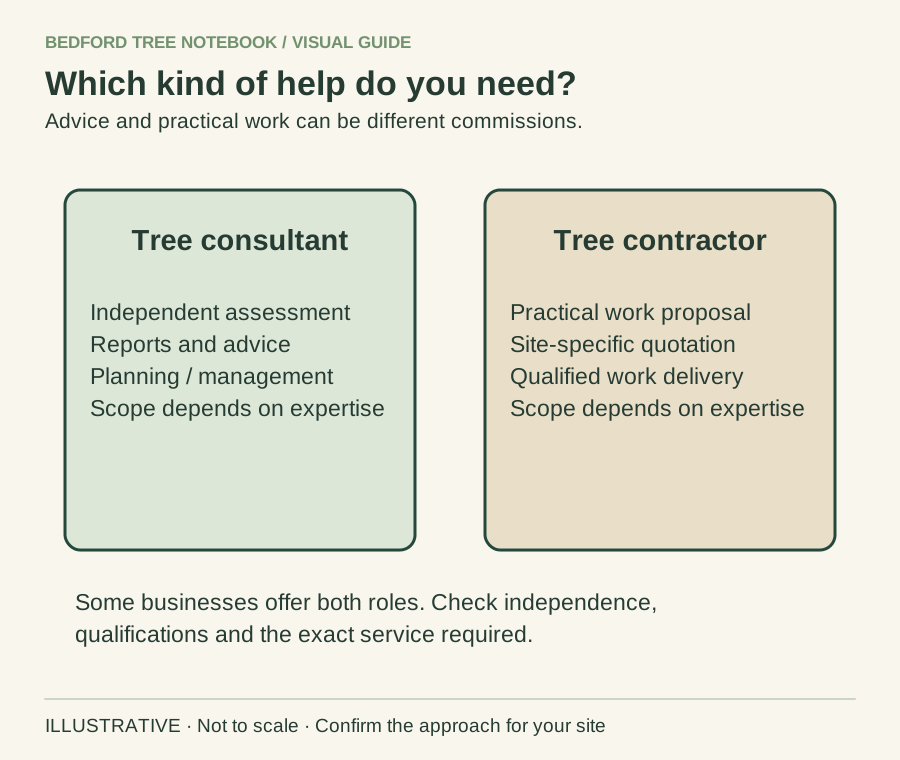
- Ask for the role and deliverable you need.
- Check relevant qualifications and any need for independence.
Separate doing the work from advising on the question
A contractor may assess a site to recommend and price work, while a consultancy appointment may be commissioned for a particular opinion or report. Some businesses provide more than one service, but do not assume a quotation visit includes every possible assessment or an independent document suitable for another organisation.
Ask the business what it is offering, who will carry it out and what you will receive. A verbal recommendation can be useful for one purpose and insufficient for another. The site-visit guide helps distinguish an attendance arrangement from the professional output. Choose based on the task rather than treating a familiar job title as evidence that every form of tree advice is included.
Identify who needs to rely on the output
A homeowner choosing routine work may need a clear recommendation and quotation. An insurer, planning authority, designer or other party may have different information requirements. Ask that recipient what it needs before commissioning a report that may not answer the relevant question.
If the issue concerns development, our planning-conditions guide helps identify existing documents to share. If the concern follows building activity, use tree concerns after building work to assemble a chronology. Do not ask a professional to write towards a predetermined answer. Explain the decision and evidence required, then let the scope establish what can appropriately be assessed.
Match experience to the actual subject
Ask about relevant qualifications, experience and the sort of work or reports the person routinely undertakes. Specialist experience in one tree-related field should not be assumed to cover every other subject. A development project, a veteran-tree question and a possible building-damage concern can call for different expertise.
A council resource on choosing tree experts emphasises being clear about the output required. That is a useful selection principle, not a claim that another council's local process applies in Bedford. Ask for the professional's role and limitations in ordinary language. If the answer requires structural, ecological or other expertise as well, clarify who coordinates those elements rather than hoping one appointment will silently cover everything.
Prepare an assessment brief rather than a desired verdict
Give the property location, tree identifiers, relevant history and the specific concern. Include documents and photographs that help explain the site, taken from safe positions. State what is unknown and avoid converting your own theory into an instruction that the professional must confirm.
For example, “assess the tree concern noticed after excavation” is a more useful starting point than “prove the builder caused the problem”. This is an illustrative wording example, not a finding about any actual job. Our tree-location-plan guide helps keep features identifiable. A good brief lets the adviser explain the appropriate method, scope and limits before you agree to commission the service.
A hypothetical report-versus-quotation problem
Imagine a homeowner asks a contractor for a removal price because an insurer has requested information about a nearby tree. The contractor visits and offers a quotation, but the insurer needs a particular professional report. The homeowner has arranged a useful service, yet not the service needed for the original decision.
Before another appointment, the homeowner can ask the insurer what output is required and commission someone with relevant expertise to provide it. This hypothetical example does not establish an insurer's requirements or a universal professional division. It illustrates why identifying the recipient and purpose first can prevent unnecessary appointments, unsuitable paperwork and pressure to carry out an operation before the underlying question has been assessed.
Ask about scope, fees and independence
Clarify the fee, deliverable, timescale and what is outside the appointment. If independence is important for the purpose, discuss that requirement explicitly and ask how any commercial relationship with proposed work is handled. Do not assume that a paid opinion automatically has the status another party requires.
The quotation-versus-estimate guide helps with commercial wording. Ask whether follow-up questions, liaison or a further visit are included. A report should not be treated as unlimited continuing advice unless that arrangement is agreed. Keep the written commission so the professional and household understand what is being purchased and what would require a separate instruction.
Keep recommendations and authority separate
A professional recommendation may inform the next step, but required permissions and ownership arrangements still need attention. If work is proposed, identify the operation precisely and ask who will deal with any relevant authority process. A consultant's report and a contractor's availability do not themselves authorise an otherwise controlled operation.
Use protected-tree applications and changing an approved proposal where relevant. If the recommendation identifies uncertainty or a need for another specialist, keep that limitation visible in the work brief. Do not pass only the conclusion sentence to the next business while omitting qualifications that materially affect how the advice should be used.
Plan the handover into practical work
Once the appropriate assessment is complete, ask how its recommendation should be translated into a contractor's scope. Share the relevant report and tree identifiers, then obtain a quotation that corresponds with the intended operation and site arrangements. If two documents differ, resolve that before work starts.
Our quotation checklist helps compare the handover. Keep records of later changes and ask whether the original adviser needs to review a significant variation. A successful project can involve several distinct appointments: assessment, authority process, work and follow-up. The aim is to coordinate them in a sensible order, not force every question through one generic request for a price.
Your next step
Choose the professional by the decision and deliverable you need. Explain whether you want practical work, advice or a report, who must rely on it and what remains uncertain. Use the project planner for a planned work enquiry, while making clear when a separate consultancy or specialist assessment is required; availability must be confirmed with the actual provider.
For an education setting, our Bedford school tree-management guide explains how risk advice, records and practical work fit together.
For continuing care rather than one operation, our long-term Bedford tree-care plan links advice, records, responsibilities and review triggers.
Turn the advice into a useful project brief.
Start with the postcode, the work you have in mind and any access considerations.
Prepare your enquiryNo obligation. A site assessment may be needed to confirm the work and price.
Sources & further reading
- Cotswold District Council: choosing a tree expert
- Arboricultural Association: choosing your arborist
- HSE: tree-work safety topics
Sources checked 31 October 2026. How we prepare guidance.