
In this guide Show sections
General guidance, not a professional assessment. Confirm site-specific advice and current requirements before work.
Planning tree work in Bedford or nearby?
Start with the postcode, the work you have in mind and any access considerations.
Prepare your enquiryNo obligation. A site assessment may be needed to confirm the work and price.
Before you make arrangements
Start with the property’s existing documents, tree identifiers and current concerns. Separate an immediate issue from routine planning; a long-term plan is not a reason to postpone an urgent report. Our assessment-signs guide helps identify the information to communicate, while the Bedford tree-work checklist provides a wider starting brief.
Review dates and review triggers
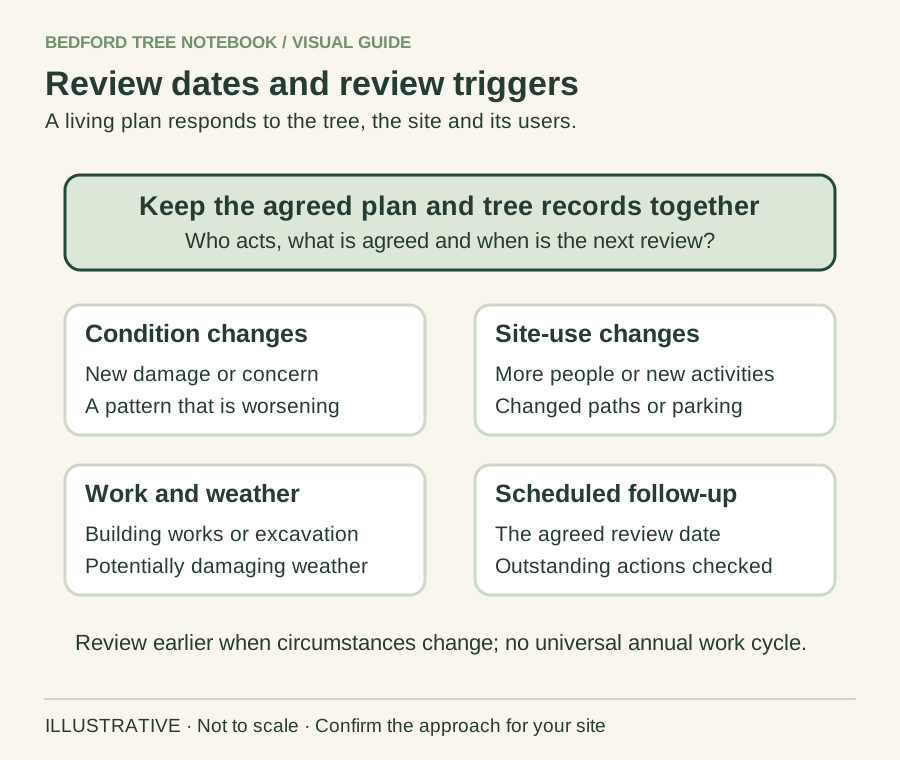
- Record responsibility for reporting concerns, decisions and completing actions.
- Agree review timing proportionate to the site and competent advice.
- Bring a review forward when relevant conditions change rather than waiting for a calendar date.
Background sources: National Tree Safety Group guidance
Give the plan a clear purpose
Write down what the plan should help you decide. It might coordinate a garden project, retain established trees, organise advice after a purchase or make responsibility clearer between household members. Explain those aims to the professional rather than commissioning an unspecified survey and hoping it will answer everything.
The consultant and contractor comparison helps distinguish management advice from a work quotation. Ask what output is appropriate for the property, who will use it and how it should be reviewed. A useful plan matches the commission to the decisions required; an impressive document can still be unhelpful if it describes a different question from the one the owner needs answered.
Create a simple tree register
Give relevant trees and hedge sections consistent labels, with a plan or photographs connecting each label to a fixed site feature. Include known species and planting dates where reliable, but mark uncertainty instead of inventing details. Keep the register proportionate to the property and its use.
Read tree-location plans for identifiers and context. The record should let another person connect a report, permission and work item with the same tree. Avoid relying solely on descriptions such as “the tall one” that can change after pruning or become unclear if nearby growth is removed. Retain earlier labels where possible so history is not lost when a new adviser visits.
Gather the history without overstating it
Bring together assessment reports, planning decisions, work specifications, planting instructions and dated observations. Distinguish a formal finding from a remembered conversation or an old quotation. Record who produced each document and what service it covered.
Our permission-records guide explains the authority paperwork, while payment and job records covers the commercial trail. A note that a tree was checked should not become a guarantee about future condition. Keep limitations and outstanding recommendations visible. If documents are missing, identify that gap in the plan so the next adviser knows what has not been established rather than assuming the absence of a record means nothing happened.
Match management to the site and its use
Describe where people normally spend time, nearby structures, public access and any significant changes planned for the garden. A new seating area, building or route can change the context in which a tree is considered. Tell the adviser about occasional use as well as daily routines.
The National Tree Safety Group guidance supports a balanced, proportionate approach. It does not justify assigning every domestic tree an identical annual professional-survey requirement. Ask what observations, assessments and review triggers are appropriate for the actual property. Keep the reasoning understandable so a later owner does not mistake one site-specific recommendation for a rule that applies to every tree.
Separate observation, assessment and work
The household can report what it notices from safe ground without being expected to diagnose defects or design pruning. A professional assessment considers the relevant question, while the work scope describes the operation subsequently authorised. Keep those stages linked but distinct.
Our cracks-and-cavities guide shows why an observation is not automatically a removal decision. If monitoring is recommended, ask who does what and which changes should prompt earlier advice. Avoid creating a routine where trees are cut simply because another year has passed. A maintenance decision should have a clear objective and a suitable specification, not just a recurring date inherited from an old invoice.
Keep tree controls with the relevant operation
Record known TPOs, conservation-area checks and tree-related planning conditions, identifying the source and date. Check the position again when a new operation is proposed rather than assuming an old decision authorises anything in the future. Ownership and entry to neighbouring land also need their own consideration.
Use Bedford TPO checks and changing an approved proposal for those records. Wildlife matters should be raised before work is booked, not filed as an annual calendar assumption. The plan should make responsibilities visible: who checks, who applies or notifies where needed and which final documents the work team will use.
Budget by scope and dependency
List proposed actions with their purpose and what needs to happen first. A planting decision may follow a separate stump and ground-preparation project; a tree assessment may need to inform plans for an extension. Distinguish agreed work from options still under discussion.
Our tree-work quotation checklist and quotes versus estimates guide help turn each phase into a clear commercial brief. Do not invent a fixed future budget by multiplying a generic pruning price. Ask for current, site-specific proposals when the scope is ready, and clarify how changes are approved. Keep urgency advice separate from a household preference to spread routine expenditure across seasons.
Include young trees and future planting
A management record should include aftercare as well as work on established trees. Record who waters new planting, reviews supports and follows supplier instructions. A young specimen can otherwise disappear from attention because the larger tree operation feels complete.
Use first-summer care, mulching and stakes and ties to coordinate those tasks. For replacement planting, consider mature size, location and site constraints before choosing the tree. The plan should describe the intended future garden as well as current concerns, allowing retention and replacement decisions to complement one another rather than treating new planting as an afterthought.
Make reviews and handovers practical
Assign each outstanding action to someone and keep the current version easy to find. Record changes after work, new advice or a significant alteration to the site. If an assessment recommends a review, retain its purpose, timing and triggers rather than only the calendar reminder.
Our end-of-visit checklist helps close individual jobs without losing follow-up. Before a sale, tenancy change or new management arrangement, prepare a concise handover linked to original documents. The next person should be able to identify the trees, understand what was done and see what remains. A usable plan supports informed decisions over time while making clear that trees and circumstances can change.
Your next step
Build an accessible record around tree identifiers, competent advice and specific actions. Keep checks, permissions, work and follow-up connected without prescribing unnecessary routine cutting. Start with the Bedford checklist, then ask the appropriate professional to help turn the property’s actual needs into a proportionate, understandable plan.
Turn the advice into a useful project brief.
Start with the postcode, the work you have in mind and any access considerations.
Prepare your enquiryNo obligation. A site assessment may be needed to confirm the work and price.
Sources & further reading
- National Tree Safety Group: common sense risk management, 2024 summary
- GOV.UK: Tree Preservation Orders and conservation areas
- Bedford Borough Council: protected trees
Sources checked 31 October 2026. How we prepare guidance.