
In this guide Show sections
General guidance, not a professional assessment. Confirm site-specific advice and current requirements before work.
Planning tree work in Bedford or nearby?
Start with the postcode, the work you have in mind and any access considerations.
Prepare your enquiryNo obligation. A site assessment may be needed to confirm the work and price.
Before you make arrangements
If a feature appears to be changing or the tree has moved, keep clear and seek appropriate advice promptly. Do not climb, probe an opening or attempt to pull parts apart. Start with the signs that need assessment and explain what is new, what is longstanding and what you cannot safely see.
Describe the feature without naming a diagnosis
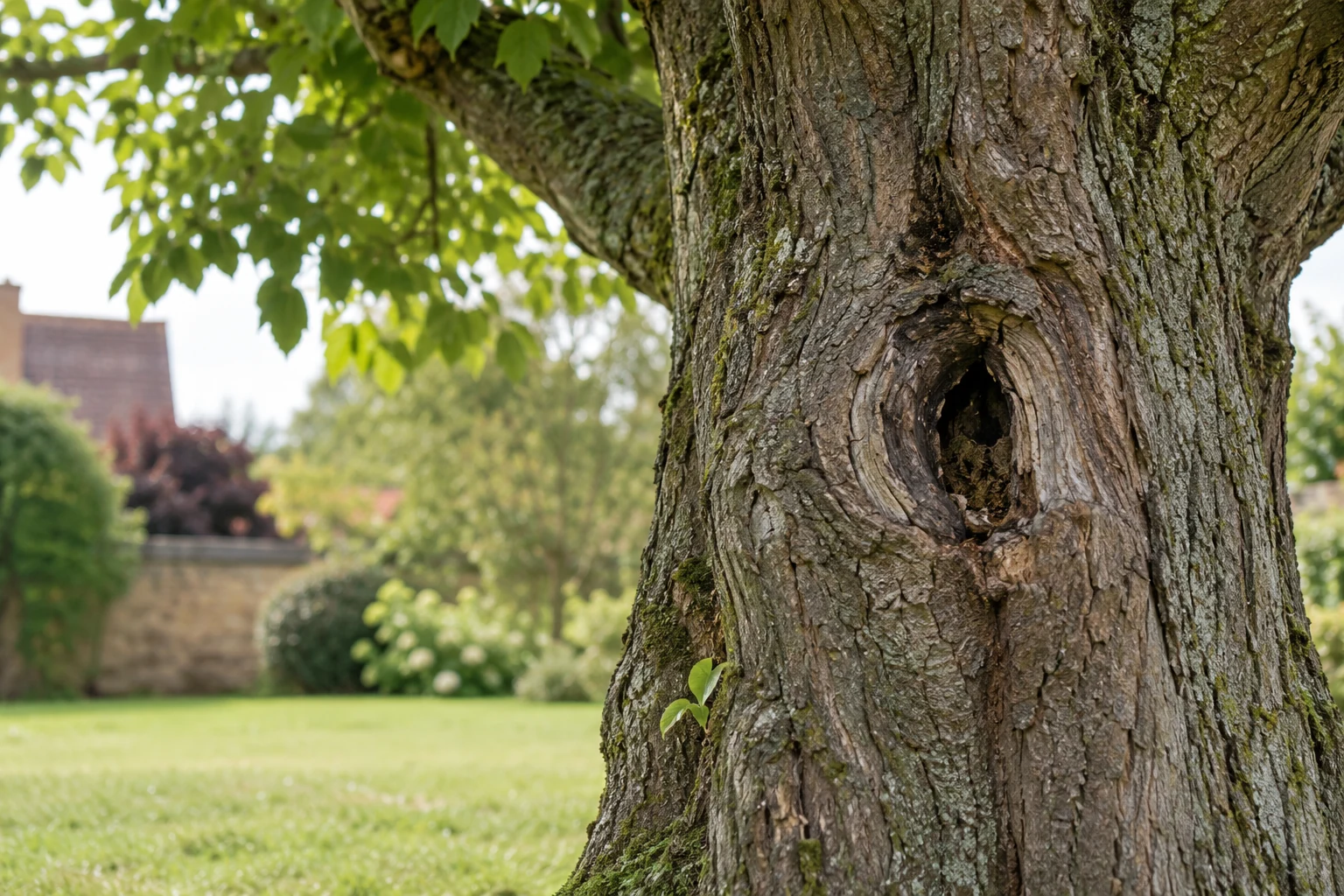
Use plain observations: an opening at the base, a vertical line on the stem, bark separating near a branch union or a hollow visible from the path. If you are not sure whether something is bark texture or a crack, say so. The professional can decide which features need closer inspection.
Avoid labels such as “rotten through” unless that is the documented finding of an appropriate assessment. The difference matters when asking for advice, notifying an owner or approaching the council. An accurate first description leaves room for investigation; a dramatic conclusion can push the conversation towards work before the underlying question has been considered.
Explain what has changed
Record when you first noticed the feature and whether you have a comparable earlier photograph. A fresh change following strong wind is different information from discovering a cavity that may have existed for years. Do not create repeat photographs by approaching a tree that appears unstable.
If a branch has fallen, describe where it came from only if that is clear from a safe position. Do not handle lodged material or enter beneath it to confirm your theory. Our storm-damage guide covers how to organise the initial response and distinguish immediate concerns from the later assessment and clean-up brief.
Do not equate a hollow with a simple answer
A cavity is a feature for competent assessment, not a homeowner’s test for automatic removal or guaranteed retention. The assessor considers the particular tree, the position and nature of the feature and the consequences of failure in that setting. An attractive leafy crown does not settle a structural question either.
Ask the professional to explain what can be concluded from the initial visit and where uncertainty remains. The RHS discussion of bracket fungi is useful background on decay, but neither a web guide nor a resemblance to another tree can determine your specimen’s condition. Keep identification, structural assessment and recommended management distinct.
Protect potential wildlife features
Openings and splits can also be relevant to wildlife. Do not put a hand, torch, camera, tool or expanding filler into a cavity to investigate it. Mention the feature when arranging the visit so the professional can consider whether additional ecological advice is needed.
Read our suspected bat-features guide alongside the Natural England bat-protection guidance. A cavity does not prove bats are present, but absence of a sighting is not a homeowner’s clearance for intrusive work. Explain any proposed branch or stem operation before it is booked, rather than raising the cavity after a team has arrived to cut.
Commission an answer to the actual concern
Decide whether you need an independent assessment, a management recommendation or a price for already specified work. Tell the business if the concern comes from a house purchase, neighbour’s observation, insurer’s request or change you have personally noticed. Provide any earlier tree reports in full.
Our tree consultant or contractor guide helps define the commission. Ask what qualifications and experience are relevant to the assessment being offered, whether a written report is included and what its limitations will be. An informal glance during an unrelated hedge visit should not quietly become the only record used for a significant property decision.
Supply context without entering the hazard
Describe nearby buildings, paths, seating, parking and public access. Say whether the area is normally busy and whether another person owns or manages the tree. A plan or labelled wide photograph can connect the concern with the correct tree when a site contains several mature specimens.
Our tree-location plan guide explains tree identifiers and site features. You do not need to produce a survey yourself. If the base is obscured or access is unsafe, record that limitation and let the professional decide how to proceed. Never use a ladder or climb a wall to obtain a more complete view.
Ask about investigation limits and outcomes
If further investigation is suggested, ask what question it is intended to answer, why the method is appropriate and how its findings will be interpreted. Equipment or a technical-sounding test does not remove the need for a reasoned explanation of the result and its practical consequences.
Request recommendations that identify the tree and distinguish actions from observations. If retention with monitoring is proposed, clarify the review arrangements and changes that should prompt earlier contact. If pruning or removal is proposed, ask how it addresses the assessed concern. Do not assume a generic crown reduction is an answer to every crack, cavity or concern about failure.
Keep permissions separate from the assessment
Before instructing work, check tree-protection controls and any wildlife requirements for the exact operation. Use Bedford tree-protection checks as a starting point and establish the correct authority for the property. An assessor’s recommendation and a planning decision serve different purposes.
If a business describes the situation as urgent, ask what reporting or evidence is required rather than assuming that any visible crack creates an exemption. Retain dated records where it is safe and appropriate to obtain them. Where ownership or access is disputed, seek the relevant advice before entering another garden or directing work to someone else’s tree.
Make the written instruction unambiguous
Once the assessment is available, compare the proposed job with its findings. Identify the tree, agreed operation, permission responsibilities and any retained features. Ask who will communicate limitations to the team actually undertaking the work, especially where a separate consultant has produced the recommendation.
If the plan changes after another inspection, obtain the revised advice and work scope before proceeding. Save the superseded version as part of the history, but make clear which instruction is current. At completion, discuss any remaining questions or review recommendations rather than treating the removal of a visible feature as proof that no future management will be needed.
Your next step
Write down what you can safely observe and ask a competent professional to assess its significance. Leave cavities and suspected cracks undisturbed. If the advice leads to work, agree a written specification and the relevant controls before booking; the quotation checklist helps record that handover clearly.
Turn the advice into a useful project brief.
Start with the postcode, the work you have in mind and any access considerations.
Prepare your enquiryNo obligation. A site assessment may be needed to confirm the work and price.
Sources & further reading
- RHS: bracket fungi
- Natural England: bats, protection and licences
- Bedford Borough Council: protected trees
- GOV.UK: TPOs and trees in conservation areas
Sources checked 31 October 2026. How we prepare guidance.