
In this guide Show sections
General guidance, not a professional assessment. Confirm site-specific advice and current requirements before work.
Planning tree work in Bedford or nearby?
Start with the postcode, the work you have in mind and any access considerations.
Prepare your enquiryNo obligation. A site assessment may be needed to confirm the work and price.
Before you make arrangements
Keep people and pets away from the affected area without entering it yourself. If there is an immediate threat to life, use the emergency services; contact the relevant network operator where utilities may be involved. Do not touch a tree, branch or fence that may be in contact with a line. Make observations only from somewhere already safe.
After a storm: safe records first
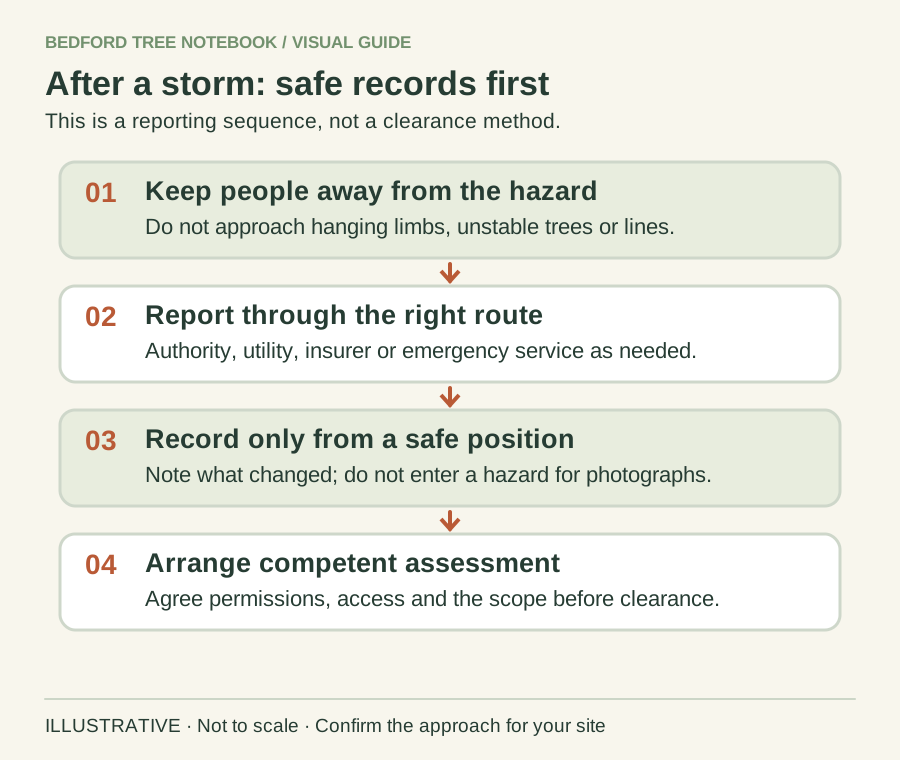
- Do not cut, climb on or try to move storm-damaged timber.
- Falling across a boundary does not by itself establish liability or permission to enter.
- This website is not emergency dispatch; use the relevant urgent reporting route where needed.
Background sources: GOV.UK guidance · Bedford Borough Council guidance
Describe what changed without approaching it
Useful information includes whether a tree has developed a new lean, whether a branch is hanging, whether the ground around the base appears disturbed and what lies nearby. You do not need to inspect every feature to request help. If the view is limited, say so rather than moving closer to improve the description.
Our leaning-tree guide explains why a change matters differently from a longstanding shape. Avoid climbing, standing beneath branches or moving material to inspect the trunk. A normal-looking section of a photograph cannot establish the condition of the rest of the tree. Tell the professional when you first noticed the change and what weather preceded it.
Identify who should receive the report
A private garden tree, council-managed tree and tree beside a road may require different contact routes. Establish the location as precisely as you safely can: address, nearby landmark and which side of a route is affected. Do not assume ownership from where a branch has fallen or where the canopy extends.
The Bedford council-tree reporting guide helps distinguish local reporting routes. If the affected tree is outside Bedford Borough, contact the authority responsible for the actual location. A contractor quotation request should not replace reporting an immediate public hazard to the appropriate organisation. Let the receiving organisation advise on the next step within its role.
Explain overhead lines and public access first
Tell the person taking the report about lines, roads, pavements, footpaths, buildings and occupied areas near the damage. These details can affect which specialists need to be involved and how the area is managed. Do not assume a cable is safe because it appears thin or because the tree has stopped moving.
Our overhead-cables guide explains what to communicate, without giving clearance distances or a work method. If a public route is affected, do not attempt an improvised tree-clearance operation. Contact the appropriate authority or network operator and follow their instructions. Keep access information factual, especially where you cannot see the full extent of damage.
Use competent assessment rather than a tidy-up assumption
Storm-damaged wood can be unstable or under forces that are not obvious. The HSE tree-work guidance makes competence and safe planning central to the work. A homeowner should not begin sawing or pulling branches apart merely to make the site easier for a contractor to assess.
Ask the professional what assessment and practical operations are proposed, and explain any limits on access. Our choosing a tree surgeon guide helps with identity, competence and insurance checks. An urgent need for advice is not a reason to abandon those checks or accept an undefined instruction to remove everything in the garden.
Keep insurers and property records informed
If the storm has damaged buildings, fences, vehicles or other insured property, contact the relevant insurer and ask what evidence and authorisation they need. Record the incident from a safe place and preserve existing reports or maintenance records. Do not put yourself at risk to obtain a photograph for a claim.
Ask who is responsible for arranging tree work, building repairs and any separate assessment. These may be different jobs. If the tree is on neighbouring land, keep communication factual and use the insurer or appropriate legal adviser where responsibility is disputed. The fallen-boundary-tree guide explains useful records without assuming that the direction of a fall establishes liability.
Check tree controls rather than assuming a blanket exemption
Storm damage does not automatically authorise every operation someone might prefer. For a protected tree or conservation-area location, ask the relevant council and professional about the actual circumstances, evidence and notification or application requirements. Avoid treating the word “dangerous” as a substitute for an assessed explanation.
Our dangerous-tree permission guide addresses that distinction. Keep photographs and professional findings where they can be obtained safely. A genuinely urgent situation needs the appropriate urgent response, but an additional request to remove an undamaged neighbouring tree is a separate proposal. Make sure the records distinguish immediate necessary action from wider elective work.
Agree what happens after the initial response
A first visit may address an immediate issue without completing all tree management or site reinstatement. Ask what has been made safe, which restrictions remain and whether further assessment is recommended. Do not infer a permanent safety guarantee from the fact that a contractor has left the site.
If later work is proposed, obtain a clear specification and price. Our tree-work quotation checklist helps separate the tree operation, timber handling, stump work and clearing. Where buildings or services have also been affected, ask who releases those areas for normal use. A cleared lawn and an assessed tree are not automatically the same outcome.
Keep the follow-up proportionate and documented
Once the immediate situation has been managed, gather the reports, photographs, permissions, instructions and invoices into a short incident record. Note any recommendations for further review and who will arrange them. If a retained tree is to be monitored, ask the professional what changes should prompt further contact.
Do not assume that every tree in the garden requires removal after one storm. Equally, do not dismiss a later change because a previous visit found no need for work at that time. The tree assessment signs guide can help describe observations, while the actual management advice should reflect the trees, site use and findings of the competent professional.
Make access instructions realistic
When arranging attendance, explain whether the professional can reach the site without passing beneath the affected tree or near a damaged structure. If you do not know, say so. Do not clear a route through fallen material or unlock a gate inside the hazard area just because access would otherwise be inconvenient.
Provide a contact number and any safe alternative meeting point. If conditions change before the visit, update the professional rather than relying on yesterday's photographs. A sensible attendance plan allows the team to assess the actual scene; it should not depend on a homeowner taking risks to prepare it.
Your next step
Keep clear and use the appropriate urgent reporting route where required. For planned follow-up, give the professional a precise location, a safe description of the change and relevant utility or public-access information. Check identity, competence, permissions and the written scope. Treat emergency response, later tree management and property repairs as connected tasks with clearly assigned responsibilities.
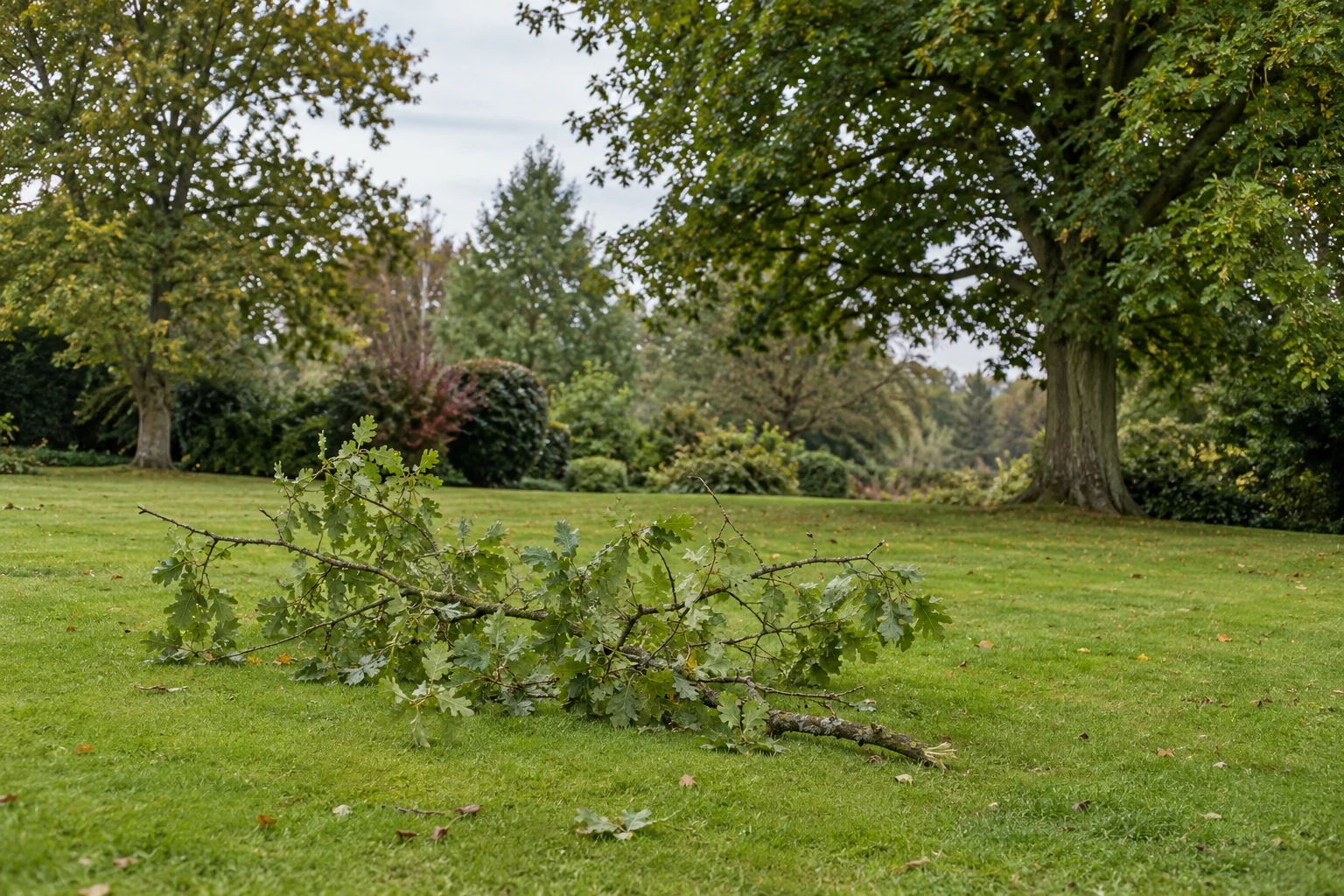
A broken branch caught in the crown needs a safe reporting and assessment approach rather than an attempt to pull it down.
Turn the advice into a useful project brief.
Start with the postcode, the work you have in mind and any access considerations.
Prepare your enquiryNo obligation. A site assessment may be needed to confirm the work and price.
Sources & further reading
- HSE: tree-work safety
- GOV.UK: Tree Preservation Orders and trees in conservation areas
- Bedford Borough Council: protected trees
- Forestry Commission: responding to extreme weather
- Bedford Borough Council: report a tree problem
- HSE: tree work safety topics
Sources checked 31 October 2026. How we prepare guidance.