
In this guide Show sections
General guidance, not a professional assessment. Confirm site-specific advice and current requirements before work.
Planning tree work in Bedford or nearby?
Start with the postcode, the work you have in mind and any access considerations.
Prepare your enquiryNo obligation. A site assessment may be needed to confirm the work and price.
Before you make arrangements
Keep away from unstable material and any possible contact with cables. Where there is an immediate threat to life, use the emergency services; public-route or utility hazards need the appropriate authority or network operator. Do not begin cutting, dragging or lifting the tree to establish which side of a fence it came from.
After a storm: safe records first
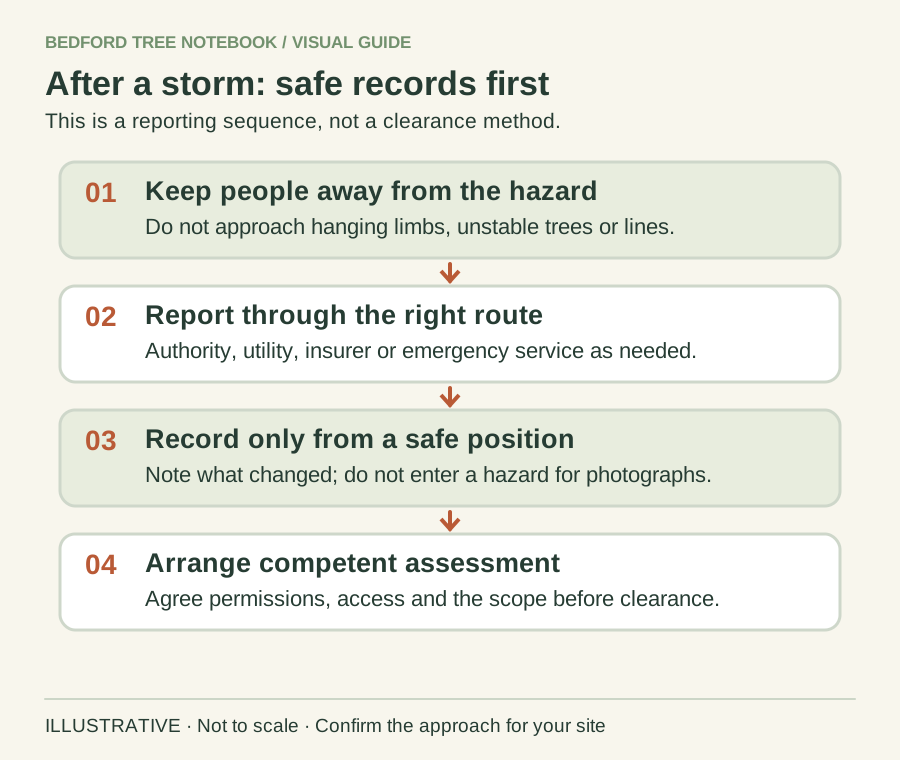
- Do not cut, climb on or try to move storm-damaged timber.
- Falling across a boundary does not by itself establish liability or permission to enter.
- This website is not emergency dispatch; use the relevant urgent reporting route where needed.
Background sources: GOV.UK guidance · Bedford Borough Council guidance
Separate the immediate hazard from the later dispute
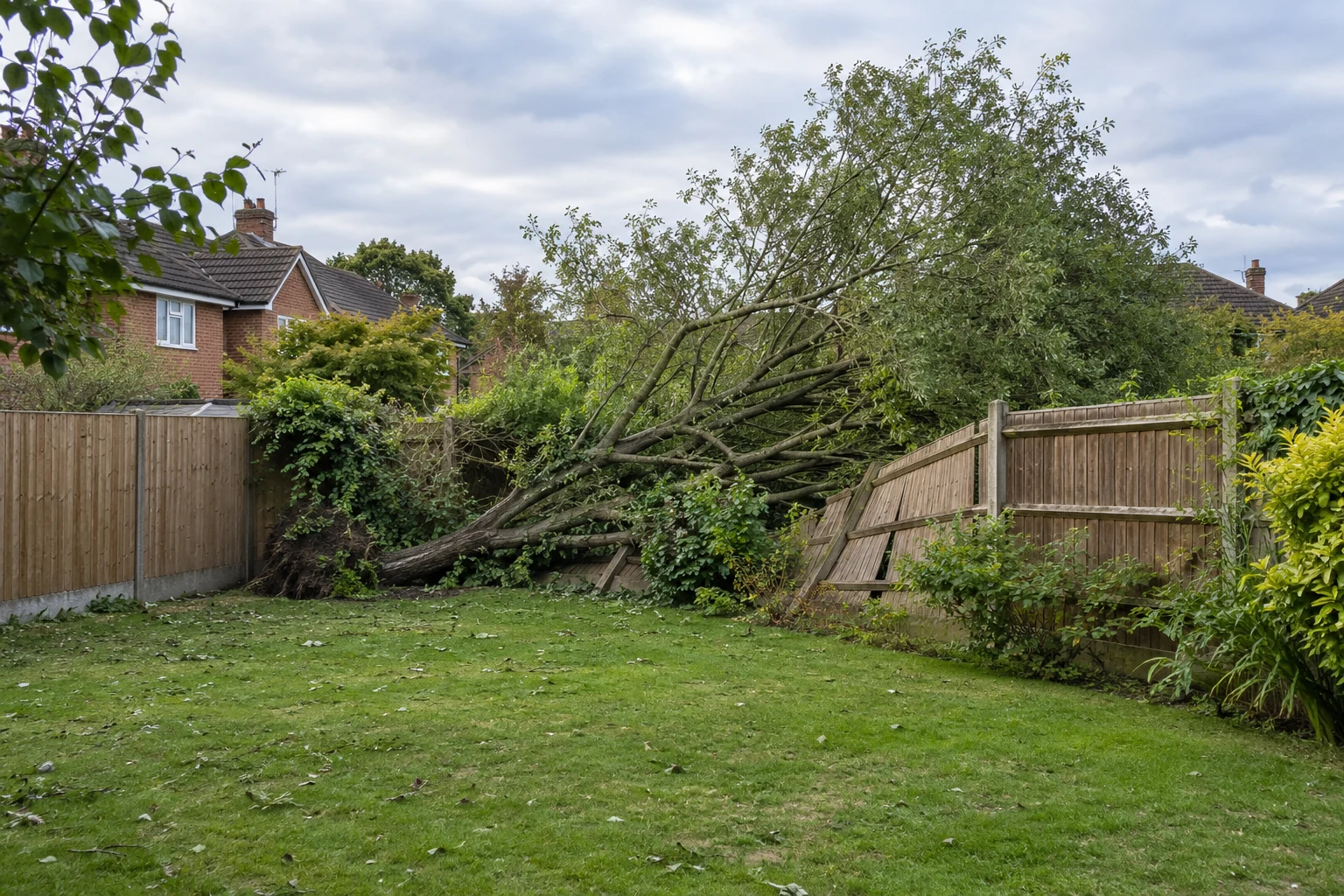
The first question is whether people can remain clear of the affected area. A tree lying on the ground may still have unstable branches, tensioned wood or an uncertain root plate. Do not treat it as safe merely because it is no longer standing upright.
Our storm-damaged-tree guide explains how to describe the scene and arrange competent help. Report any road, pavement or public-footpath obstruction through the correct route. Questions about payment or ownership still matter, but they should not lead a homeowner to enter a hazardous area or attempt an improvised clearance operation while responsibility is being discussed.
Record location and damage from a safe position
If it is safe to do so, record the date, approximate time you became aware of the incident and the affected properties. Take only photographs available from a safe, accessible place. A wide view can show the relationship between the tree, fence and buildings; close detail is not worth approaching unstable material.
Keep factual observations distinct from assumptions. Write “fence panel damaged beside the rear corner” rather than “the neighbour's neglected tree destroyed our fence” unless an appropriate investigation has established those matters. Existing photographs of the garden may also help explain the previous layout. Do not move important evidence solely to obtain a clearer image.
Confirm ownership rather than relying on the fall direction
Where the trunk stood before the incident may be relevant, but a damaged fence is not necessarily a precise legal boundary marker. If ownership is uncertain, ask your conveyancer or another appropriate adviser about the title information and actual circumstances. Do not assume that where the canopy landed determines ownership or liability.
The shared-boundary tree-work guide helps identify questions for the discussion. If the tree stood on public land or another organisation's property, record that possibility and contact the relevant owner or authority. Keep the enquiry neutral while the facts are checked. A quick sketch can assist communication but cannot settle a disputed boundary.
Contact insurers before agreeing substantial clearance or repairs
Tell the relevant insurer about damage and ask what reporting, evidence and authorisation process applies. If neighbours have separate policies, each should obtain advice about their own circumstances. Keep claim references and the names of the people handling the matter.
Ask which operations may be arranged, who will instruct them and what documents are needed. Do not promise reimbursement or accept a demand for payment without appropriate advice. The fact that one person obtains a contractor's quotation does not itself establish who is legally responsible for the cost. Urgent safety action and the later allocation of costs should be recorded distinctly so neither is mistaken for an admission about liability.
Agree access and the practical work scope
A contractor may need access from both properties or from a shared route. Establish who can authorise each part of that access and communicate restrictions, pets, locked gates and fragile structures. Do not enter a neighbour's garden because the tree crossed the fence or because your preferred contractor would find that route easier.
Our narrow-access guide helps describe the whole route. A written scope should identify which tree material is being handled, what is being retained and what happens to debris. Boundary repairs, stump treatment and ground reinstatement may need separate arrangements rather than being assumed within an emergency clearance price.
Check controls and evidence for the actual operations
If the tree was protected or stood within a conservation area, ask the council and competent professional about the actual work and any relevant evidence or requirements. A fallen or damaged tree should not be used as a reason to undertake unrelated pruning or remove another tree without the necessary checks.
Our dangerous-tree permission guide explains why the circumstances and proposed operations matter. Government guidance on tree protection provides background, but does not decide the incident. Keep professional findings and safely obtained photographs with the record rather than assuming an exemption can be established later from a vague description.
Preserve records of earlier concerns without rewriting them
Locate any previous tree reports, correspondence, work records or reports of a change in condition. Supply the originals to the adviser or insurer where requested. Do not edit earlier messages to make them appear more definite than they were, and do not invent a maintenance history that the paperwork cannot support.
A previous inspection does not automatically prove either that the tree was safe indefinitely or that someone was negligent. Those are conclusions for appropriate assessment and advice. Our tree-permission records guide suggests a useful filing approach. Keep observations, professional opinions and commercial documents clearly labelled so the sequence can be understood by someone new to the matter.
Plan a documented handover between clearance and repair
At the end of the agreed tree work, ask what remains and which areas have been released for ordinary access. Record retained timber, remaining stump material, damaged surfaces and any follow-up recommendations. Do not assume that fence or building repairs can begin simply because visible branches have been removed.
Use the end-of-visit checklist to compare the contractor's scope with the result. Then agree the separate repair responsibilities through the appropriate insurers, owners and contractors. If the incident has damaged a retained tree as well, ask whether further assessment is recommended. Keep outstanding tasks visible rather than closing the record after the first invoice is paid.
Use a shared factual incident note
Where communication with neighbours is possible, a short factual note can reduce confusion: incident date, affected locations, reports made and professionals appointed. Each person can retain their own records without agreeing to a conclusion about responsibility. Keep any disagreement clearly identified rather than disguising it as an accepted fact.
If one neighbour will be absent, agree how access requests and updates will be handled. Avoid circulating sensitive insurance or personal information more widely than needed. The note is a coordination tool, not a settlement agreement. Obtain appropriate advice before accepting terms about payment, liability or the final division of repair work.
Your next step
Keep people clear, document the scene only from safe positions and contact the relevant owner, insurer or authority. Obtain competent tree-work advice and agree access before practical operations. Preserve the record without assuming fault. If ownership, liability or payment is disputed, seek advice on the actual circumstances rather than relying on a general garden article or the direction in which the tree fell.
Turn the advice into a useful project brief.
Start with the postcode, the work you have in mind and any access considerations.
Prepare your enquiryNo obligation. A site assessment may be needed to confirm the work and price.
Sources & further reading
- HSE: tree-work safety
- GOV.UK: Tree Preservation Orders and trees in conservation areas
- Bedford Borough Council: protected trees
Sources checked 31 October 2026. How we prepare guidance.