
In this guide Show sections
General guidance, not a professional assessment. Confirm site-specific advice and current requirements before work.
Planning tree work in Bedford or nearby?
Start with the postcode, the work you have in mind and any access considerations.
Prepare your enquiryNo obligation. A site assessment may be needed to confirm the work and price.
Before you arrange the work
Identify the tree and the boundary on a simple sketch. Record which land the trunk appears to stand on, but do not treat a garden fence or online image as a definitive title assessment. Seek appropriate advice if ownership is disputed.
A canopy is not a boundary
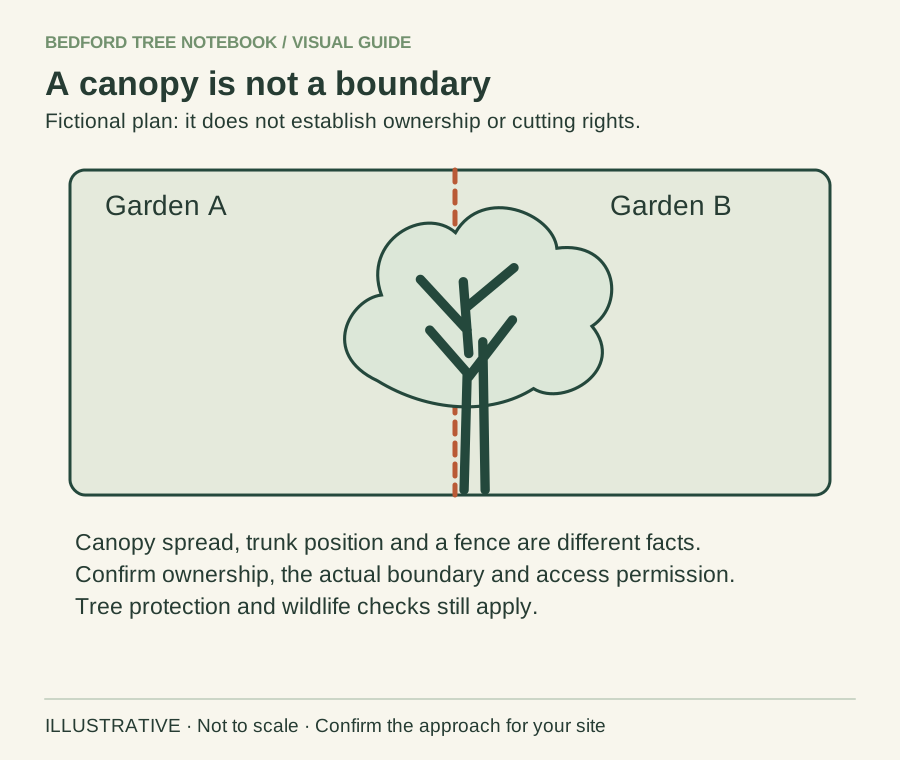
- Do not assume a fence precisely marks the legal boundary.
- Discuss proposed work with the owner.
- A diagram cannot establish a right to cut or enter land.
Describe the result without promising a right
Explain whether the issue is overhang, shade, access or routine maintenance. Avoid commissioning work on another person’s tree on the strength of an informal assumption. Our overhanging-neighbour-tree guide is a useful starting point for questions to resolve.
Tree protection and wildlife requirements remain separate checks. A neighbour’s agreement does not replace any required council process, and a council decision does not settle ownership.
Agree the practical arrangements
If the contractor needs to enter another garden, agree the route and timing with the person able to authorise it. Cover gates, pets, parked vehicles, delicate planting and how debris will leave. Put important arrangements in writing and give the contractor a copy.
Use parking and shared access where several homes depend on one drive. Do not assume that keeping one gate open means the entire work area is available.
Keep the specification specific
Identify which tree or hedge faces will be worked on and what remains untouched. Ask how the business will handle an unexpected disagreement or a request to add work during the visit. A changed instruction should be checked and agreed, rather than passed casually across the fence.
For a hedge containing different species or ownership sections, our mixed boundary hedge guide helps structure the brief. Avoid promising that a uniform cut is suitable along the whole boundary.
Identify who is commissioning each part
Write down who is asking for the work, who owns or controls the tree and who can agree access. Those roles may belong to different people. A shared interest in a tidier boundary is not the same as a joint authority to commission every operation. If a management company, landlord or another representative is involved, ask what evidence the contractor needs before treating an instruction as authorised.
Keep cost-sharing arrangements separate from the tree-work specification. If neighbours agree to split a bill, confirm who contracts with the business and how payment will be handled. The contractor should not be left to settle a private disagreement about contributions after the job. Our payments and written records guide helps organise that conversation. If agreement is incomplete, identify the disputed part instead of presenting the entire boundary as available for work. The purpose is to give the business a reliable brief, not to use a quotation as evidence that a boundary claim is correct.
Define access in everyday detail
An access agreement should identify the route, working date or agreed window, gates and any limits on where equipment or material may go. Explain whether occupants need to remain able to use a side passage. Mention pets, delicate planting, parked cars and anything another household needs to move before arrival.
Do not assume a neighbour can take responsibility for professional site controls; any role must be appropriately assessed and agreed by the contractor. Ask the business how the working area will be managed and how changes will be communicated. If one route becomes unavailable, tell everyone involved promptly; do not assume the team can use another part of the neighbouring garden. The shared parking guide helps where the route starts in a drive used by several homes. Keep contact details limited to the people who need to coordinate access and share them only for that practical purpose.
Use a neutral specification for the boundary
Describe the actual tree or hedge section and the result sought. References such as “the tree nearest the rear gate” work better when matched to a marked photograph. Avoid describing an entire line of planting as one owner’s hedge where ownership changes along it or has not been established.
A neutral brief can still explain the problem clearly: a branch restricts a path, a hedge face has grown beyond the intended width or work requires access from both sides. Ask the professional what operation is appropriate rather than instructing a cut to an assumed property line. The mixed-hedge guide covers why several species may need different treatment. Once the scope is agreed, circulate the same version to the people whose authorisation or access is required. A small marked sketch is often more useful than several separate verbal descriptions that disagree about which section will be touched.
A hypothetical disagreement before arrival
Suppose two neighbours agree that a hedge needs attention, but one expects a light trim and the other expects a substantial height reduction. A contractor’s quotation based on only one conversation could arrive at the site with an operation the other household never agreed to.
The useful response is to make the proposed scope visible before booking: identify the faces and top included, describe the intended dimensions where appropriate and record the access needed. If the neighbours cannot agree, tell the business which part remains uncertain. Do not ask the team to negotiate a changed operation while equipment is set up. This example concerns communication and project scope; it does not determine ownership or either neighbour’s legal rights. A boundary or legal dispute may require separate advice. The tree contractor’s task is to assess and deliver authorised work, not to provide an informal ruling simply because its staff are on site.
Plan clearing and the completion conversation
Agree where branches, logs and other material will be placed and which route will be used to remove them. If one garden receives the arisings, record that arrangement rather than assuming the person who requested the work will handle everything. Ask who will check gates, surfaces and planting once the team says access is safe.
Keep the completion conversation tied to the written scope. If someone asks for extra work during the visit, the business should check authorisation, suitability and any relevant controls before changing the plan. A verbal request from a person watching across a fence should not silently replace the agreed instruction. Retain the final scope, important access messages and invoice together. If there is a concern afterwards, describe the specific operation or surface involved and raise it promptly with the business. That produces a clearer record than mixing a workmanship question with an older disagreement about the boundary.
Your next step
Choose a date once authorisation, access and the written scope are clear. Keep conversations factual and focused on the proposed job; a contractor’s site visit is not a way to decide a boundary dispute.
If the garden is rented, first resolve who can commission the work using tree work at a rented Bedford property.
If a tree has already fallen across the boundary, use recording a fallen-tree incident before making assumptions about ownership, liability or clearance.
Turn the advice into a useful project brief.
Start with the postcode, the work you have in mind and any access considerations.
Prepare your enquiryNo obligation. A site assessment may be needed to confirm the work and price.
Sources & further reading
- GOV.UK: Tree Preservation Orders and conservation areas
- Citizens Advice: before you get home improvements done
Sources checked 31 October 2026. How we prepare guidance.