
In this guide Show sections
General guidance, not a professional assessment. Confirm site-specific advice and current requirements before work.
Planning tree work in Bedford or nearby?
Start with the postcode, the work you have in mind and any access considerations.
Prepare your enquiryNo obligation. A site assessment may be needed to confirm the work and price.
What to check
Check protection controls before any work. The effect of pruning, ownership of cut material and possible disputes need care; obtain advice if agreement is difficult.
A canopy is not a boundary
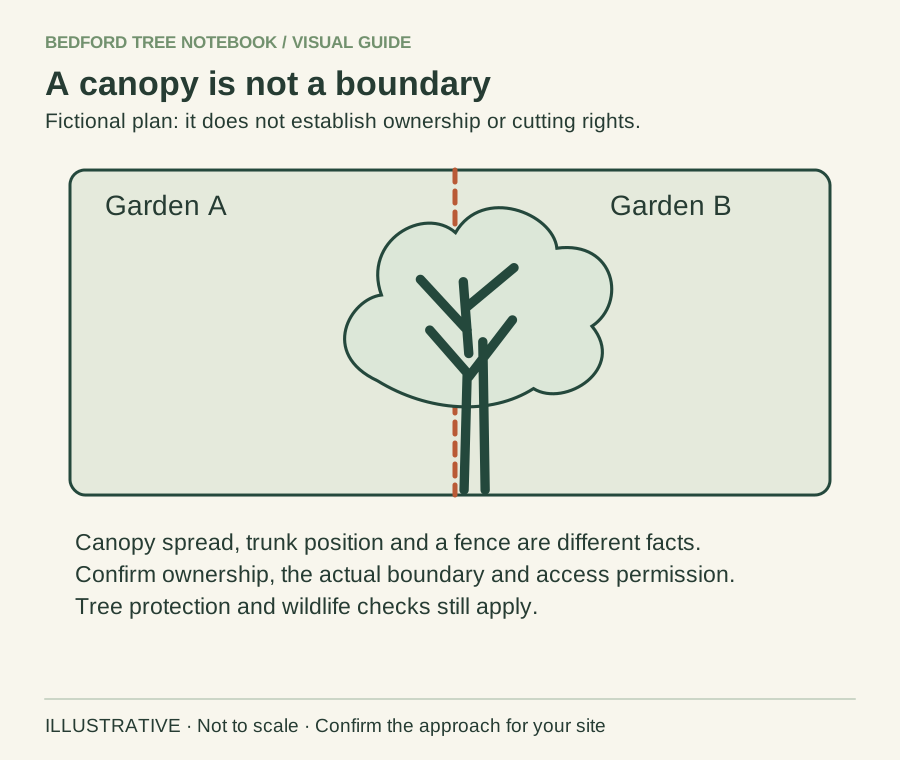
- Do not assume a fence precisely marks the legal boundary.
- Discuss proposed work with the owner.
- A diagram cannot establish a right to cut or enter land.
Begin with a conversation
Explain the practical problem, such as a branch obstructing a route, and ask whether the owner will discuss a professional solution. A shared description of the issue is more useful than starting with an instruction to remove the tree. Keep the discussion separate from any unresolved boundary dispute.
Agree access and the intended work
If a contractor needs to enter neighbouring land, secure an appropriate agreement first. Mark the relevant branches in a safe photograph if that helps everyone understand the proposal. Avoid suggesting that the photograph itself settles the boundary or the legality of pruning.
Think about the tree as a whole
Cutting to a line may have consequences for the tree that are not apparent from the ground. Ask a competent arborist about suitability and potential harm. Protection controls still need checking. Where there is a dispute or a significant legal uncertainty, obtain advice appropriate to the facts.
Keep the arrangement clear
Record who commissions and pays for the work, the agreed access and how the cut material will be dealt with. Give the contractor a consistent written scope. Do not allow a referral enquiry to imply that the neighbour has consented when they have not.
Separate the practical problem from the disagreement
Try to describe the issue in terms that another person can recognise: a branch obstructs a garden route, foliage touches a structure or a hedge prevents an agreed access arrangement. Avoid beginning with claims about the neighbour's intentions or a demand for the whole tree to be removed. A precise description makes it easier to discuss a proportionate professional recommendation even where relations are already strained.
Our shared garden boundary guide helps organise the practical questions. Keep ownership, the boundary position, access and the work specification separate. Agreement on one does not automatically settle the others. If a genuine legal dispute remains, obtain advice appropriate to the documents and facts. A tree contractor can explain a proposed operation, but its willingness to quote should not be used as evidence that a disputed right has been established.
Understand the limit of general guidance
National guidance describes trimming branches or roots that cross a boundary, but the application of rights and restrictions to a particular situation can require advice. Protection controls, potential harm, ownership questions and the extent of any proposed operation all matter. Do not reduce the question to a slogan that anything crossing a fence can simply be cut. A fence's location may itself be disputed or differ from the legal boundary.
Use checking a TPO in Bedford before commissioning work to a potentially protected tree. Ask a competent arborist whether the intended pruning is suitable and explain any restrictions on access. Do not enter the owner's land, lean into it to work or assume a right to use it for equipment. Where the intended approach depends on cooperation, settle that arrangement explicitly rather than allowing a broad legal assumption to replace practical permission.
Hypothetical example: clearance beside a garden entrance
Imagine a branch overhangs a side path and the homeowner wants easier access. An initial demand to 'cut everything back to the fence' may not explain which clearance is needed or whether the proposed cuts are suitable. A more useful conversation identifies the route, its users and the affected branch, then asks a professional to describe a workable operation. The owner can consider a defined proposal rather than an open-ended instruction.
If access to the neighbouring garden would be needed, that must be arranged separately. The parties should also agree what happens to cut material instead of assuming it can be thrown back over the boundary. This invented example is about communication and scope, not a ruling on a particular property right. Our quotation checklist helps turn an agreed recommendation into clear instructions for the business eventually commissioned to carry it out.
Record agreement in a form the contractor can use
Set down the tree identity, work description, access route, timing and material handling. State who commissions the work and who pays which business. If the owner has agreed only to a limited operation, do not describe that as general consent to prune further during the visit. Give the contractor the same written version that the relevant parties understand, rather than separate summaries that differ in important details.
If someone changes their mind before the job, tell the business promptly. Do not ask the team to resolve the disagreement while equipment is running or to proceed because a deposit has been paid. Our payment and records guide helps keep changes visible. A scope can be commercially agreed yet still depend on access or authorisation that is not available. Resolve those dependencies before the visit so the contractor is not placed between incompatible instructions on the day.
Keep future maintenance out of accidental promises
After the work, keep the agreed scope and relevant correspondence. A one-off arrangement should not be assumed to create a permanent programme or permission for future entry. If regrowth becomes an issue later, revisit the objective, tree condition and required checks rather than treating an old email as unlimited authority. The same applies if a new owner or contractor becomes involved.
Use the end-of-visit checklist to review the job only after the contractor releases the work area. Raise a specific concern about the agreed result with the contracting business, and keep any separate boundary disagreement distinct. This site can help organise a planned enquiry but cannot determine ownership, settle a dispute or certify that a proposed cut is lawful. Clear records and appropriately qualified advice give the parties a better basis for decisions than an assumed agreement remembered differently on each side of the fence.
What if only one person pays?
Payment and authorisation are separate matters. Record which business is contracted, what work is agreed and whether access is available, even if one neighbour offers to cover the whole cost. Do not let a financial arrangement be interpreted as broader permission than was given. The contractor should receive a consistent instruction, and any material change should be discussed with the relevant parties before the job proceeds rather than after it has been invoiced.
Your next step
Agree access and a clear scope in writing. For substantial work, ask a competent arborist to assess how pruning could affect the tree.
For the practical arrangements, use tree work near a shared boundary to agree access and keep the scope specific.
Turn the advice into a useful project brief.
Start with the postcode, the work you have in mind and any access considerations.
Prepare your enquiryNo obligation. A site assessment may be needed to confirm the work and price.
Sources & further reading
- GOV.UK: high hedges, trees and boundaries
- GOV.UK: Tree Preservation Orders and conservation areas
- Bedford Borough Council: protected trees
Sources checked 31 October 2026. How we prepare guidance.