
In this guide Show sections
General guidance, not a professional assessment. Confirm site-specific advice and current requirements before work.
Planning tree work in Bedford or nearby?
Start with the postcode, the work you have in mind and any access considerations.
Prepare your enquiryNo obligation. A site assessment may be needed to confirm the work and price.
Before you start
Do not climb onto the roof, stand beneath a damaged limb or pull a branch away with a rope. If there is a hanging or broken branch, a sudden change or another immediate concern, keep clear and seek suitable help. A routine website enquiry is not an emergency attendance request.
Show what is around the tree
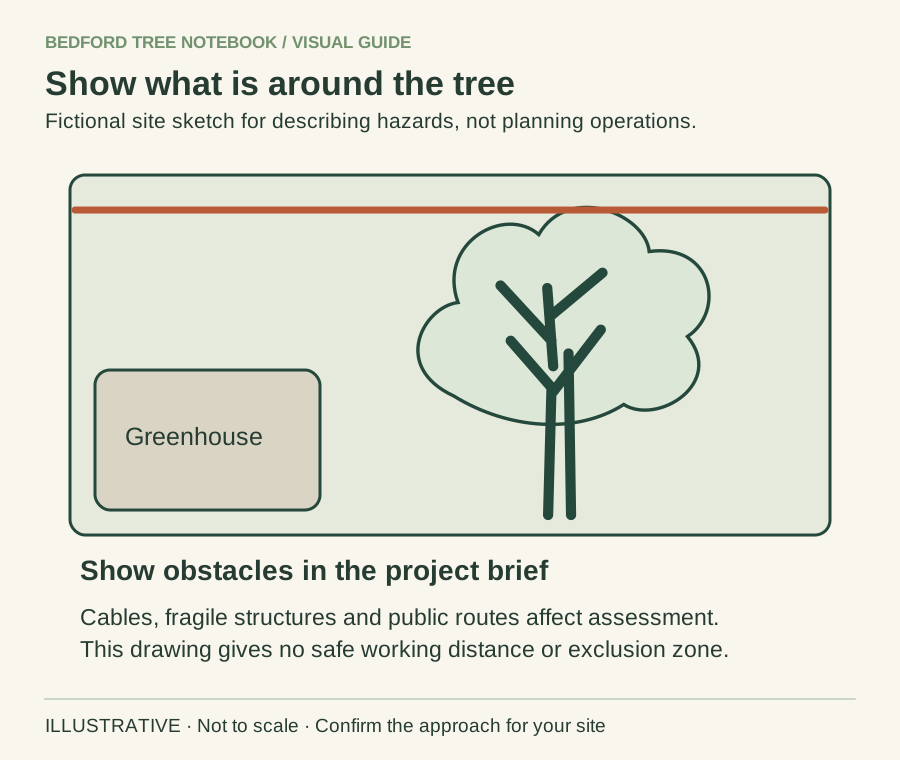
- Describe overhead lines and fragile structures before a visit.
- Do not approach lines or enter a work area to obtain a photograph.
- Qualified contractors and the relevant network operator determine arrangements.
Record what you have actually noticed
Describe which part of the building is involved: roof covering, gutter, fascia or another feature. Say whether you have seen physical contact, heard movement in wind or noticed a nearby branch from inside the house. Distinguish observation from an assumption about damage.
If you already have photographs taken safely from the ground or through a window, keep a wider view as well as a detail. There is no need to enter a risky position to obtain evidence for an initial conversation.
Tell the professional whether something changed
A long-standing low branch and a branch that moved after a storm raise different questions. Note when the issue was first noticed and any relevant event you know about. Do not infer that the tree is safe or unsafe solely from how long it has been there.
The tree-assessment guide helps distinguish a request for advice about condition from ordinary pruning. If the concern has changed since a quotation visit, update the contractor before a planned work date.
Ask about a targeted solution
Explain the clearance you want and ask what suitable work could achieve it. Depending on the actual tree and site, the discussion may concern a particular limb, lower branches or a different approach. This website cannot choose that operation from a written description.
Crown lifting and crown reduction address different objectives. Avoid asking for the largest possible cut back as a shortcut. The professional should explain the proposed result and why it is appropriate for the tree.
Keep the roof question separate
If you can see a defect or have experienced a leak, obtain advice from someone competent to assess the building. A tree professional’s recommendation about branches does not automatically diagnose a roof problem or establish who is responsible for repairing it.
Share any relevant findings between the people involved, with your permission. If both tree and building work are needed, agree their sequence rather than having one business arrive assuming that the other has already prepared the area.
Explain the space around and below the branch
Tell the contractor about a conservatory, greenhouse, extension, neighbouring roof or restricted passage. Mention overhead services without attempting to identify or measure a safe working distance yourself. The HSE tree-work resources explain why equipment, height and nearby lines require proper planning.
Ask the contractor to assess access and the working method. A small branch can still present a complicated job if it is above a fragile structure; apparent size alone does not define the work or its price.
Agree the intended finish
A useful quotation should identify the tree, the branches or specification involved, material removal and the important access assumptions. If the aim is roof clearance, ask how the written scope describes that outcome and what maintenance advice accompanies it. Do not infer a guarantee that regrowth can never become an issue.
Check permissions and protection before authorising work. If the tree is council-managed, follow the Bedford reporting route rather than instructing a private contractor to cut it yourself.
Describe the roof relationship in ordinary terms
Explain whether the branch rests on the roof, touches it only in movement or is simply close to it. Mention the affected structure: main house, porch, conservatory, shed or garage. A professional may need to inspect both the tree and the access around that structure before deciding on a suitable operation.
Avoid estimating an exact clearance from a misleading photograph. If you can only say that contact appears to occur in wind, say that. Our leaves-and-gutters guide covers a different issue that is sometimes described as roof trouble. Keeping the contact and debris questions separate can make the recommendation more focused.
A hypothetical coordination with roof repairs
Suppose a roofer needs access to repair a gutter and a nearby branch is also being discussed with a tree contractor. Share the planned sequence with both businesses. Ask whether either needs the other stage completed first, and record who will confirm the area is ready. Do not assume that one contractor can safely work beneath or alongside another active operation.
This is a coordination example, not a diagnosis that the branch caused the damage. Keep the roofer’s findings separate from the tree professional’s recommendation. If scaffolding or temporary access is proposed, add it to the narrow-access brief so the tree quote reflects the site that will actually exist.
Ask what clearance means in the proposal
A useful pruning description should explain the intended result for the identified tree, rather than merely say away from roof. Ask how the professional will describe the work, what limitations it sees and whether follow-up should be anticipated. Do not convert that discussion into a promise that a branch can never approach the building again.
Our crown-reduction comparison helps clarify operations if unfamiliar terms appear. Targeted branch work and wider crown work are different proposals and should be explained on their merits. Check any relevant authority documents against the final operation, especially if the recommendation changes after a closer inspection.
Keep the building accessible after the visit
Discuss where material will be lowered, carried and loaded, and identify delicate structures that must be considered in the plan. Tell the contractor about fragile glazing, covered drains or a route shared with household members. These details belong in the access assessment rather than an informal request made after work begins.
At handover, ask what tree work was completed and what remains for the building specialist. Use the completion checklist to keep those responsibilities separate. A branch being removed does not itself confirm that a roof repair is complete or that the building’s condition has been professionally assessed.
Putting it into practice
Prepare a short account of the contact, safe photographs and any known protection information. Ask a competent arborist to recommend a proportionate response and a written work specification. If you suspect building damage, arrange an appropriate building inspection rather than asking a tree quote to establish the cause or condition of the roof.
If the concern is leaf debris rather than contact, see leaves and gutters to separate the maintenance questions.
For other garden structures, tree work near sheds and greenhouses covers a different set of access and protection questions.
Where the roof has solar equipment, branches near solar panels adds the relevant electrical-system and access questions.
Turn the advice into a useful project brief.
Start with the postcode, the work you have in mind and any access considerations.
Prepare your enquiryNo obligation. A site assessment may be needed to confirm the work and price.
Sources & further reading
Sources checked 31 October 2026. How we prepare guidance.