
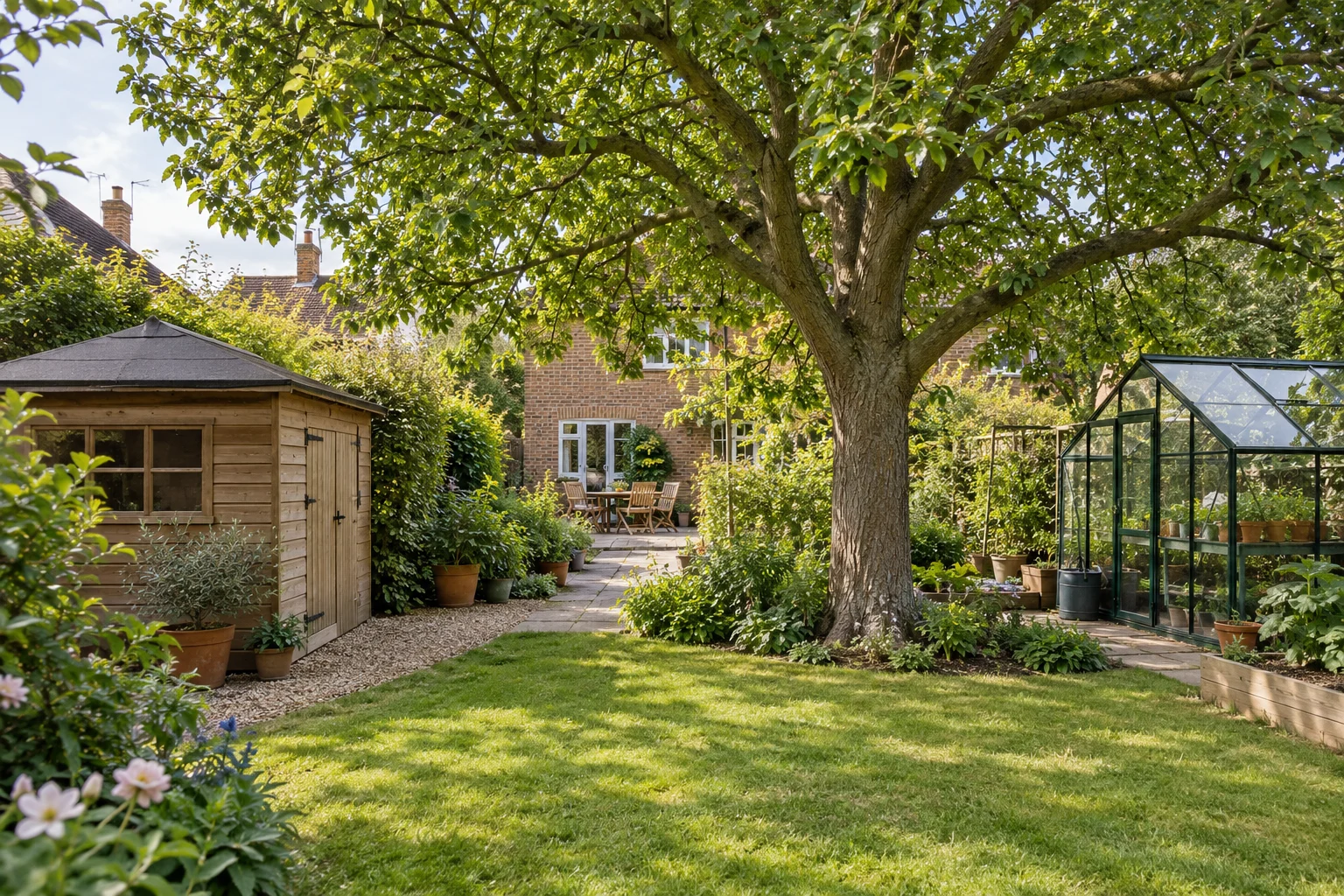
In this guide Show sections
General guidance, not a professional assessment. Confirm site-specific advice and current requirements before work.
Planning tree work in Bedford or nearby?
Start with the postcode, the work you have in mind and any access considerations.
Prepare your enquiryNo obligation. A site assessment may be needed to confirm the work and price.
Before you make arrangements
Record where the tree and structure stand, what you have noticed and what needs to change. Keep away from damaged glass, unstable structures or suspect branches. The branch-touching-roof guide helps describe direct contact; this guide covers the wider arrangement around garden buildings and the working area.
Show what is around the tree
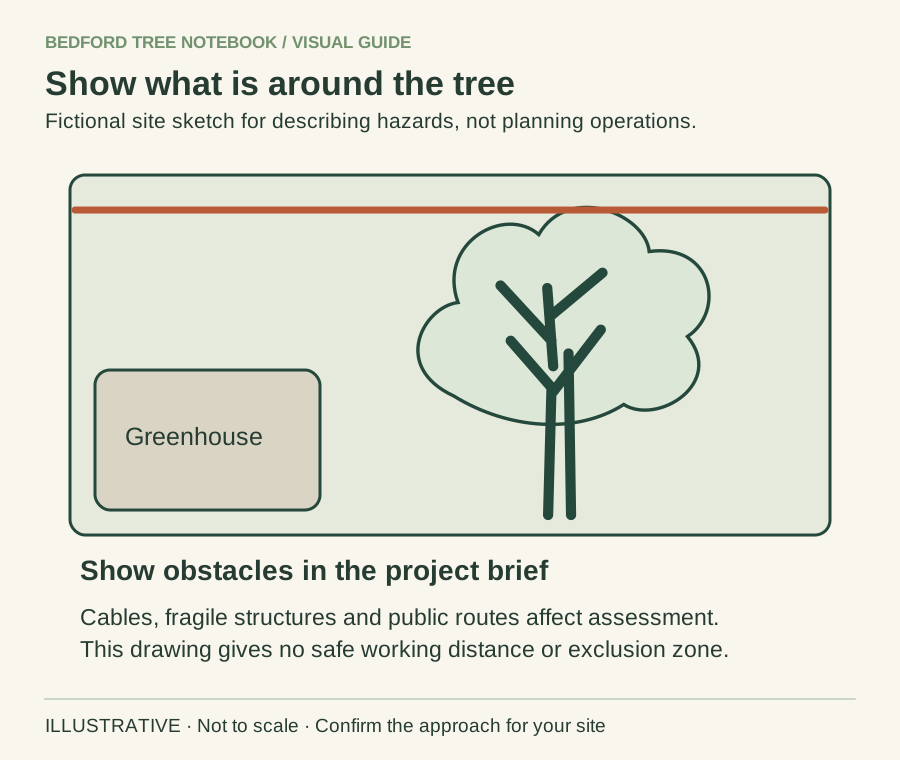
- Describe overhead lines and fragile structures before a visit.
- Do not approach lines or enter a work area to obtain a photograph.
- Qualified contractors and the relevant network operator determine arrangements.
Explain the actual relationship
Say whether branches touch a roof, hang above glazing, restrict a door or simply shade the structure. Include how the space is used: storing tools, growing plants or providing a route through the garden. Those details help distinguish an access problem from a building-condition concern.
Use photographs showing both the tree and the structure, taken from an already safe position. A close-up of one branch may not show how the canopy relates to the whole building. Do not climb onto a shed or enter a damaged greenhouse for a better view. If you cannot safely photograph the relevant area, explain that limitation and ask the contractor how an appropriate inspection should be arranged.
Keep tree and building assessments distinct
A tree professional can consider the tree and proposed operation, while a damaged structure may require relevant building or glazing expertise. Do not ask one observation to establish a cause it cannot prove. A cracked base or distorted door does not by itself identify which tree or root, if any, is responsible.
RHS guidance on trees near buildings explains why site and building factors matter. Our tree-consultant guide helps when a formal opinion is needed rather than a work quotation alone. Tell the contractor about any existing report or investigation. Avoid commissioning removal purely to obtain reassurance about a structure when the source of the problem has not been established.
Define the clearance objective
Explain the space you need and why: opening a door, maintaining the roof, protecting a growing area or using a path. Ask the tree professional what operation, if any, is suitable and what limitations apply. A request for a large reduction may not be the most appropriate response to one local obstruction.
Read crown lifting explained and reduction versus thinning to understand different terms. Do not prescribe cuts from a distance or assume a specific clearance can be maintained permanently after one visit. Ask about future growth and maintenance so the written recommendation relates to the actual purpose rather than an undefined wish to “cut it away from the shed”.
Tell the contractor about fragile features
Identify glazed panels, plastic roofing, guttering, solar equipment, water tanks and other features that affect the surroundings. Mention existing damage so the business can distinguish the starting condition from a later concern. Ask how the proposal accounts for the structure without attempting to design the professional method yourself.
Our garden preparation guide helps identify movable belongings. Do not dismantle glazing, disconnect equipment or move heavy structures on your own initiative to make access easier. If preparation by another qualified person is needed, agree who organises it and when. A clear sequence is more useful than discovering during the visit that a supposedly movable feature cannot safely be moved.
A hypothetical greenhouse-clearance enquiry
Imagine a homeowner reports that a branch reaches over a greenhouse roof and makes gutter maintenance difficult. The initial request is to remove the tree entirely. A useful brief instead explains the access problem, shows the branch and glazing from a safe viewpoint and asks for an appropriate assessment.
The tree professional can then consider the suitable operation and its limits, while any damaged glazing is handled separately. This hypothetical example does not promise that pruning will be possible or that removal will be unnecessary. It shows how identifying the actual problem leaves room for a reasoned recommendation. The eventual quotation should describe the agreed tree work and relevant protection arrangements, not merely repeat the first suggested solution.
Include the access route behind the structure
A narrow gap beside a shed may be part of the route for people, equipment or material. Measure only from safe positions and describe turns, steps and overhanging roofs. Tell the contractor if the apparent route is not actually available because it belongs to a neighbour or contains fixed services.
Use narrow-garden access measurements when preparing the enquiry. The business should assess suitability rather than rely on a single width. If another route would require taking down a fence panel or passing through the house, keep that arrangement provisional until the relevant people agree. Do not assume a contractor's ability to reach the tree also settles how debris will leave the garden.
Check permissions before changing the scope
A garden building's presence does not remove applicable tree controls. Check the tree's status, ownership and relevant wildlife considerations before committing to an operation. If a new shed or greenhouse forms part of a wider development project, mention any relevant planning documents or conditions.
Our planning-conditions guide helps connect those records with the tree enquiry. Ask the relevant authority to clarify uncertainty rather than assuming that an obstruction or maintenance problem creates an exemption. A change from targeted pruning to removal should be considered as a new proposed outcome, with the scope and required checks updated before the contractor proceeds.
Agree the handover and future maintenance
Keep the final quotation clear about the tree operation, material handling, protection and any separately arranged work on the structure. Ask what the contractor expects you to do before arrival and what follow-up is recommended afterwards. Photograph existing damage from a safe place if useful.
Once the area is released, use the completion checklist to review the agreed outcome. If the tree work has created the expected clearance but the building still needs repair, keep those responsibilities separate. A successful garden-building project may involve more than one business, and the final tree-work invoice should not be assumed to cover repairs that were never included in its scope.
Your next step
Prepare a brief showing the tree, structure, access and actual concern. Ask for a site-specific recommendation and a clear scope before choosing the operation. Use the project planner to start the enquiry, then explain the nearby shed or greenhouse and any separate building assessment that may be needed.
Turn the advice into a useful project brief.
Start with the postcode, the work you have in mind and any access considerations.
Prepare your enquiryNo obligation. A site assessment may be needed to confirm the work and price.
Sources & further reading
Sources checked 31 October 2026. How we prepare guidance.