
In this guide Show sections
General guidance, not a professional assessment. Confirm site-specific advice and current requirements before work.
Planning tree work in Bedford or nearby?
Start with the postcode, the work you have in mind and any access considerations.
Prepare your enquiryNo obligation. A site assessment may be needed to confirm the work and price.
Before you arrange the work
Find the permission reference, decision notice, approved plans and any later written approvals. Identify the exact tree on the drawings. If a condition or plan is unclear, ask the local planning authority for a written explanation before booking the operation.
Separate the permission checks
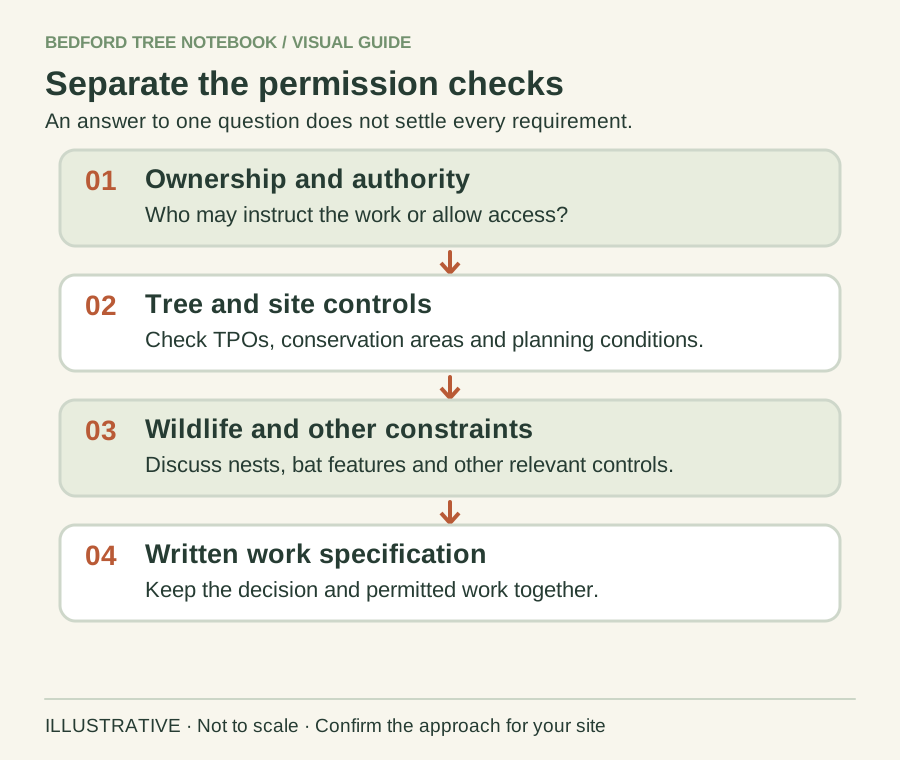
- Check every relevant control, not only the presence of a TPO.
- Keep written decisions with the exact proposal.
Background sources: GOV.UK guidance
Read the documents as a set
A decision notice may refer to drawings or a tree-protection scheme rather than list every detail in its own text. Put those documents alongside the contractor’s proposal. Check tree numbers, retained planting and any requirements affecting access or ground protection. Do not assume that a builder’s timetable is evidence that all conditions have been dealt with.
Start with which council handles the tree enquiry if the property’s authority is uncertain.
Keep maintenance and development distinct
National guidance recognises that planning permissions and tree controls can interact. That does not make every permission a general authority to remove nearby trees. The particular approved development and work matter. Seek clarification about the exact operation rather than relying on a general statement that planning permission exists.
Our protected-tree application guide covers the separate paperwork for a proposed tree operation. Neither a quotation nor a contractor’s recommendation replaces the required authority.
Agree what happens if the design changes
A revised driveway, scaffolding position or building footprint may change how a tree is affected. Tell the designer and tree professional before equipment arrives. Ask who will coordinate a response with the planning authority and who is responsible for maintaining any agreed protection.
If the tree-work specification itself changes, use changing a proposal after permission to prepare the questions. Keep the approved version clearly distinguished from later ideas.
Create a document register before the visit
Start with a small list rather than a large email attachment. For each document, record its reference, date and purpose: decision notice, approved drawing, tree schedule, protection plan or later written response. Put a clear label on anything superseded. If a document refers to another drawing you do not hold, identify that gap and ask the person managing the development for it.
The register helps a tree contractor understand which constraints are known and which still need clarification. It also stops a diagram copied from a property sale listing being mistaken for an approved plan. You are not being asked to interpret every condition yourself. The practical aim is to assemble the evidence needed by the appropriate adviser. If the project includes more than one consent, keep their references distinct and explain why each may be relevant. Our listed-building guide covers a common reason that one site can raise separate approval questions.
Map the proposed job against the development sequence
Write down when the tree work is intended to happen relative to demolition, deliveries, scaffolding, excavation and landscaping. Do not assign technical protection measures yourself; ask the relevant professional which activities need to be coordinated. A tree operation considered before building starts can raise different practical questions from the same operation after a new driveway has been laid.
For example, a homeowner may intend to prune a tree after an extension is finished. The contractor’s usual access route may then cross new paving, while the development documents describe a different protected working area. This hypothetical example does not determine which arrangement is acceptable. It shows why the sequence and documents need to be discussed together. Ask who will resolve the conflict and what written information the tree team should use. Avoid treating the presence of builders or scaffolding as evidence that the tree-related requirements have already been satisfied.
Identify responsibility for coordination
Where a builder, designer, arboricultural adviser and tree contractor are involved, nominate a contact who will circulate the current information. Ask each business what it needs before its part can proceed. A contractor may be waiting for a clear specification while a designer assumes the contractor is arranging a planning enquiry. Discovering that gap before booking is more useful than arguing about it afterwards.
Record responsibilities in ordinary language: who asks the authority the outstanding question, who supplies the current drawing and who briefs the people attending. This is not an invitation to pass a specialist duty to a homeowner by default. If a task needs professional competence, clarify who has been engaged to provide it. Ask for any separate fee or visit to be identified. Keep the coordination note with the quotation so that an apparently complete price is not accepted while an important dependency remains unresolved.
Separate a recommendation from authority to proceed
A site inspection can produce a sensible tree-care recommendation that differs from an earlier project proposal. Keep the professional reasoning, but do not treat the recommendation itself as a revision of an approval or condition. Describe the difference and ask the appropriate authority or project adviser how it should be handled before work.
The same care applies to a suggestion from another trade. A paving installer’s preferred excavation area, for example, does not settle what can happen near a retained tree. Ask for the construction requirement to be explained so it can be considered alongside the tree documents. Our guide to changing approved tree work helps structure that comparison. Keep the accepted quotation provisional where a material question remains open. If clarification changes the scope, ask the contractor to revise the written proposal rather than adding an informal instruction to a drawing that other people may never see.
Handover information worth retaining
At completion, ask for the invoice and any agreed record of the tree work to use the same tree identifiers as the final scope. Keep that record with the relevant decision and plans. It can help explain what was commissioned if a later professional assesses the site or a different contractor is engaged for the next stage.
Do not ask the tree contractor to certify compliance with an entire development permission unless that service has expressly been agreed and the person is competent to provide it. A receipt for pruning is not automatically a planning-condition discharge or an assessment of construction effects. If you need confirmation for the development file, establish the required form of evidence with the responsible adviser. Finally, record any work deliberately deferred and the reason, so that an unfinished landscaping item is not confused with a change to the tree-work scope. The distinction matters when the next business takes over the site.
Your next step
Give the contractor the relevant plans and written requirements before accepting the final scope. Record unresolved conditions as matters to settle before work starts, rather than promises to sort out on the day.
If the concern arises after construction, use tree concerns after building work to prepare a factual assessment brief.
For a proposed extension, read tree surveys and Bedford house extensions before fixing the design or arranging tree work.
For a newly completed property, our new-build garden tree-care guide connects planning records, handover information and establishment care.
Turn the advice into a useful project brief.
Start with the postcode, the work you have in mind and any access considerations.
Prepare your enquiryNo obligation. A site assessment may be needed to confirm the work and price.
Sources & further reading
- GOV.UK: planning applications affecting trees and woodland
- GOV.UK: Tree Preservation Orders and conservation areas
- Bedford Borough Council: protected trees
Sources checked 31 October 2026. How we prepare guidance.