
In this guide Show sections
General guidance, not a professional assessment. Confirm site-specific advice and current requirements before work.
Planning tree work in Bedford or nearby?
Start with the postcode, the work you have in mind and any access considerations.
Prepare your enquiryNo obligation. A site assessment may be needed to confirm the work and price.
Before you make arrangements
Tell the designer about trees within and immediately beside the site, including neighbouring trees. Ask what information the planning authority needs for your actual proposal and what professional advice is appropriate. The tree consultant guide helps define the role, while reading a location plan helps you keep tree identities consistent.
Design around trees before digging
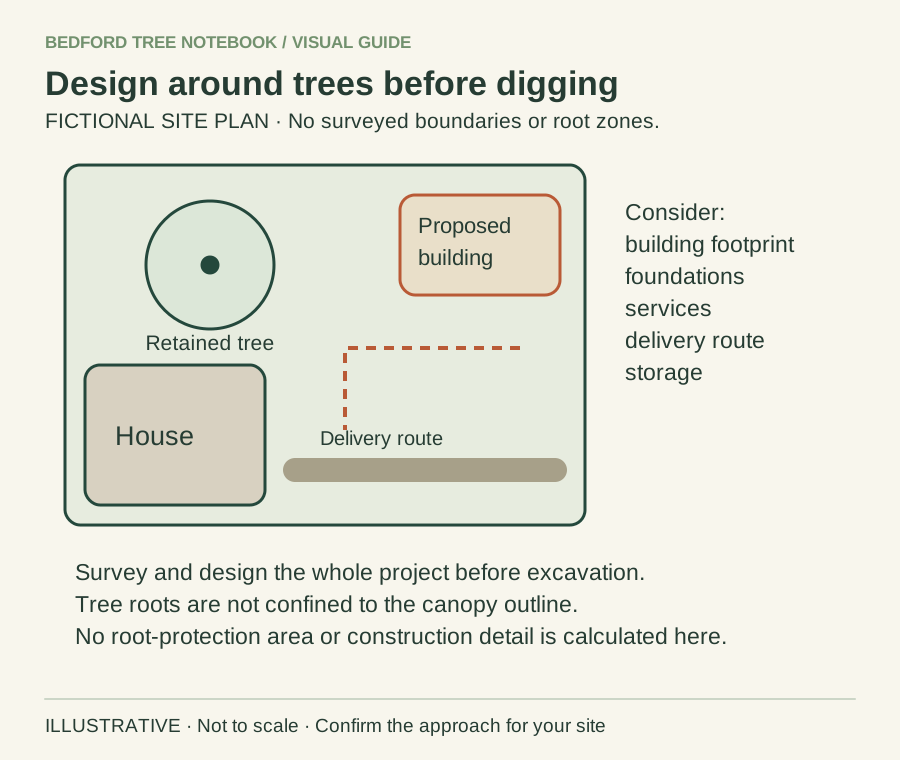
- Include foundations, service trenches, delivery, storage and future maintenance in the brief.
- Commission the relevant site-specific survey and design before excavation.
- A canopy outline does not map all roots, and permitted development does not cancel tree controls.
Background sources: Bedford Borough Council guidance · GOV.UK guidance
Begin with a question the survey can answer
Explain the intended extension, likely construction approach and the stage of design. Are you testing an initial layout, supporting an application or responding to a planning request? Those purposes can require different information. Ask the consultant to state the survey scope, deliverables, assumptions and any information they need from the architect or engineer.
A condition-focused inspection and an assessment of development implications may overlap, but neither should be assumed to cover the other automatically. Be specific if your concern includes a damaged tree, a neighbour's specimen or potential building movement. Agree who will interpret the findings for the design and whether subsequent revisions require further input.
Confirm current local submission requirements
Use the responsible council's current planning resources and ask about the requirements for the actual application. Government guidance on planning applications affecting trees describes why tree information and appropriate expertise matter. Do not use another authority's checklist as proof that a Bedford submission will be accepted.
For a property advertised as Bedford, confirm the local planning authority rather than relying on the postal town. Our council-identification guide explains the distinction. Ask the designer how arboricultural plans will coordinate with the site survey and proposed drawings so that dimensions and tree references agree throughout the application.
Include off-site trees that may be relevant
A trunk outside your boundary can still be relevant to the design and construction of an extension. Show neighbouring trees on the information you give the consultant and explain any limits on access or visibility. Do not enter another person's land or assume the neighbour will allow pruning merely because your project would benefit.
The shared-boundary guide is useful when ownership and access are uncertain. Ask the consultant how information about an off-site tree will be obtained and what limitations should be recorded. The aim is an honest assessment based on available evidence, not a neat plan that silently omits awkward trees at the edge of the drawing.
Let root protection influence the layout
Roots are not confined to the patch beneath the visible canopy, and a guessed circle around a trunk is not a professional root-protection assessment. Ask how the consultant's findings affect the footprint, excavation, drainage and routes for new services. A design may need specialist engineering or a revised layout rather than a promise to “be careful” during digging.
Read visible roots in the lawn for the limits of surface observations. Do not dig exploratory trenches or cut roots to make the design fit. Ask who will specify and oversee any justified investigation or specialist construction approach, and obtain the relevant advice before machinery reaches the site.
Plan the construction site as well as the building
A tree can be affected by vehicle movements, storage, excavation or changes around its rooting area even when no branch is cut. Show likely access, temporary compounds, deliveries, drainage routes and spoil handling to the designer and consultant. A protection drawing that ignores how the builder will reach the work is incomplete as a practical plan.
Our tree concerns after building work guide explains why records of site activity can become important later. Discuss protective arrangements before the contract and programme are settled. Ask who is responsible for communicating restrictions, checking them during the project and resolving a proposed change when access proves more difficult than expected.
Keep planning permission and tree controls distinct
Do not assume a discussion about an extension authorises whatever tree work makes construction easier. Ask the designer and council how any planning permission, approved plans, conditions and separate tree controls interact in your case. The answer depends on the actual documents and work, not a general statement that the extension is allowed.
Our tree-work planning-conditions guide provides questions to raise, and the protected-tree application guide covers a different possible route. If the proposal changes, check the revised position before work. A contractor's willingness to carry out pruning is not confirmation that the necessary planning or tree permissions have been resolved.
Check whether specialist building advice is also needed
Arboricultural advice does not replace structural or geotechnical advice about foundations and ground conditions. Give relevant tree information to the engineer and make sure their assumptions are compatible with the retained-tree plan. If existing cracks or movement are already a concern, record them and ask who should investigate before the extension proceeds.
The subsidence-concerns guide explains why nearby trees should not be blamed without evidence. Similarly, a foundation detail does not establish whether excavation is acceptable for a retained tree. Ask the professionals to coordinate their recommendations rather than leaving the builder to reconcile two documents that were prepared for different purposes.
Make revisions and responsibilities explicit
A survey is useful when its findings influence a real decision. Keep the final tree schedule, plans, impact assessment and protective arrangements with the current design. Mark superseded drawings so that they are not used for pricing or site instructions. Ask whether moving a wall, service trench or access route needs an updated arboricultural review.
Before construction, identify who can approve changes, who must be consulted and what records are expected. If tree work is separately recommended, obtain a written quotation that matches the authorised specification. The quotation checklist helps you keep practical operations, waste and access within the agreed scope rather than treating every tree issue as an informal builder's task.
Ask what the drawings must communicate on site
A useful protection plan needs to be understood by the people carrying out the building work. Ask the consultant and designer how retained trees, protected areas and agreed routes will be identified, and how the latest information will reach subcontractors and delivery teams.
This is particularly important where the site is small and the obvious place for a skip or pallet conflicts with an agreed restriction. Resolve that conflict before work begins, rather than assuming a drawing can be adapted informally on the day. Keep a named route for questions so a subcontractor can obtain the right decision instead of improvising around a tree.
Your next step
Speak to your designer about the trees before finalising the extension layout. Commission appropriately scoped arboricultural advice and coordinate it with engineering, planning and construction information. Keep the latest documents together and make sure the site team understands the protective arrangements. An early assessment can identify design choices while they are still easier to change.
Turn the advice into a useful project brief.
Start with the postcode, the work you have in mind and any access considerations.
Prepare your enquiryNo obligation. A site assessment may be needed to confirm the work and price.
Sources & further reading
- GOV.UK: planning applications affecting trees and woodland
- Bedford Borough Council: protected trees
- GOV.UK: Tree Preservation Orders and trees in conservation areas
- HSE: avoiding danger from underground services
- Bedford Borough Council: adopted Local Plan 2030, paragraphs 8.39–8.40
- National Tree Safety Group: common sense risk management, 2024 summary
Sources checked 31 October 2026. How we prepare guidance.