
In this guide Show sections
General guidance, not a professional assessment. Confirm site-specific advice and current requirements before work.
Planning tree work in Bedford or nearby?
Start with the postcode, the work you have in mind and any access considerations.
Prepare your enquiryNo obligation. A site assessment may be needed to confirm the work and price.
Before you make arrangements
Record what you have noticed and follow the advice of your buildings insurer and an appropriately qualified building professional. If there is an immediate concern about the building's safety, use the appropriate urgent route rather than waiting for a tree-work quotation. Do not dig around foundations, cut roots or attempt your own structural investigation.
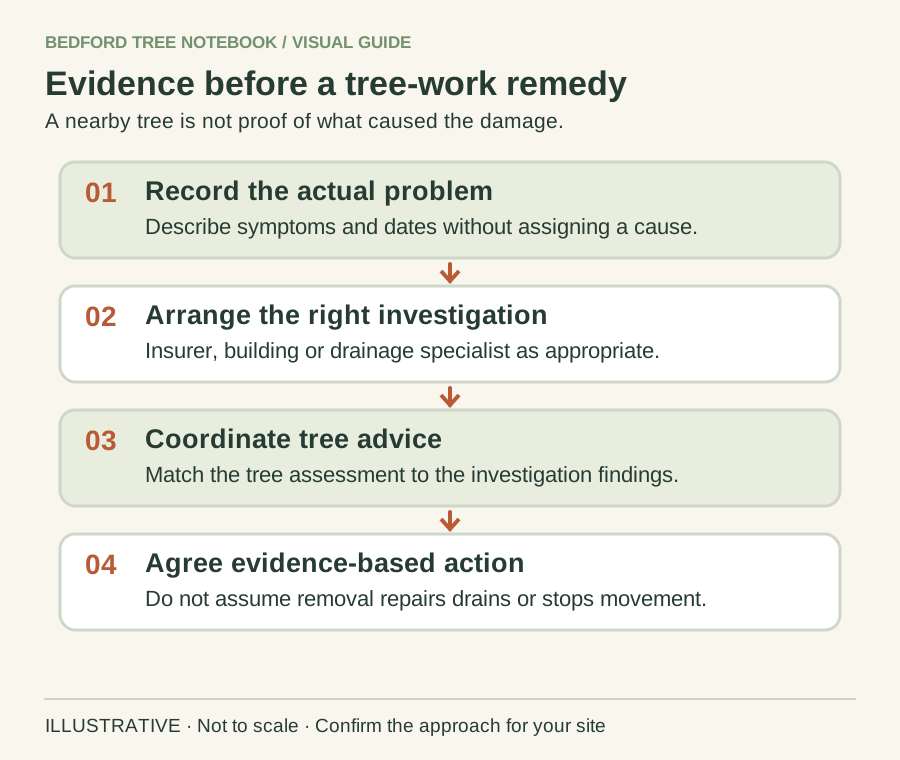
Evidence before a tree-work remedy
- Tell the relevant insurer or property professional about suspected damage.
- A tree’s proximity or roots in a drain do not alone settle causation or liability.
- Coordinate any proposed pruning or removal with the investigation and permission checks.
Background sources: RICS guidance · RHS guidance
Describe the evidence without deciding the cause
Note where the concern appears, when you first saw it and whether you have earlier photographs or reports. A dated sequence can be more useful than a statement that a tree “looks too close”. Keep factual observations separate from theories about why a crack or movement has occurred.
The RICS subsidence guide is an appropriate starting point for understanding why professional investigation matters. Let the relevant adviser explain what should be monitored and how. Do not use an online crack chart or a tree's apparent size to decide either that the problem is harmless or that immediate felling will solve it.
Contact the insurer and appropriate building adviser
Ask your buildings insurer what reporting and investigation process applies to the actual policy and circumstances. If you already have a surveyor or structural engineer involved, make sure they know about the insurer's instructions. Keep reference numbers, written advice and any requirements about further work together.
Avoid commissioning irreversible work that may disrupt an investigation without first discussing it with the responsible advisers. The point is not to delay a genuine urgent response; it is to avoid replacing evidence with an assumption. Ask who is coordinating the case, what information they need and which decisions should wait for their findings. Insurance coverage and liability require advice on the actual facts.
Understand why nearby trees need context
The relationship between vegetation and buildings depends on more than distance. Ground conditions, the building and the evidence of movement can all be relevant. Most trees near buildings do not cause damage, so proximity alone is not a diagnosis. Equally, an attractive or long-established tree should not be used as a reason to dismiss a properly raised concern.
Our trees-near-drains guide covers one possible overlapping issue. Give advisers information about drains, previous building works and known trees or hedges, including those on adjacent land. Do not assume all Bedford gardens have the same soil or that a general geological description settles the conditions beneath your particular home.
Ask what an arboricultural commission should cover
Where tree expertise is required, clarify whether the purpose is identification, management advice, an assessment linked to building investigation or a practical work specification. Provide the building adviser's findings rather than asking the tree professional to reconstruct the case from a single photograph.
The tree consultant guide helps distinguish advice from a contractor's quotation. A price to remove a tree is not evidence that removal is necessary. Ask how recommendations will be coordinated with the engineer or insurer, what uncertainties remain and whether a revised opinion is needed when further monitoring or investigation becomes available. Keep reports within their stated purpose and limitations.
Do not prescribe removal or severe pruning yourself
A suggested remedy needs to respond to the established problem and wider consequences. Tree removal may not be appropriate, and in some circumstances changes following removal can themselves need careful consideration. Ask the building and tree advisers to explain the proposed approach rather than treating cutting as a harmless precaution.
Our remove-or-prune guide explains why those choices require an assessed objective. Avoid requesting a drastic crown operation because it sounds less final than felling. Neither a familiar pruning label nor a generic percentage establishes an effective response to a building problem. Obtain a clear written recommendation and understand what it is expected to achieve before commissioning practical work.
Separate ownership and neighbour discussions from diagnosis
If a tree stands on neighbouring land, do not enter the property, cut roots or issue an unsupported demand for removal. Pass the relevant information through the adviser coordinating the case, and seek legal advice where responsibility or access is disputed. A diagnosis and the arrangements for implementing a remedy are separate stages.
Read tree work near shared boundaries for practical record-keeping questions. Keep correspondence factual and retain copies. The direction of branches or the location of a fence does not resolve every ownership question. This article does not establish liability or determine what a neighbour must do; those conclusions need the actual evidence and appropriate advice.
Check protection and the proposed work together
Tree protection does not disappear because a building concern has been raised. Ask the professional and responsible council how any necessary application or evidence should be handled. Supply the actual reports and a precise work description rather than relying on a statement that the tree is “causing subsidence”.
Our protected-tree application guide helps prepare the practical information, and Bedford protection checks explain where to start locally. Do not assume an exemption applies without clarification. If the recommended operation changes during the investigation, check whether the permission position and quotation also need revision before instructions are issued.
Keep a case record that future advisers can understand
Create a timeline of reports, observations, correspondence, decisions and completed operations. Identify the tree on a plan so different professionals do not discuss different specimens. Keep monitoring records in the form requested by the responsible adviser and distinguish a provisional view from a final recommendation.
When work is completed, retain the specification, permissions and completion evidence alongside the building investigation. Ask what follow-up is needed and who is responsible for it. The tree-permission records guide provides a useful filing approach. A tree-work receipt alone does not certify that a structural issue has been resolved or that no further monitoring will be required.
Understand provisional recommendations
During an investigation, an adviser may explain several possible outcomes before the evidence is complete. Record these as possibilities, with the conditions that would lead to each one. Do not forward a provisional comment as though it were a final instruction to the tree owner or contractor.
If someone asks for a quotation while a diagnosis is still being developed, explain that status to the business. A price can inform planning without authorising the work or proving the proposed remedy. Ask the coordinator when there will be enough evidence for a decision and which further findings could alter the recommendation already discussed.
Your next step
Contact your insurer and appropriate building adviser, preserve the evidence and ask how tree expertise should be incorporated. Obtain a coordinated written recommendation before arranging removal, root work or severe pruning. If practical work is justified, check permissions and obtain a quotation matching that recommendation. Keep the building investigation and tree-work records connected without treating them as interchangeable documents.
Turn the advice into a useful project brief.
Start with the postcode, the work you have in mind and any access considerations.
Prepare your enquiryNo obligation. A site assessment may be needed to confirm the work and price.
Sources & further reading
- RHS: trees near buildings
- GOV.UK: Tree Preservation Orders and trees in conservation areas
- Bedford Borough Council: protected trees
- RICS: subsidence
Sources checked 31 October 2026. How we prepare guidance.