
In this guide Show sections
General guidance, not a professional assessment. Confirm site-specific advice and current requirements before work.
Planning tree work in Bedford or nearby?
Start with the postcode, the work you have in mind and any access considerations.
Prepare your enquiryNo obligation. A site assessment may be needed to confirm the work and price.
Before you make arrangements
Record the symptoms, the affected location and any previous drainage reports. Do not open unsafe chambers, enter confined spaces or expose roots yourself. Our underground-services guide explains why surface features and old plans do not establish the exact position or condition of buried services.
Evidence before a tree-work remedy
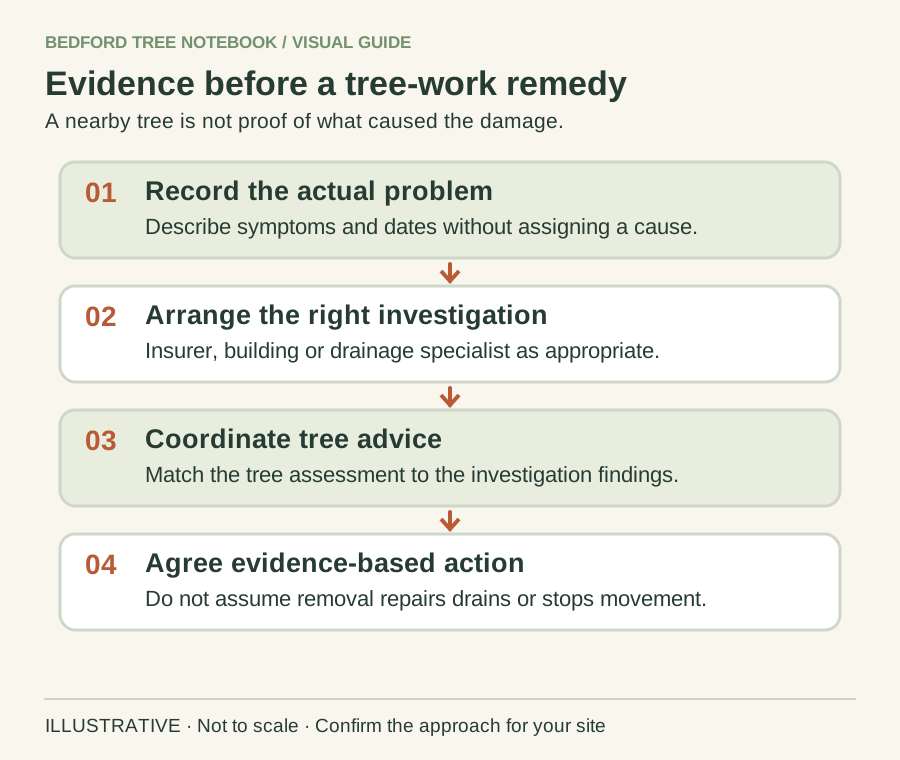
- Tell the relevant insurer or property professional about suspected damage.
- A tree’s proximity or roots in a drain do not alone settle causation or liability.
- Coordinate any proposed pruning or removal with the investigation and permission checks.
Background sources: RICS guidance · RHS guidance
Describe the drainage problem before naming a tree
Tell the drainage professional whether the issue is repeated blockage, slow flow, a damaged pipe, water appearing at the surface or something else. Note when it occurs, what has already been attempted and which part of the property appears affected. Keep invoices and reports from earlier visits.
A sentence such as “the tree has broken the drain” assumes the conclusion. Start instead with the observed problem and the evidence available. If you have a camera report, ask for the footage, location information and written findings in a usable form. A contractor's brief verbal description may not be enough for a separate professional to understand what was found.
Understand what root presence does and does not establish
The RHS guidance on trees near buildings explains that roots may enter drains, particularly where defects allow access to moisture. The presence of roots should therefore lead to questions about the pipe as well as the surrounding vegetation. It does not, by itself, identify a particular tree or settle responsibility.
Ask what evidence connects the observed roots to the proposed tree work. A tree's proximity is relevant context, not a laboratory identification or a structural diagnosis. If several trees or hedges stand nearby, make sure each professional knows this. Avoid commissioning removal on the strength of a guess about which plant has the largest canopy.
Clarify which drainage system is involved
Find out whether the affected pipe serves only your property or is part of a shared or public system, and ask the appropriate drainage adviser or service provider about ownership and responsibility. Do not infer the answer solely from the position of an inspection cover or the route shown on a rough garden sketch.
Keep this enquiry separate from ownership of the tree. A drain can cross land with different ownership arrangements, and the tree may stand in another garden. The shared-boundary guide helps you record those uncertainties. Get appropriate advice before arranging access, excavation or work on a system you may not control.
Give the arboricultural adviser the actual findings
If tree advice is needed, supply the drainage report and any relevant plans. Explain what repair is proposed and where excavation, lining, replacement or other work would occur. Ask the tree professional which effects on retained roots require consideration and what further information is needed.
Our consultant-or-contractor guide helps distinguish an independent assessment from a price for removal. A tree contractor should not have to infer the drainage diagnosis from a homeowner's summary of a brief phone call. Likewise, the drain professional should know if tree controls, important retained roots or an uncertain boundary could affect the repair approach.
Avoid turning a repair into unassessed root cutting
Excavating to reach a pipe may disturb tree roots even if tree work is not the stated purpose. Ask the professionals to coordinate the repair method and any justified root investigation. The appropriate approach depends on the tree, ground, service and extent of the work; this article cannot provide a safe root diameter or digging distance.
Read visible roots in the lawn for the limits of what can be judged from the surface. Do not cut exposed roots merely because they obstruct the repair route. Where a retained tree is involved, agree how unexpected findings will be handled before the excavation contractor starts.
Check whether building movement is a separate concern
If there are cracks, settlement or other signs of building movement, tell the building surveyor and insurer as appropriate. A leaking drain and nearby tree may be parts of a more complicated investigation. Ask who will coordinate the evidence rather than treating each trade's preferred operation as a confirmed remedy.
The subsidence-concerns guide explains why tree removal should follow appropriate diagnosis and advice. Repairing a drain does not automatically answer a tree-safety question, and pruning a tree does not demonstrate that the drain has been repaired. Keep each problem, recommendation and completion record identifiable so outstanding questions remain visible.
Keep tree controls and access in the repair plan
Before any separate tree work, investigate applicable protection and ownership. For Bedford-area properties, use the responsible council's current resources and ask for clarification if root-related works or a repair method raise an uncertain question. Do not assume underground work is outside all tree considerations because no branch will be cut.
Our Bedford protection-map guide explains the official starting point. Also agree access across neighbouring or shared land, protection of surfaces and disposal of excavated material. A genuine drainage problem does not automatically authorise every associated operation. Resolve what needs permission or specialist input while the method is still being planned.
Compare remedies against the evidence
Ask each professional what their proposed work addresses and what uncertainty remains. A repair proposal should identify the drain section and expected outcome; a tree recommendation should explain its objective and evidence. If a recommendation changes after further investigation, obtain a revised written explanation rather than simply extending the original job.
Our quotation checklist helps separate inclusions and exclusions for any practical tree work. Keep drainage repair and tree work clearly scoped, even if one business coordinates both. At completion, ask which records show the agreed operations and what follow-up is recommended. Avoid describing the whole issue as resolved if a separate building or tree assessment is still outstanding.
Ask how success will be checked
Before accepting a drainage repair, ask what completion evidence will show that the specified section has been addressed and what follow-up the drainage professional recommends. Separately ask whether the tree adviser expects any review of a retained tree after nearby works. These are different questions even when one visit produces both sets of records.
If a blockage returns, retain the new findings rather than assuming the earlier diagnosis must have been complete. A clear history helps the next adviser compare locations and recommendations. It also reduces the risk of repeating tree work that was never demonstrated to address the actual drainage defect.
Your next step
Collect the drainage evidence first and ask the relevant professionals to coordinate it with tree, building and ownership questions. Describe observations rather than blaming a particular tree. If justified tree work is proposed, check protection, agree the specification and obtain a written quotation. Keep repair and tree records together so any later concern starts with an accurate history.
For an off-mains property, trees near private drainage separates the system specialist, tree advice and the proposed groundworks.
Turn the advice into a useful project brief.
Start with the postcode, the work you have in mind and any access considerations.
Prepare your enquiryNo obligation. A site assessment may be needed to confirm the work and price.
Sources & further reading
- RHS: trees near buildings
- HSE: avoiding danger from underground services
- Bedford Borough Council: protected trees
Sources checked 31 October 2026. How we prepare guidance.