
In this guide Show sections
General guidance, not a professional assessment. Confirm site-specific advice and current requirements before work.
Planning tree work in Bedford or nearby?
Start with the postcode, the work you have in mind and any access considerations.
Prepare your enquiryNo obligation. A site assessment may be needed to confirm the work and price.
Before you make arrangements
Do not cut, grind or excavate roots to test a theory. Keep people away from an obvious trip hazard where practical and seek suitable advice. The surface-roots and grinding guide explains why removing a stump and dealing with roots associated with a standing tree are different propositions.
The visible part is only part
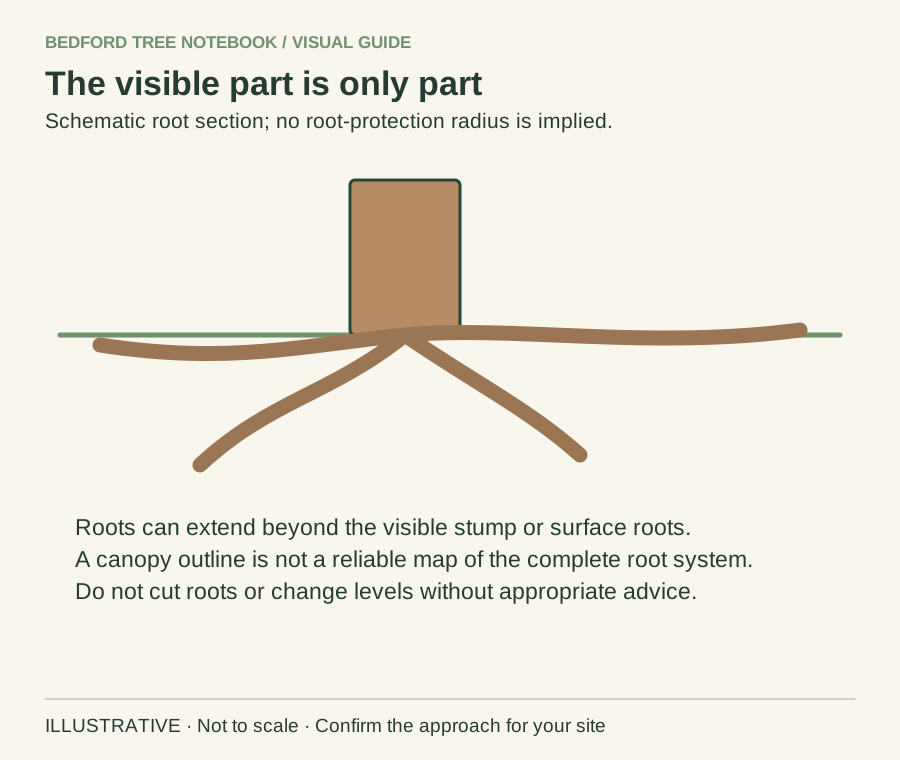
- Visible roots do not map the complete system.
- Root cutting, compaction and changes of level can affect a retained tree.
- Obtain site-specific advice before interfering with roots.
Describe where and how the roots affect use
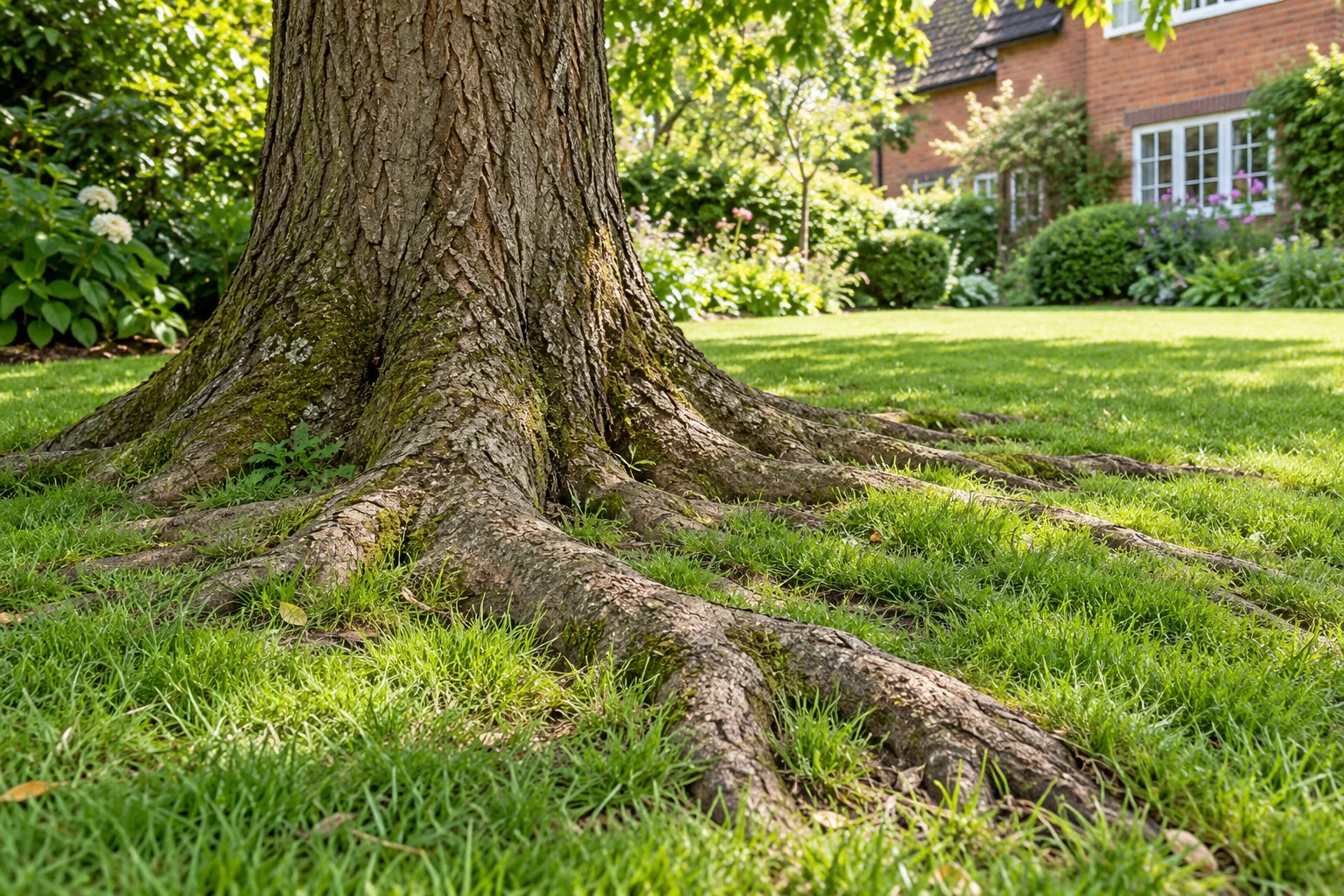
Identify the part of the lawn concerned and the practical difficulty. Does a raised area interrupt a route, prevent ordinary mowing or conflict with proposed turf preparation? Mark the area on a simple sketch with nearby trees, boundaries and fixed structures.
Take photographs from safe ground-level positions without digging to expose more. Explain whether you have noticed a change or are simply reassessing an established feature. Avoid identifying the source tree solely by proximity; a professional may need more information. A factual brief such as “raised roots beside the path make this section difficult to mow” is more useful than an unsupported conclusion that the nearest tree is defective or causing every uneven patch.
Separate observation from diagnosis
A visible root, thin grass and a surface change may prompt questions, but a photograph cannot establish the full root system or the tree's condition. Explain what you know and leave the unknowns visible. If the tree also shows a new lean, movement or other significant change, raise that separately and seek an appropriate assessment.
Our signs that need assessment helps describe those concerns. Do not infer that a root above the lawn proves the tree is unstable, nor that a longstanding visible feature proves it can be altered safely. The purpose of the first enquiry is to identify the right professional conversation, not to obtain a definitive diagnosis from a short description.
Ask about the tree before the surface finish
If work might affect roots belonging to a retained tree, tell the tree professional what you hope to change. Ask what assessment is needed and whether the intended garden operation could affect the tree. A landscaper's desired finish and the tree's requirements must be considered together.
Forest Research discusses risks to roots from maintenance and construction activities. That background supports the need for a considered approach, not a homeowner cutting rule based on root thickness or distance. Our tree-consultant guide helps if a more detailed opinion is needed. Avoid authorising a root operation before the relevant professional understands the tree, site and proposed outcome.
Consider alternatives to removing the root
Explain the result you need and ask whether the layout or management of the area can change instead. A professional may discuss options for the particular site, but do not assume that adding soil, installing a surface or creating a border is automatically suitable around roots.
The lawn-protection guide helps identify surface and access concerns during tree work. Keep proposed level changes in the brief and ask what effect they may have. The best solution depends on the actual growing area, the tree and how the household uses the space. A garden article cannot choose the construction detail, but it can help you avoid treating “make it level” as an adequate technical instruction.
A hypothetical lawn-and-path problem
Imagine a homeowner wants to widen a lawn path where raised roots are visible beside a mature tree. The initial plan is to cut the roots flush and lay new turf. Before proceeding, the homeowner asks a suitable professional to consider the tree and intended route.
The conversation can then explore what can be changed and which options need further assessment. This hypothetical example does not prescribe a particular alternative or establish that root removal is acceptable. It illustrates the order of decisions: define the use problem, assess the tree-related implications, then agree any garden works. Starting with a cutting operation can commit the project to a method before anyone has considered whether it is appropriate.
Include ownership and tree-protection questions
A root visible in your lawn may relate to a tree beyond the boundary. Do not assume that its position gives authority to carry out any desired work. If ownership or rights are disputed, obtain advice about the particular circumstances before instructing a contractor.
Our overhanging-neighbour-tree guide introduces the wider need to distinguish ownership, access and applicable controls; it should not be read as a universal rule permitting root cutting. Check relevant tree protection through the appropriate council resources and ask the authority about uncertainty. Keep the proposed operation clearly described so any professional or legal advice relates to the actual plan rather than an undefined complaint about roots in the garden.
Coordinate a later lawn or paving project
Tell everyone involved about the retained tree and root concern before accepting separate quotations. A tree assessment, surface preparation and finished landscaping may be different scopes. Ask who confirms the handover condition and who is responsible for the final design.
Use stump work before paving where a previous stump is involved, while making clear that a standing tree creates additional questions. Do not let an agreed garden timetable become a reason to bypass assessment. If a root is unexpectedly encountered during later work, the relevant contractors should have a process for stopping and seeking instructions rather than treating it as routine debris.
Keep advice and decisions easy to follow
Ask for the relevant recommendation in writing and retain any conditions or limitations. Record which tree and area were assessed, what operation was considered and what remained outside the scope. A general statement that “roots were checked” is less useful than a clear description connected to your plan.
If your project changes, ask whether the earlier advice still applies. A recommendation for a small alteration should not be stretched to cover a larger excavation or different surface. Keep photographs of the starting area and the final agreed work if useful, but do not enter a restricted zone to obtain them. A clear record helps the next professional understand the decision without making fresh assumptions about what happened underground.
Your next step
Use the project planner to describe the lawn-use problem and the nearby tree, then seek appropriate advice before deciding on root or ground work. Keep diagnosis, ownership and the landscaping design as separate questions. Agree a method only after the relevant professionals understand the intended change and its limits.
If a driveway is planned, our driveway and tree-roots guide explains why levels, excavation and future loading belong in the design conversation.
If raised beds or changed levels are planned, read ground levels around trees before assuming that covering the area protects the roots.
Turn the advice into a useful project brief.
Start with the postcode, the work you have in mind and any access considerations.
Prepare your enquiryNo obligation. A site assessment may be needed to confirm the work and price.
Sources & further reading
Sources checked 31 October 2026. How we prepare guidance.