
In this guide Show sections
General guidance, not a professional assessment. Confirm site-specific advice and current requirements before work.
Planning tree work in Bedford or nearby?
Start with the postcode, the work you have in mind and any access considerations.
Prepare your enquiryNo obligation. A site assessment may be needed to confirm the work and price.
Before you make arrangements
Sketch the existing tree, proposed bed, current and intended levels, and route for moving materials. Record what is approximate. Our tree location-plan guide helps make the proposal understandable without pretending it is a survey, while visible roots in the lawn explains the limits of surface observations.
A new level changes root conditions
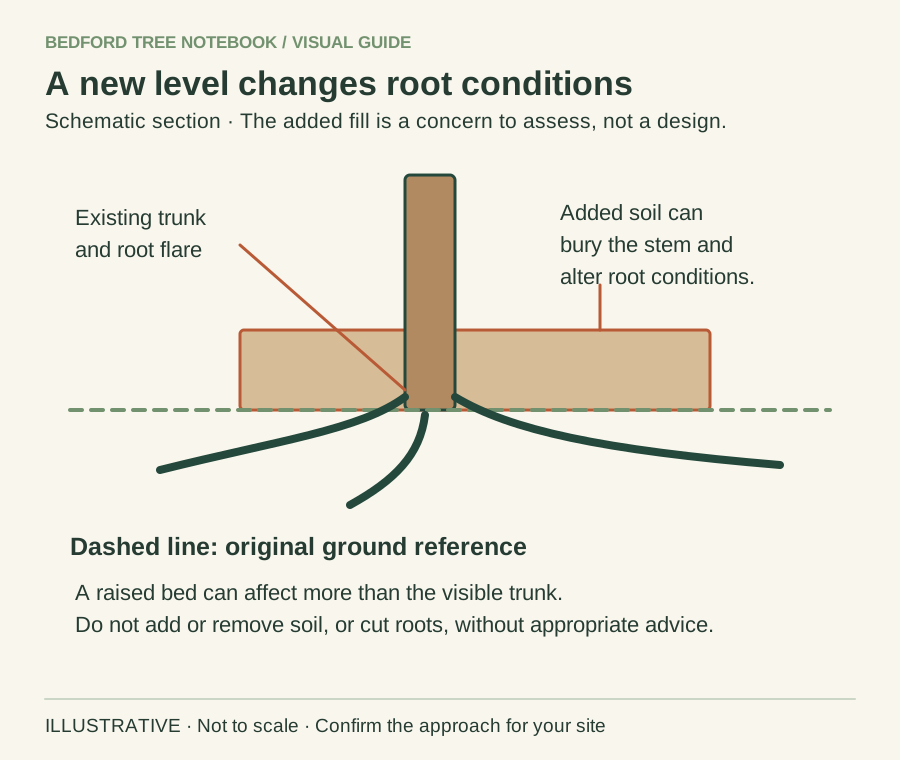
- Check the original planting level and any recorded changes before altering a new garden.
- A gap around the trunk alone does not establish that a raised bed is safe for all roots.
- Ask about the actual proposal before adding fill, removing soil or changing access over roots.
Background sources: RHS guidance · www.forestresearch.gov.uk
Describe the whole level change
Tell the adviser where soil will be added, removed, retained or compacted. Include the depth and extent where reliably known, but do not invent measurements to make the plan appear complete. A raised bed beyond the trunk can still overlap roots, and a lower path can involve excavation even when the finished design looks modest.
Explain whether this is a new proposal or a concern about work already completed. That difference affects the useful next step. For completed work, keep photographs and the construction history rather than attempting to reverse it yourself before advice. Our tree concerns after building work guide helps organise the record.
Understand why trunk burial is a concern
RHS tree-planting guidance places the first root flare at the surrounding soil surface and explains problems associated with deep planting. That principle helps explain why adding soil or a deep mound against an established trunk should not be treated as an innocuous planting improvement.
Do not infer that simply exposing a small ring around the stem resolves every effect of a wider level change. The rooting environment, drainage and construction method also matter. If the base is already buried, obtain appropriate advice before digging or cutting around it. A remediation plan needs to respond to the individual tree and what has actually happened.
Keep roots in view without guessing their extent
Roots do not stop at the visible canopy edge, and their position cannot be established from a tidy garden sketch. Ask what assessment is needed for the proposed location and operation. A bed wall, edging trench or post hole may be relevant even if the soil within the bed is not especially deep.
Our driveways near trees guide explains the wider principle of examining the complete construction rather than only its finished surface. Do not cut a root because it crosses the preferred bed line or appears inconvenient. Ask whether a different layout, construction approach or separate planting area could meet your objective with less interference.
Distinguish mulch from a raised soil bed
An appropriate surface mulch and a substantial addition of growing medium are different treatments. Mulch is not an excuse to bury the trunk or repeatedly raise the garden level as material is topped up. The mulching guide explains why the material and position need attention.
Tell the adviser whether the proposed area will contain annual vegetables, shrubs, climbers or other planting. Installation, watering, cultivation and later replacement can create continuing disturbance, not just a one-off change. A raised vegetable bed may be better located elsewhere than directly within a retained tree's important rooting environment. The decision should consider future gardening activity as well as the initial build.
Consider water movement and soil conditions
A new bed or retaining edge can change where water collects and how adjacent ground drains. Adding soil may also alter the conditions around roots. Ask how the actual design, existing levels and site conditions should be considered together rather than assuming improved drainage for vegetables will also suit the tree.
Our waterlogged-garden guide helps identify observations to report. Do not dig drainage trenches among retained roots to solve a suspected moisture problem without advice. Similarly, do not assume every Bedford plot has the same ground conditions. A suitable response depends on evidence from the actual property, not a general description of local soil.
Plan material handling and temporary storage
Heavy bags, pallets, repeated barrow movements and spoil can affect the garden before the bed is finished. Identify how materials will reach the proposed position and where they will wait. A design that avoids direct excavation can still create problems if installation repeatedly compacts the ground around the tree.
Forest Research's soil-compaction guidance explains why rooting conditions matter, but its specialist treatments should not be copied into a domestic DIY plan. Ask the relevant professionals what protective arrangements suit the project. Keep those arrangements within the contractor's price and instructions, so they are not abandoned when delivery or storage proves inconvenient.
Include walls, services and boundaries in the enquiry
A raised bed may attach to a wall, sit beside a fence or cover the route of a service. These are separate questions from the tree's condition. Explain what supports the proposed soil and who owns any neighbouring structure or land. Do not assume a timber edge requires no consideration simply because it is not a masonry wall.
The underground-services guide helps with buried hazards, while trees near retaining walls addresses a more structural setting. If different specialists are involved, give each the same current proposal. Avoid leaving a landscaper to reconcile conflicting tree, drainage and wall advice after construction has started.
Check controls before affecting a retained tree
Tree protection and relevant planning conditions may apply to the actual tree or site. Ask the responsible council or adviser about uncertainty before work that could affect retained roots or the tree's growing environment. The fact that the project is described as a raised bed does not answer every question about its effects.
Use Bedford protection checks and the planning-conditions guide to assemble the documents. Do not treat the absence of branch cutting as proof that tree considerations are irrelevant. Keep the proposed method and any approval requirements aligned, especially if the bed dimensions, edging or level change is revised.
If levels have already changed, preserve the history
Record when work occurred, materials used and any observed changes in the tree. Supply photographs from before and after if available. Do not remove soil, dismantle structures or expose roots simply to prove a theory about the cause; further disturbance can complicate the situation.
Ask for an assessment that distinguishes the actual concern, possible causes and justified next steps. A colour change or sparse crown does not establish that the bed caused damage, but the history may be relevant. The leaf-colour guide helps record symptoms. Keep any recommendations, limitations and follow-up with the project documents rather than relying on an informal assurance that the tree should recover.
Your next step
Prepare the complete bed and level-change proposal before installing it near a retained tree. Seek advice on roots, soil, water and construction arrangements, and consider a different location where that avoids unnecessary conflict. If the work is already complete, preserve the history and obtain an assessed response before attempting corrective excavation or root work.
Turn the advice into a useful project brief.
Start with the postcode, the work you have in mind and any access considerations.
Prepare your enquiryNo obligation. A site assessment may be needed to confirm the work and price.
Sources & further reading
- RHS: planting trees and shrubs
- RHS: mulches and mulching
- Forest Research: soil compaction, practical considerations
- GOV.UK: Tree Preservation Orders and conservation areas
- RHS: improving health of declining trees and shrubs
Sources checked 31 October 2026. How we prepare guidance.