
In this guide Show sections
General guidance, not a professional assessment. Confirm site-specific advice and current requirements before work.
Planning tree work in Bedford or nearby?
Start with the postcode, the work you have in mind and any access considerations.
Prepare your enquiryNo obligation. A site assessment may be needed to confirm the work and price.
Before you make arrangements
Identify what is already around the tree: soil, lawn, old mulch, paving or stump grindings. Ask before changing levels near established roots, especially where the site is constrained or a tree is protected. Our visible-root guide explains why covering an awkward surface is not automatically a harmless solution.
Mulch around, not against, the stem
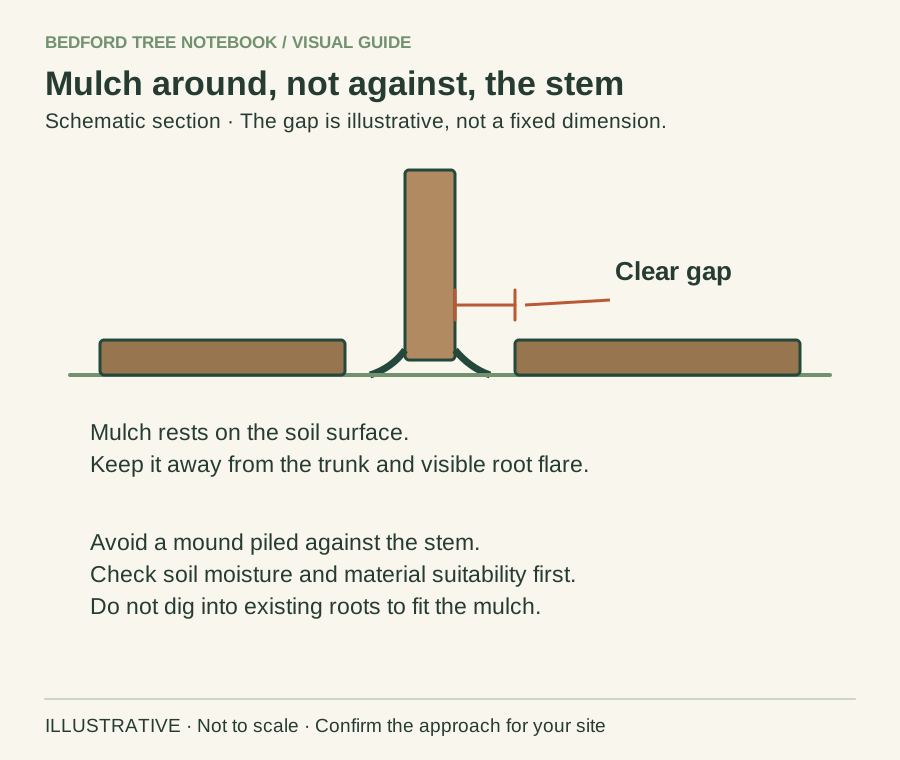
- Keep mulch clear of the trunk and root flare.
- Apply suitable material over moist soil without burying the stem.
- Do not dig or cut retained roots to prepare a mulch ring.
Background sources: RHS guidance · RHS guidance
Know what you want the mulch to achieve
Explain whether the aim is reducing competition around a young tree, conserving moisture or making ordinary garden maintenance easier. Those objectives help decide whether the proposed arrangement is appropriate. A decorative finish alone is not enough reason to add more material to a tree that is already surrounded by accumulated mulch.
The RHS mulching guidance describes common materials and practical considerations. Use it as background while checking the particular tree and site. If a nursery or landscaper has specified aftercare, keep their instructions with the planting record so a later gardener does not replace the intended arrangement with a different one simply for appearance.
Leave the trunk base clear
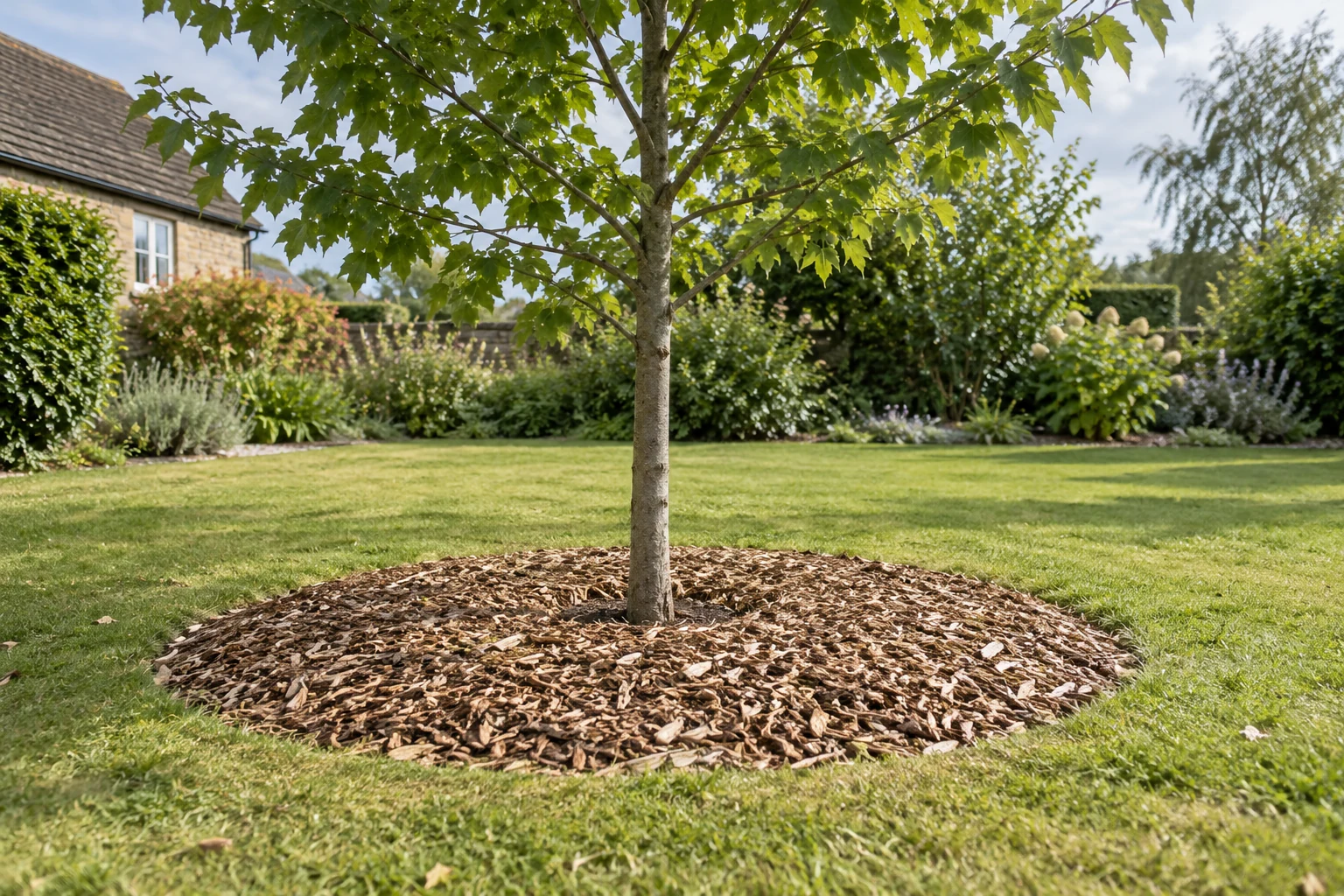
A common mistake is pushing material up against the stem so the ring becomes a steep mound. The RHS tree-planting guide advises keeping mulch away from woody stems. The important visual distinction is a surface layer around the planting area, with the trunk base left clear, rather than a cone covering it.
When asking someone to mulch the garden, describe that finished arrangement explicitly. Do not rely on “make it tidy” if the worker has not been given tree-care instructions. If the base is already buried or its original level is unclear, seek advice before removing or adding material rather than guessing how the tree was planted. For newly planted trees, the RHS describes a clear collar of about 10 cm around woody stems. Use that as a visible reference alongside the planting instructions, not a reason to excavate an uncertain established base.
Check the existing layer before topping up
Mulch changes over time, but that does not mean every maintenance visit should add a fresh full layer. Look at what remains, whether it has spread onto the stem and whether soil or debris has been mixed into it. Tell the adviser if the garden has been repeatedly topped up without a record.
A planting ring that has gradually become deeper may hide the original ground reference. Treat that as a question to resolve, not a reason to make the mound symmetrical. Ask the gardener how they will assess the existing condition and maintain the intended arrangement. The work specification should make clear whether they are replenishing a suitable surface layer or correcting an uncertain earlier installation. RHS general advice for biodegradable mulch is a layer around 5–7.5 cm over moist, unfrozen soil. Check existing depth first; that guidance is not an instruction to add the full amount repeatedly.
Choose material with the maintenance in mind
Ask what the proposed mulch contains, how it will be delivered and what preparation is included. Material supplied for a border may not be the same as fresh grindings left after a stump job. Avoid describing every woody by-product as an interchangeable planting treatment.
Our stump-grindings guide helps separate disposal arrangements from care of retained trees. If the material is coming from work elsewhere in the garden, ask whether it is appropriate for the intended use before it is spread. Keep the tree-care decision separate from a desire to avoid removal costs. A convenient place to put material is not necessarily the right place for it.
Do not bury an established root area
Mulching and raising ground levels are different proposals. If a project involves importing substantial soil, edging a deep bed or changing paving beside a tree, describe the complete works rather than calling everything “mulch”. An arboricultural adviser may need to consider the effect on retained roots and future access.
Use tree concerns after building work if recent landscaping forms part of the background. Do not cover exposed roots merely to make mowing easier, and do not cut them to produce a flat ring. Tell the professional about planned edging, excavation and access for deliveries so the advice reflects the real project, not just the final photograph.
Keep watering and drainage in view
A mulched surface does not tell you whether the planting area needs water. Make sure the aftercare plan still includes appropriate checks and that the person watering understands where the rootball is. If water collects persistently, adding more material is not a substitute for understanding the conditions.
Our first-summer tree-care guide explains the importance of a named watering responsibility. For saturated ground, read waterlogging and trees before commissioning changes. Ask the supplier how the mulch fits with the particular planting and soil. Avoid interpreting a neat, dark surface as proof that moisture beneath it is automatically suitable.
Coordinate with mowing and garden access
A clearly maintained planting area can help other gardeners notice the tree, but only if they know how it should be treated. Tell anyone cutting grass or managing borders about the trunk, supports and intended mulch edge. Machinery should not be allowed to rub the stem or turn within a sensitive planting area.
If a contractor needs to cross the garden, discuss the route separately. A mulch ring is not a designated standing place for equipment, materials or vehicles. Our lawn-protection guide helps prepare that conversation. The responsibility for protecting a retained tree should remain visible even when the immediate job is unrelated to tree care.
Write down the agreed finished arrangement
For a small garden task, the record can be simple: which trees, intended treatment area, material, preparation, what remains clear and who disposes of unwanted material. Where the site is complicated, obtain advice and a more specific scope rather than relying on a general drawing from the internet.
Ask whether maintenance or follow-up is included and how the arrangement will be checked. If several newly planted trees have different needs, label them in the record. A single instruction for “all trees” can conceal differences in age, planting position or previous treatment. Photographs can document the agreed result, but they should support the written brief rather than replace it.
Review the result as a care measure
After the task, look for consistency with the agreed scope: the intended trees treated, trunk bases clear, no unexplained changes of level and no material left where it obstructs access. If something differs, ask the person responsible to explain before anyone simply adds more mulch to disguise the issue.
Keep a photograph and date with the maintenance record so the next visit starts with useful context. If the tree later shows a concern, tell the assessor what was changed rather than assuming mulch cannot be relevant. A good result is an arrangement that fits the tree and remains manageable, not the tallest or darkest ring in the garden.
Your next step
Agree the purpose, material and finished arrangement before work begins. Keep the trunk base clear and avoid treating mulch as a way to bury roots or solve drainage by appearance. If planting is recent, combine the task with the first-summer care plan and support review so maintenance instructions stay consistent.
Turn the advice into a useful project brief.
Start with the postcode, the work you have in mind and any access considerations.
Prepare your enquiryNo obligation. A site assessment may be needed to confirm the work and price.
Sources & further reading
Sources checked 31 October 2026. How we prepare guidance.