
In this guide Show sections
General guidance, not a professional assessment. Confirm site-specific advice and current requirements before work.
Planning tree work in Bedford or nearby?
Start with the postcode, the work you have in mind and any access considerations.
Prepare your enquiryNo obligation. A site assessment may be needed to confirm the work and price.
Before you make arrangements
Keep away from a tree that appears to have moved, has hanging branches or shows another immediate concern. Avoid walking or driving over saturated ground to investigate. Note where water collects, when it appeared and any recent drainage or building changes. Use the assessment-signs guide if the concern is about the tree rather than simply the wet lawn.
Describe duration and location
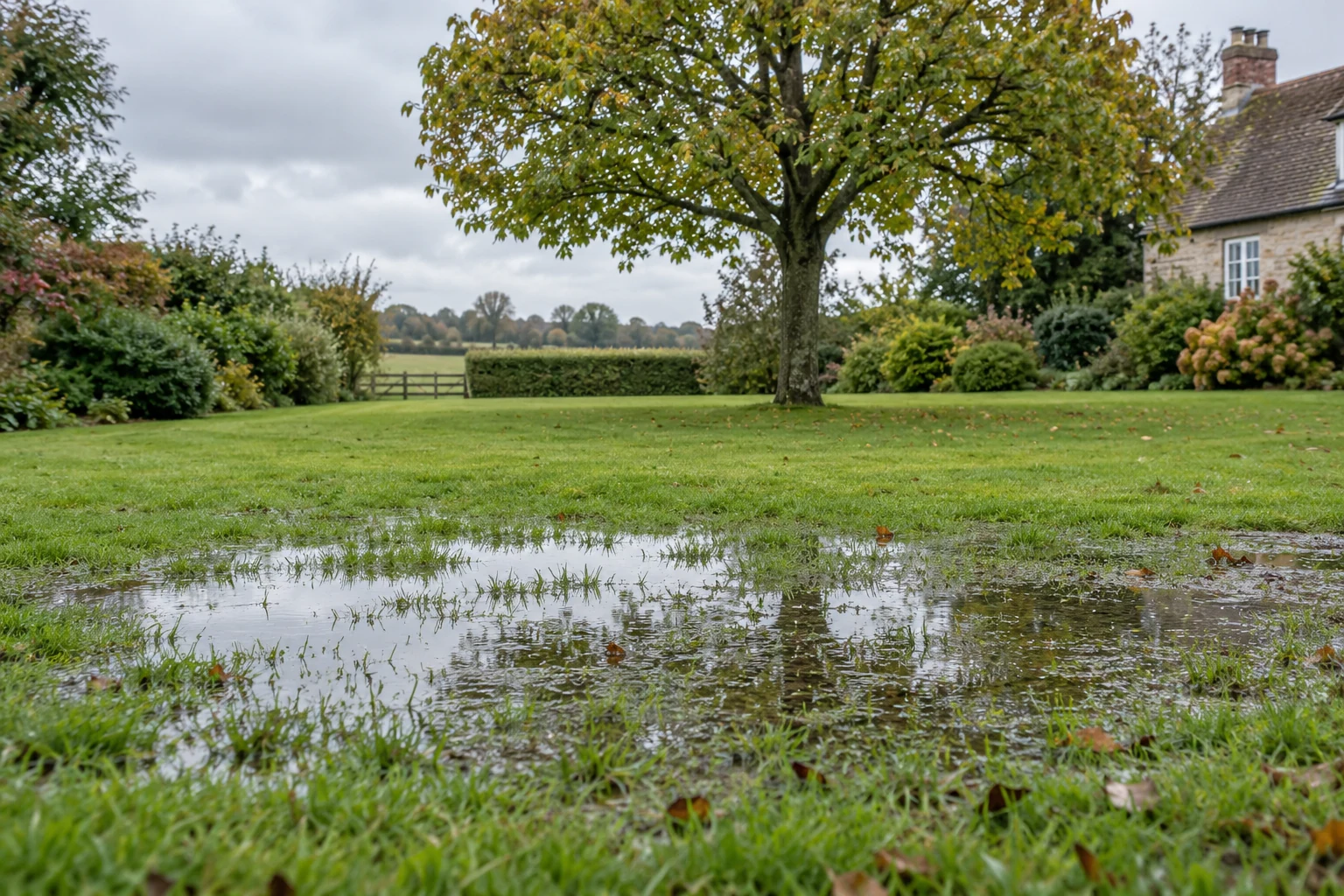
A useful record distinguishes a temporary surface puddle from persistent saturation. Note whether water disappears soon after rainfall or remains in the same area over several days. Record the observation without assuming that every Bedford garden has the same soil, drainage or relationship to a nearby watercourse.
A few dated photographs from an accessible path can show the pattern without repeated disturbance. Mark the affected tree on a simple plan if several stand in the garden. Include whether the water is against the trunk, across an access route or collecting lower down the plot. You are documenting conditions, not carrying out a drainage survey.
Understand why prolonged saturation matters
Waterlogged soil contains less air available to roots. The RHS waterlogging guidance explains why persistent saturation can affect plant health and why visible symptoms may resemble other problems. That background does not establish the cause of a particular tree’s decline.
Tell the assessor about leaf changes, dieback or reduced growth without treating any one symptom as proof. If you also suspect a change in lean or ground movement, make that clear when arranging advice. Health and structural condition are connected but distinct questions; a general gardening recommendation about wet soil should not be presented as a safety assessment.
Record changes around the garden
Think about what has changed before proposing an intervention. A new patio, altered ground levels, building work, a damaged drain or repeated vehicle access may be relevant information. Distinguish timing from causation: noticing water after an extension does not prove that the extension created the problem.
Our tree concerns after building work helps organise this history. Gather available plans, photographs and contractor records, particularly where drainage or surfacing formed part of the project. If you do not know where water goes, write that down. Guessing at a buried route can mislead both the drainage specialist and the tree assessor.
Do not dig a drainage trench through roots
An instinctive solution can create another problem if it involves excavation near a retained tree. Do not cut a trench, lower soil levels or install pipes simply because the ground looks wet. Such changes need to consider the tree, underground services, neighbouring land and a lawful destination for the water.
Read visible-root concerns and underground services before ground work before commissioning an excavation. Explain that a tree is part of the site constraints when requesting drainage advice. Tree and drainage professionals may need to coordinate their recommendations rather than supplying two unrelated quotations that conflict when work starts.
Separate drainage diagnosis from tree assessment
A drainage specialist may investigate a pipe or water route, while an arboricultural professional considers the tree and proposed changes near it. Ask each person what their inspection includes and which questions remain outside their service. One report should not be silently substituted for the other.
Our trees beside drains guide covers that coordination. If a drain is suspected, share relevant findings with the tree assessor rather than assuming removal is the first or only solution. Where flooding or sewage is involved, use the appropriate authority or utility reporting route and avoid contact with potentially contaminated water. This article does not provide clean-up or water-safety instructions.
Plan access and protect saturated ground
A visit may need to be arranged around the condition of the access route. Tell the business about soft ground, standing water, steps and surfaces that cannot support normal use. Do not lay an improvised route through a root area or invite equipment across a wet lawn without an agreed plan.
The lawn-protection guide helps separate preparation from the contractor’s working arrangements. Ask whether an initial assessment can be undertaken from existing safe access or needs to wait until suitable conditions. A delay in a routine visit is different from leaving an immediate concern unreported; explain the problem clearly so the appropriate response can be decided.
Be cautious about replacement planting
If replacement planting is being considered, investigate the site conditions before choosing a new tree. A species selected only for its appearance may repeat the same difficulties if the ground remains unsuitable. The planting position, future size and maintenance also need consideration alongside tolerance of wetter conditions.
Use replacement planting after removal to prepare that brief. Ask the adviser whether changes to the ground are appropriate and what needs to be checked first. Do not assume that importing topsoil or making a mound beside retained roots is harmless. The advice should relate to the whole site rather than treating the planting hole in isolation.
Keep tree controls in the decision
If advice proposes pruning, removal or intrusive ground work affecting a protected tree, establish the relevant planning position before instructing it. Our Bedford protection-map guide explains the starting records. Persistent water does not itself establish permission to undertake tree work.
Keep the drainage findings, tree advice and any authority correspondence together. If the proposal changes from managing water to removing a tree, make sure that change is explicit and supported by the appropriate reasoning. Commercial agreement with a contractor and regulatory approval are separate steps. Where a neighbour’s land or shared drain is involved, clarify authority and access before arranging the job.
Agree what will be reviewed afterwards
After an assessment or ground project, ask what observations should be recorded and who should review them. Water levels and plant appearance can change with weather and season, so a single photograph after work does not necessarily demonstrate a lasting solution. Retain the agreed scope and any limitations.
If the tree is retained with a recommendation for further assessment, make that action visible in the household record. If the drainage project is completed separately, share its as-built information with the tree adviser where relevant. A coordinated record avoids repeatedly starting the same conversation from an unlabelled puddle photograph while losing the investigations already undertaken.
Your next step
Prepare a short site history and describe the duration of wet conditions, relevant tree changes and access restrictions. Seek the appropriate drainage and tree advice before disturbing the ground. The tree consultant comparison can help you commission an assessment rather than a premature removal quotation.
Dry conditions raise different questions: mature trees in dry weather helps record changes without treating every leaf symptom as a watering instruction.
Turn the advice into a useful project brief.
Start with the postcode, the work you have in mind and any access considerations.
Prepare your enquiryNo obligation. A site assessment may be needed to confirm the work and price.
Sources & further reading
- RHS: waterlogging and flooding
- Bedford Borough Council: protected trees
- GOV.UK: TPOs and trees in conservation areas
Sources checked 31 October 2026. How we prepare guidance.