
In this guide Show sections
General guidance, not a professional assessment. Confirm site-specific advice and current requirements before work.
Planning tree work in Bedford or nearby?
Start with the postcode, the work you have in mind and any access considerations.
Prepare your enquiryNo obligation. A site assessment may be needed to confirm the work and price.
Before you make arrangements
Record the actual changes, when you first noticed them and any recent work around the tree. Do not climb, test branches or dig around roots to assess dryness. Our leaf-colour guide helps organise observations without turning a seasonal change into an assumed diagnosis.
A record is more useful than a guess
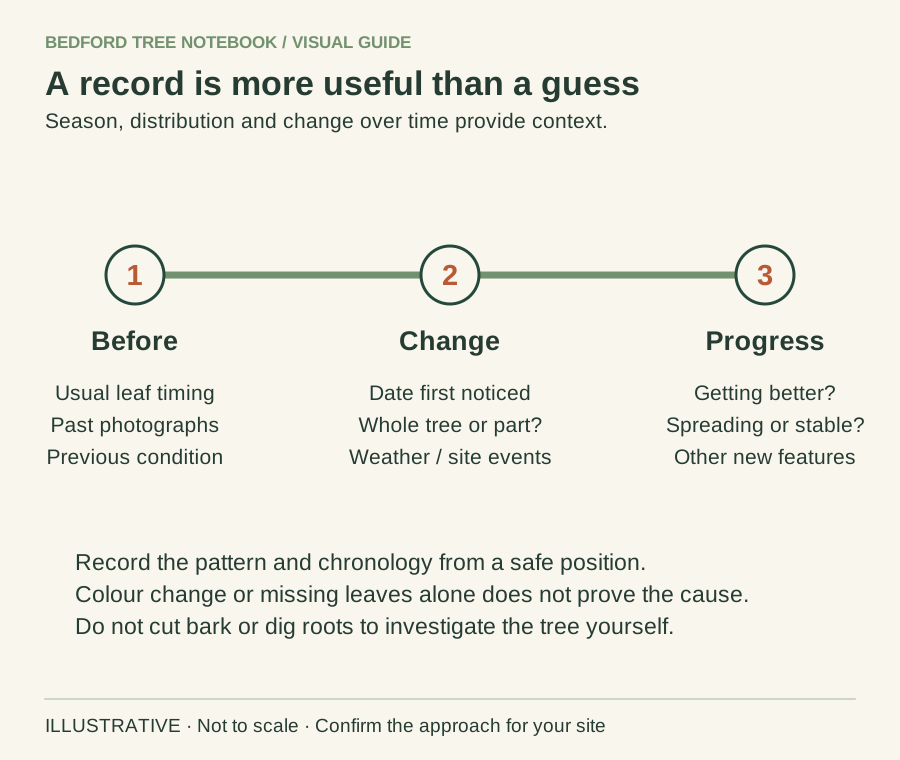
- Record dates, location on the tree and relevant site or weather changes.
- Photograph only from safe, accessible ground without approaching hazards.
- Seek appropriate assessment if changes persist, worsen or accompany structural concerns.
Background sources: RHS guidance · RHS guidance · RHS guidance
Distinguish the tree from the surrounding lawn
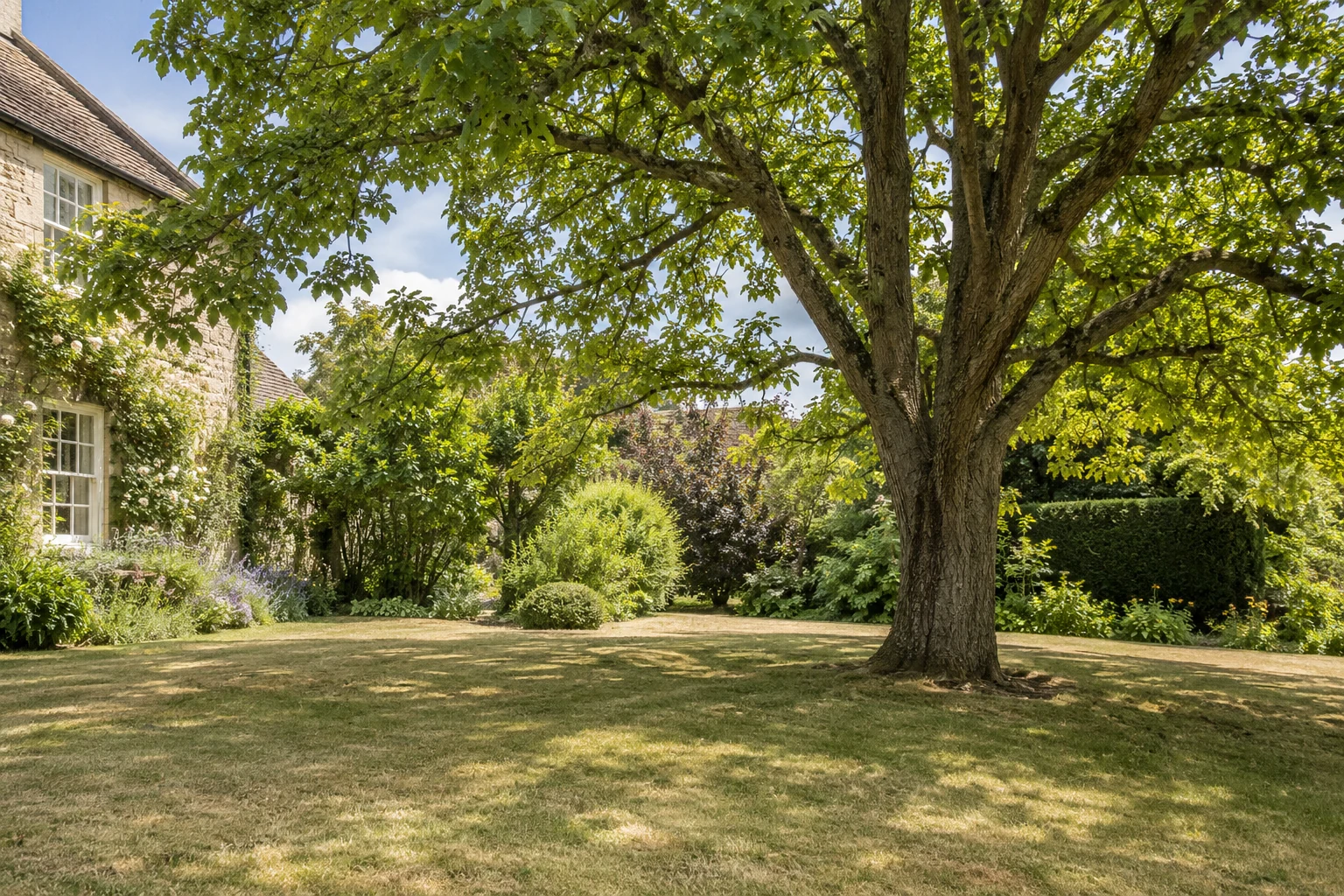
Grass may look dry while the tree's rooting environment is different, and recent rain may not mean every part of that environment has been adequately wetted. A photograph of the lawn alone cannot determine whether an established tree needs intervention. Explain the tree's appearance and site history separately.
Our newly planted tree summer-care guide addresses a different situation. Recently planted stock and long-established trees should not be given the same automatic care schedule. Ask for advice relevant to the actual specimen, ground and conditions rather than transferring a watering recommendation from a young tree to every mature tree on the property.
Record which changes are new
Note leaf size, colour, early shedding or changes in the crown that are visible from a safe position. Use dated photographs from broadly similar viewpoints if available. Distinguish a feature that has been present for years from one that appeared during the current period.
Tell the adviser if only one side or branch is affected, or if several different plants have changed at the same time. Those details help frame the enquiry without diagnosing the cause. Our tree assessment signs guide is useful where a new structural feature is also present. Do not assume dry weather explains every change simply because the timing overlaps.
Explain the individual tree and site
Species, age, establishment, condition and local growing circumstances can affect the response to dry conditions. Give any reliable planting or inspection records and say what you do not know. Avoid treating a species described as drought tolerant as immune to all stresses or other problems.
Do not assume all Bedford gardens share the same soil or exposure. A paved front garden, a shaded rear plot and a recently altered site can present different conditions. Ask whether the issue calls for horticultural advice, arboricultural assessment or another specialist. The purpose is to choose a response supported by the actual tree and setting, not a universal action triggered by a weather forecast.
Protect roots from additional disturbance
During a garden project, tell the contractor about retained trees before paving, excavation, soil storage or changes of level are planned. An already challenging growing period is not a good reason to ignore those constraints. Avoid assuming the tree will recover from any root damage once rain returns.
Read driveways near trees and tree concerns after building work for the coordination questions. Keep heavy traffic and materials within appropriately assessed arrangements. Do not dig exploratory holes or cut roots to improve access to water; the intervention itself can create a separate problem that a watering proposal will not resolve.
Ask whether watering is appropriate and practicable
If watering is being considered, ask what the actual objective is and whether it is appropriate for the specimen and site. The RHS watering guidance explains why plant needs and conditions matter. It is not a fixed litres-per-week prescription for every large tree.
Discuss how any recommended approach would reach the relevant soil without creating runoff, waterlogging or unsafe access. Consider current local water-use restrictions where applicable. Do not fit an elaborate irrigation system or excavate around a mature tree simply because a generic guide recommends more water. Obtain advice before a substantial intervention, and keep the plan responsive to changing conditions.
RHS distinguishes generally resilient established trees from newly planted stock, while recognising that exceptional drought can justify selective watering. The useful decision is therefore which plants actually need help and how it can be delivered appropriately, rather than watering every mature tree to a fixed timetable. Symptoms and site conditions still require interpretation.
Do not assume pruning will relieve the problem
A reduction in visible foliage is not a universal treatment for dry-weather concerns. Ask what evidence supports any proposed operation and how it suits the tree's condition. A contractor should explain the objective rather than offering a broad crown cut as an automatic response to leaf shedding.
The remove-or-prune guide helps frame that decision. If the recommendation is to defer elective work or undertake further assessment, ask what observations should prompt another contact. A practical work quotation and an assessment of the underlying concern are different deliverables. Keep that distinction clear when deciding whether an appointment is for advice, an inspection or a specified operation.
Keep building concerns on the correct route
Dry weather sometimes coincides with worries about cracks or movement in a house. The nearby tree should not be assumed to be the cause. Report the building concern to the relevant professional and insurer as appropriate, and ask how any arboricultural input should be coordinated with the investigation.
Our subsidence-concerns guide explains why removal should not be treated as a harmless precaution or an immediate cure. Do not use a dry lawn, leaf shedding or species reputation as proof of causation. Keep building observations and tree observations identifiable so the responsible advisers can decide what the evidence actually supports.
Include habitat and controls in any work decision
If work is recommended, the usual ownership, wildlife and protection questions still apply. Dry conditions do not automatically authorise cutting or establish a legal exemption. Ask the relevant professional and council about the actual proposal where uncertainty remains.
Use Bedford tree-protection checks and the active-nest guide for different parts of the preparation. Do not disturb cavities or remove deadwood yourself to check what is present. A concern about the tree's response to weather should lead to proportionate assessment, not an undefined permission to strip habitat features or make a preferred garden change.
Review observations after conditions change
Continue the record in the form recommended by the adviser. A change after rain can be useful information but does not prove the original cause or establish that all concerns have disappeared. Ask what follow-up is appropriate and which new features should prompt earlier professional contact.
Our long-term care guide helps connect seasonal observations with existing reports and recommendations. Avoid setting a permanent treatment schedule from one unusual summer. Keep the tree's response, site changes and professional findings together so a later decision can account for the pattern rather than relying on a single alarming photograph or a reassuring view after rainfall.
Your next step
Observe safely, record changes and protect the rooting environment from additional disturbance. Seek advice appropriate to the tree and concern before introducing watering, pruning or other interventions. Coordinate any building-movement questions with the right specialists, and keep follow-up proportionate to actual findings. A dry spell is context for assessment, not a diagnosis or a universal tree-work instruction.
Turn the advice into a useful project brief.
Start with the postcode, the work you have in mind and any access considerations.
Prepare your enquiryNo obligation. A site assessment may be needed to confirm the work and price.
Sources & further reading
- RHS: watering plants wisely
- RHS: brown leaves on woody plants
- RHS: trees near buildings
- Bedford Borough Council: protected trees
- RHS: improving health of declining trees and shrubs
- RHS: weather damage
Sources checked 31 October 2026. How we prepare guidance.