
In this guide Show sections
General guidance, not a professional assessment. Confirm site-specific advice and current requirements before work.
Planning tree work in Bedford or nearby?
Start with the postcode, the work you have in mind and any access considerations.
Prepare your enquiryNo obligation. A site assessment may be needed to confirm the work and price.
Before you make arrangements
Find the planting date, species or cultivar, supplier instructions and any agreed aftercare. Note whether the tree was planted in the ground or remains in a container. Identify who will look after it during holidays or a change of tenancy. Our replacement planting guide helps connect this summer’s care with the original site and planting decisions.
Water the roots, check the conditions
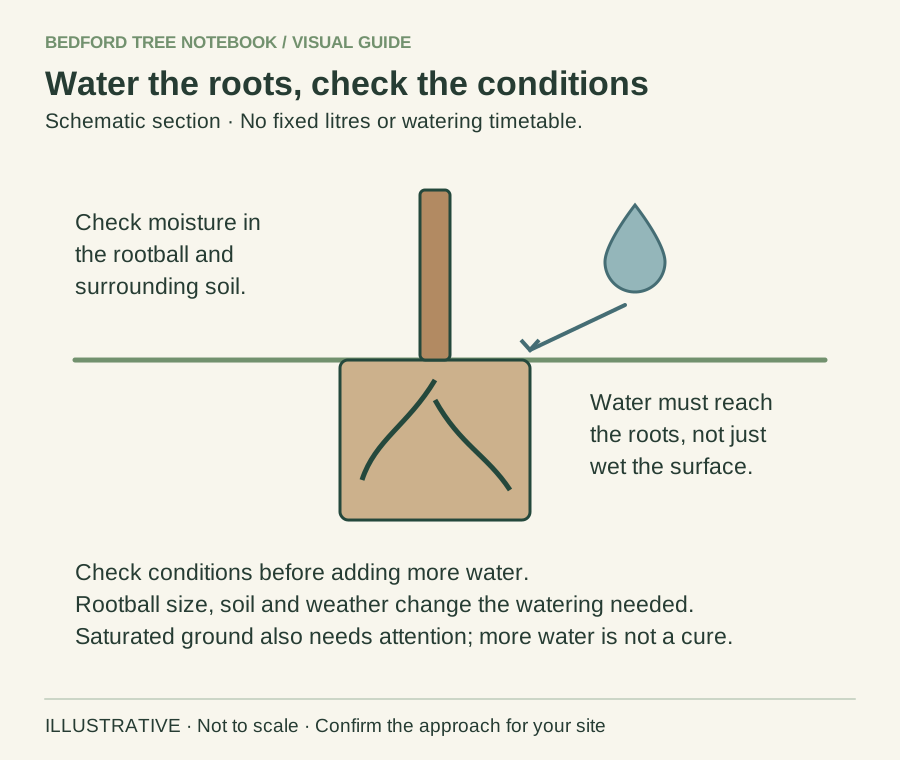
- Check the actual rootball and surrounding soil conditions using the planting advice for your tree.
- Water needs vary with size, weather, drainage and planting conditions.
- Arrange aftercare cover during holidays and seek advice if symptoms persist.
Background sources: RHS guidance · RHS guidance
Ask for an aftercare plan that fits the tree
If a nursery, landscaper or tree contractor supplied the tree, ask what their recommended aftercare involves and who carries it out. Clarify whether follow-up visits are included or whether the household is responsible between visits. Make any warranty conditions understandable before assuming the supplier will identify a problem automatically.
Record the type and size of planting stock if known. A small bare-root tree and a much larger specimen may need different establishment arrangements. The RHS planting guide provides background, but the useful handover explains your tree, your site and the circumstances that should prompt contact with the supplier.
Look beyond the surface after rain
Rain on the lawn does not always tell you how much moisture has reached the newly planted rootball. Explain the position if the tree stands near a wall, beneath another canopy or where water tends to run away. These site details are more useful than assuming every wet-looking garden needs the same response.
The RHS watering guidance emphasises slow watering around young-tree roots and attention during dry spells. Ask the supplier how to assess moisture for the particular planting. Avoid a rigid calendar that adds water regardless of conditions, and do not interpret wilting alone as proof that more watering is always the answer. Water slowly over the rootball area so it can soak in rather than immediately running away. Adjust the plan to actual moisture and weather; do not keep applying water to saturated ground simply to complete a daily task.
Make watering a named responsibility
A first-summer routine can fail because everyone assumes someone else has watered. Agree one person to oversee the checks and a simple way to record what has been done. If several people help, distinguish checking conditions from automatically applying water every time they pass the tree.
Before a holiday, explain the agreed method, access to equipment and whom to contact if conditions change. Include any local water-use restrictions that apply at the time, checking current supplier guidance rather than relying on an old exemption remembered from another summer. If a contractor provides aftercare, confirm how missed access or extreme weather will be handled and recorded.
Use mulch as part of establishment
A suitable mulch can reduce competition and help conserve moisture, but it does not remove the need for observation or replace appropriate watering. Ask what material and arrangement were intended, especially if other household members may top it up during normal garden maintenance.
Our mulching around trees guide explains why the trunk base should not be buried in an accumulating mound. Keep the planting record clear if a landscaper intends to return to complete borders or lay turf. The person finishing the garden should understand that covering the planting area is part of the tree’s aftercare, not simply a cosmetic opportunity to conceal bare soil.
Keep routine gardening away from the stem
A young tree can be overlooked when the lawn is mown or edges are trimmed. Make its position obvious to anyone maintaining the garden and agree how the planting area will be kept clear of competing vegetation without damaging the stem or shallow roots. Do not use the trunk as a convenient support for other equipment.
If a guard was supplied, ask how it should be checked as the tree grows and what the particular product is intended to do. A guard is not a reason to run machinery close to the stem. Where several contractors maintain different parts of the garden, include the tree in their shared instructions rather than relying on a verbal comment made on planting day.
Review ties and supports
Look at the support arrangement as part of ordinary ground-level observation. A tie that was suitable at planting can later rub, tighten or break; a stake can become loose or lean. Do not assume that supports can be left indefinitely because the tree still appears upright.
Use reviewing tree stakes and ties for the questions to raise. The decision to adjust or remove support should reflect establishment and the particular system, not a date selected without checking. If the tree moves at the base or the support has failed, seek advice rather than pulling the stem upright and tightening everything as firmly as possible.
Record symptoms without prescribing a cure
If leaves change colour, shoots die back or growth seems poor, note when it began and whether conditions have changed. A safe photograph of the whole young tree and planting area helps the supplier understand more than a close-up of one leaf. Include watering and planting history with the enquiry.
Do not respond to every symptom with fertiliser, pruning or additional water. Different causes can produce similar visible effects, and an unsuitable intervention may distract from the original issue. Our waterlogging guide explains why excessive moisture also needs consideration. Ask what should be left unchanged until the adviser has enough information to recommend the next step.
Keep expectations realistic through the season
A newly planted tree is not a finished feature with guaranteed growth in a particular month. Ask the supplier what progress is reasonable for that stock and how they would distinguish routine establishment from a concern. The response should take account of the season and the planting circumstances rather than promising a uniform result.
If replacement is suggested, first understand why the original planting struggled. Our small-garden replacement-tree guide helps revisit mature size and site suitability. Replacing the same tree in the same unresolved conditions can turn an aftercare difficulty into a repeated project. Keep decisions about the location, stock and maintenance together.
Hand the record into the following year
At the end of the first summer, keep the planting date, species details, advice, photographs and any unresolved questions. Note which supports or guards remain and who is responsible for checking them. These details are useful if the household changes gardener, tenant or contractor before the next growing season.
Do not delete the aftercare reminder merely because the tree has survived its first summer. Establishment can take longer, particularly for larger stock. Ask what should continue and when support or maintenance should be reviewed. A short, accessible record is more practical than leaving the only instructions inside a nursery label that may weather or become separated from the tree.
Your next step
Start with the supplier’s site-specific instructions, assign responsibility and keep a simple care record. Ask for advice if the tree or its support changes rather than adding treatments by guesswork. Pair this guide with mulching and stake-and-tie checks so the first summer is managed as one coordinated aftercare job.
Turn the advice into a useful project brief.
Start with the postcode, the work you have in mind and any access considerations.
Prepare your enquiryNo obligation. A site assessment may be needed to confirm the work and price.
Sources & further reading
Sources checked 31 October 2026. How we prepare guidance.