
In this guide Show sections
General guidance, not a professional assessment. Confirm site-specific advice and current requirements before work.
Planning tree work in Bedford or nearby?
Start with the postcode, the work you have in mind and any access considerations.
Prepare your enquiryNo obligation. A site assessment may be needed to confirm the work and price.
Before you make arrangements
Find the planting date, original instructions and details of the support system if available. Observe from ground level without pulling the trunk or trying to test anchorage yourself. If the tree has moved at its base, the support has failed or access is unsafe, ask the supplier or a competent professional what should happen next. Our first-summer guide places supports within the wider aftercare plan.
Review ties as the stem grows
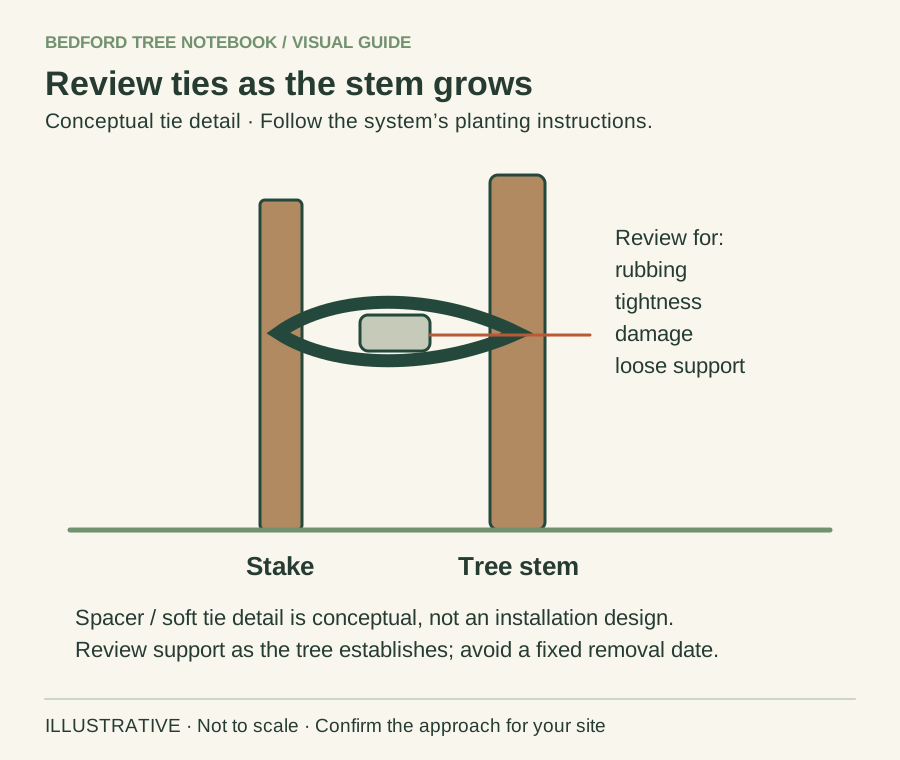
- A tie should support the tree without constricting the growing stem.
- Check support condition and abrasion, especially after damaging weather.
- Removal depends on establishment, stock and the support system, not one universal anniversary.
Background sources: RHS guidance
Understand what the support was intended to do
A support arrangement should relate to the tree, stock size, exposure and planting circumstances. Different systems are not interchangeable simply because they all contain a stake. If you inherited the garden, do not assume that a conspicuous tall support was correctly selected or that a small tree automatically needs the same treatment.
The RHS guide to staking trees provides an overview of approaches. Ask the supplier or adviser to explain the purpose of the system already installed. Clarifying that intention helps you recognise whether later maintenance is preserving the intended support or merely keeping an old stake in place because nobody has reconsidered it.
Look for changes at the tie
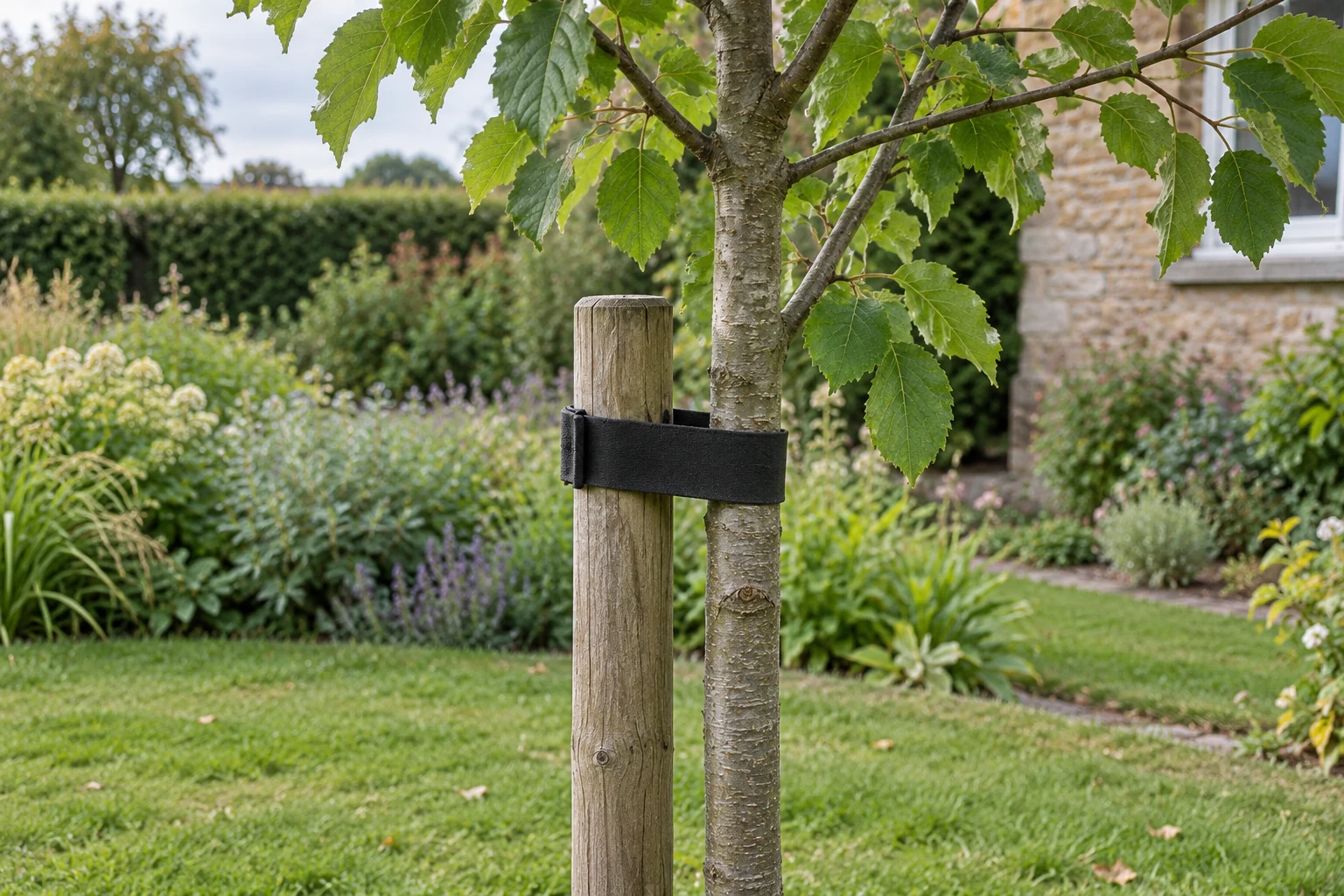
Observe whether the tie appears tight, damaged, displaced or rubbing against the stem. Growth can change the fit over time, and the condition after a windy period may differ from the condition at planting. A tidy-looking bow or strap does not itself show that support is suitable.
If bark looks affected, report what you see rather than tightening another tie around the same area. Do not replace a purpose-made system with improvised wire or cord while waiting for advice. A photograph taken from a safe, accessible position can help the supplier understand the arrangement. Include the whole support as well as the part you are concerned about.
Notice the stake and surrounding ground
A leaning, loose or broken stake raises questions about the support and the planting, not simply about how firmly someone can drive it back into the ground. Describe any movement, changes in soil level or recent garden work. If the route around the tree has become a regular passage, mention that as part of the history.
Our waterlogging guide is useful where the ground is persistently wet. Do not probe around roots or excavate to inspect the anchorage yourself. Ask whether the tree needs a site visit and what observations can safely be made beforehand. A support problem should not become an unplanned root-disturbance project.
Avoid a universal removal anniversary
There is no useful rule that every support must be removed after exactly the same number of months. The right decision depends on establishment, the planting stock and the type of support. The RHS describes typical support periods rather than a guarantee that a calendar date fits every tree.
Ask the installer what review was intended and who should decide when the support can be changed or removed. Record that decision rather than leaving the instruction as “take it out next year”. If a tree still seems dependent on support after the expected period, seek an explanation of the underlying issue instead of simply replacing the stake indefinitely. As background, RHS guidance describes roughly eighteen months to three years as typical, with longer support possible for some stock. It also recommends checking after bad weather. Those observations support a review rather than automatic removal on an anniversary.
Keep supports separate from guards and labels
A tree guard, nursery label, irrigation device and support tie can each have a different purpose and review requirement. Make a simple record of what is fitted, especially if the tree came with several accessories. An instruction to check the stake does not necessarily cover a label or guard that has become tight.
When arranging garden maintenance, identify which items the worker may adjust and which need advice first. Do not let accessories accumulate because each was added by a different person. The mulching guide also helps keep the base visible, making it easier to notice the arrangement without moving material or disturbing the planting.
Do not force a tree into a preferred position
If the trunk appears to lean, explain whether that is new and whether the base or support has moved. Pulling the stem upright and fastening it as tightly as possible is not a substitute for understanding why the position has changed. The tree may need an assessment of planting, support or another factor.
Read leaning trees and assessment for the distinction between appearance and a changing concern. Avoid using a larger stake to conceal an unresolved problem. Ask the supplier what information they need and whether any temporary access precautions are appropriate. The aim is suitable establishment, not an artificially rigid trunk at all costs.
Give the next gardener a clear handover
Support maintenance is often lost when the person who planted the tree is no longer the person caring for it. Keep the planting date, species, installer details and review instruction somewhere accessible. If a landlord or managing agent arranges the work, clarify which checks the occupier is expected to report and which visits are provided.
Our landlord tree-management guide explains the wider record. If a contractor changes a support, ask for a short note of what was done and what remains to review. That is more useful than an invoice saying only “garden maintenance”, especially when several trees have different systems or were planted at different times.
Review after other garden works
A support can be knocked, buried or altered during a project that has nothing to do with the tree. Tell anyone laying turf, moving materials or working on a nearby fence about the planting and its accessories. Do not assume a stake is a convenient fastening point for temporary netting or equipment.
If damage occurs, document it safely and contact the person responsible for tree aftercare. Our preparing a garden for tree work provides a broader coordination checklist. Check that any reinstatement preserves the intended ground level and leaves supports accessible for review rather than hiding them within a new border or raised edge.
Agree the final support decision explicitly
When a professional reviews the arrangement, ask whether it should remain, be adjusted, be replaced or be removed, and why. If there are conditions attached, record them. Understand who will carry out the change and whether another review is needed afterwards.
Where the tree’s establishment is uncertain, keep that question open instead of treating a support adjustment as a complete answer about health or stability. If replacement planting is recommended, revisit the site and stock choice before repeating the same installation. Our replacement planting guide helps organise that decision. A good record follows the tree’s needs rather than the life of the original stake.
Your next step
Make support checks part of the tree’s ordinary aftercare record and ask for advice about tight ties, rubbing, failed stakes or changing position. Use the planting history and actual establishment to guide the review. Combine this with first-summer care and mulching rather than leaving each accessory to a different, undocumented maintenance routine.
Tree guards need a separate check: rubbing, damage and trapped growth can be relevant even where the supporting tie appears satisfactory.
Turn the advice into a useful project brief.
Start with the postcode, the work you have in mind and any access considerations.
Prepare your enquiryNo obligation. A site assessment may be needed to confirm the work and price.
Sources & further reading
Sources checked 31 October 2026. How we prepare guidance.