
In this guide Show sections
General guidance, not a professional assessment. Confirm site-specific advice and current requirements before work.
Planning tree work in Bedford or nearby?
Start with the postcode, the work you have in mind and any access considerations.
Prepare your enquiryNo obligation. A site assessment may be needed to confirm the work and price.
Before you make arrangements
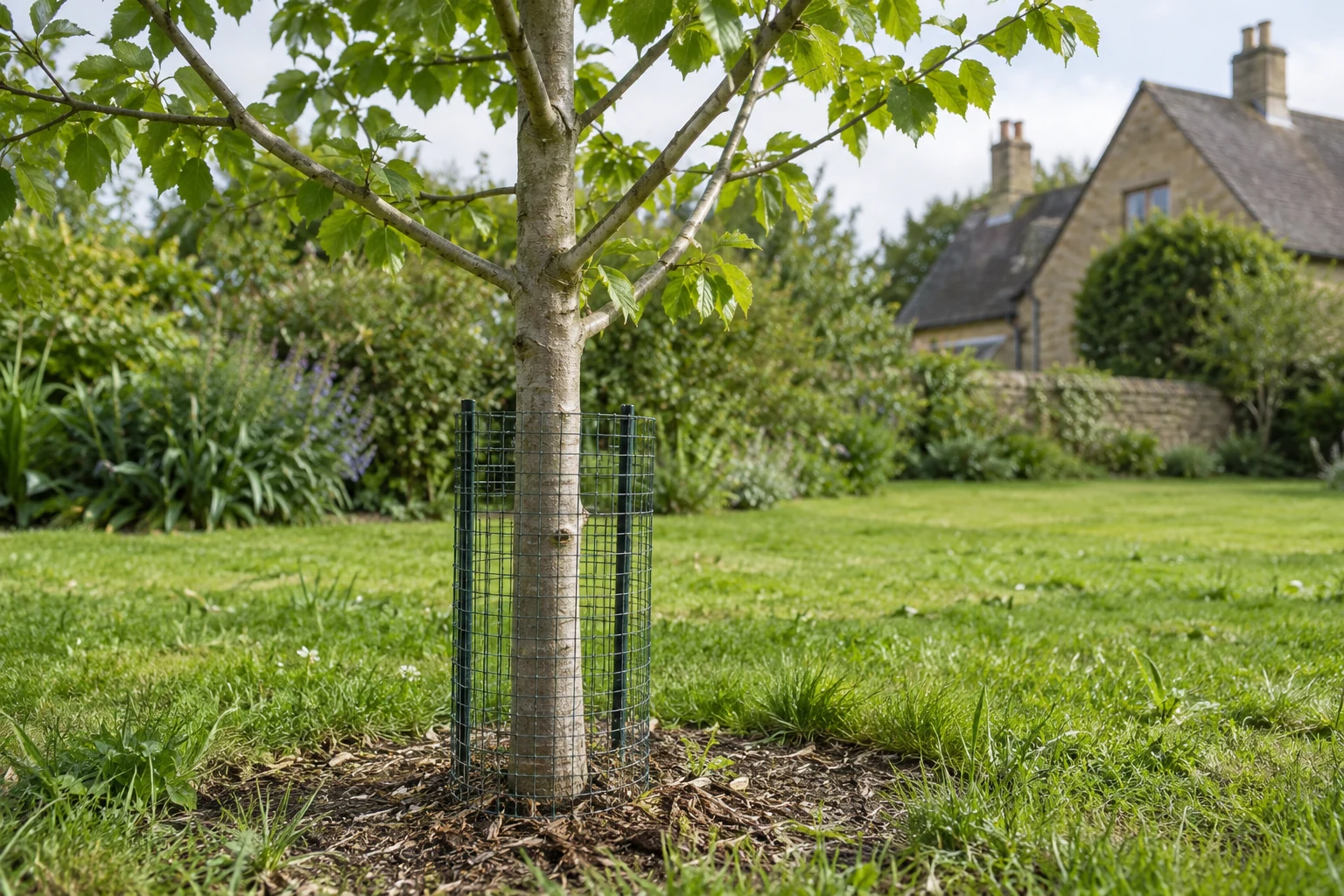
Observe from safe ground and record visible contact, damage or trapped growth without forcing material away from bark. If the guard is embedded, sharp, unstable or difficult to handle, seek competent help. Our stakes-and-ties guide covers a related but different system: support against movement is not the same purpose as protection from browsing or other damage.
Protection must allow for growth
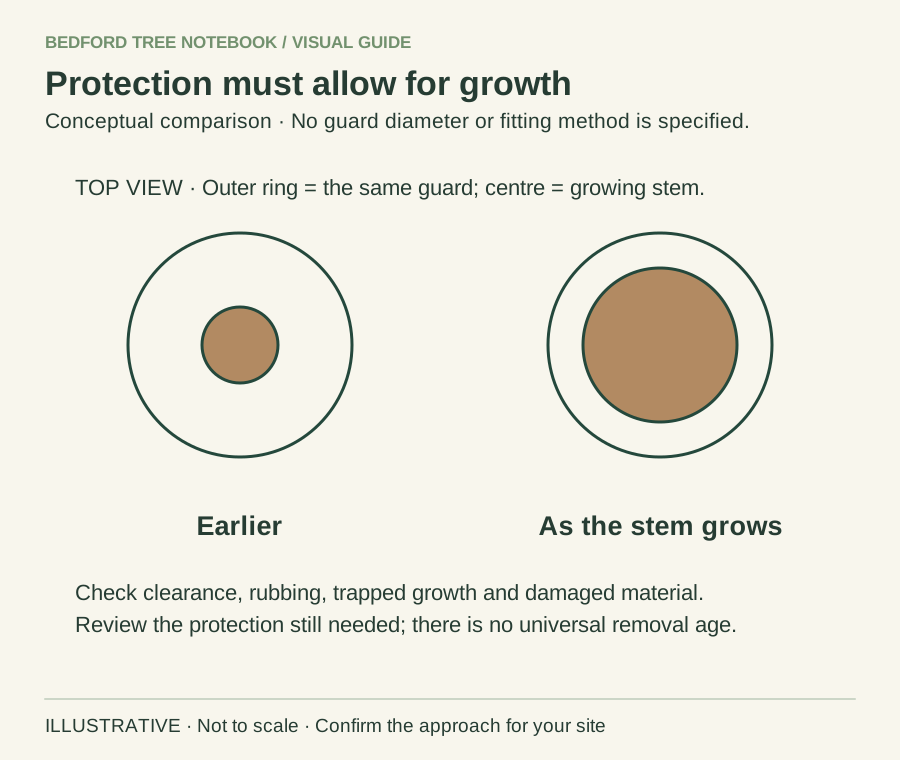
- A guard can become unsuitable as the stem grows or the material deteriorates.
- Review animal protection and aftercare together instead of removing every guard on one anniversary.
- Seek help where material is trapped against bark; do not cut blindly against the tree.
Background sources: www.woodlandtrust.org.uk · GOV.UK guidance
Identify the purpose of the guard
Ask what the guard was installed to protect against. A mesh barrier, spiral, tube or larger enclosure may address different animals or site conditions. The Forestry Commission guidance on protection from mammal damage describes why design needs to match the threat.
Do not assume a guard is necessary merely because it was supplied, or unnecessary merely because no damage is visible today. Find the planting or handover instructions where possible and ask who is responsible for review. This is especially relevant on a new development or shared garden, where the homeowner may not have chosen the original protection.
Keep guards, stakes and ties distinct
A guard protects; a stake-and-tie arrangement provides support where appropriate. They may sit close together, but changing one can affect the practical arrangement of the other. Identify what is attached to what before deciding that a loose or rubbing part can simply be removed.
Our tree stakes and ties guide explains why support requirements change with establishment. A tree needing a guard does not automatically need indefinite staking, and a tree still needing support may no longer need the same guard. Ask for the actual functions and review points to be explained rather than treating all hardware around the stem as one permanent installation.
Look for contact and altered fit
Record whether the tree is pressing against the material, whether an edge is rubbing and whether growth has become trapped. Include an overall photograph showing the arrangement and a closer view only where safely accessible. Do not prise an embedded guard away from the stem to reveal the injury underneath.
The tree increases in girth, so an initially generous fit can change. A label suggesting a long product life is not a substitute for checking the actual tree. If bark appears damaged, ask whether assessment is needed before replacement or removal. The aim is to address the cause of contact without creating further injury during a hurried attempt to tidy the planting area.
Record weeds, debris and the base condition
Growth and debris inside a guard can obscure the stem and make routine observation harder. Note what is present and whether it appears to be pressing against the tree or trapping a component. Avoid pulling material forcefully if you cannot distinguish it from the tree or if the guard's condition is uncertain.
The Woodland Trust management guidance includes checking and reviewing guards as part of establishment care. Its woodland context is useful background, not a universal instruction for every domestic product. Ask what routine care is appropriate for this guard and tree, especially where a contractor or developer remains responsible.
Do not diagnose the tree from a damaged guard alone
A rubbing guard is a concern to address, but altered foliage, poor growth or a leaning stem may have several explanations. Tell the adviser about planting history, watering, ground conditions and support as well as the visible contact. Do not assume changing the guard will automatically resolve every symptom.
Our leaf-colour guide helps organise the broader observations. A photograph does not establish the depth or consequences of bark damage, and a tree producing new leaves is not proof that constriction is harmless. Ask what can be concluded from the inspection, what remains uncertain and whether any further review is recommended.
Ask whether replacement, adjustment or removal is justified
The decision should consider current protection needs, the tree's size, the guard's condition and practical access. There is no single age at which every guard becomes redundant, and no reason to retain a harmful fit merely to reach a nominal removal date. Ask for a recommendation suited to the actual tree.
If a replacement is proposed, clarify what problem it addresses and how it will be reviewed as growth continues. Do not replace a rubbing component with an improvised tight wrap or attach hardware directly to the bark. Where removal is awkward or material is embedded, obtain competent help rather than cutting blindly beside the stem.
Keep the surrounding planting area suitable
Guard care belongs alongside watering, mulch and other establishment tasks, but those tasks should not be confused. A guard does not compensate for unsuitable planting conditions, and mulch should not be piled inside it against the trunk. Keep the original planting information available when asking for advice.
Our mulching guide explains the surface-treatment question, while new-tree summer care addresses moisture needs. If soil has been added or the tree seems buried, report that separately rather than excavating around the base yourself. An appropriate care plan considers the planting as a whole instead of solving one visible problem while ignoring another.
Clarify authority on shared or newly built sites
Before changing guards on a communal or developer-managed tree, confirm who can instruct the work. A tree within sight of your home may belong to a management company, landlord or another owner. Report the observed problem through the agreed route and keep a record of the response.
The new-build tree-care guide helps identify relevant handover and planting documents. Avoid assuming a guard is purely decorative or that replacing it answers any planning-condition question. The practical care responsibility and legal records may involve different people, so make sure the concern reaches whoever can arrange a competent response for that tree.
Create a review point rather than forgetting it again
Record what was found, what was changed and who carried out the work. Ask what signs should prompt another contact and how future guard checks fit with the tree's establishment plan. If animal damage remains a risk, keep that purpose visible so protection is not removed without a considered alternative.
Our long-term Bedford tree-care guide provides a simple way to connect observations and actions. Do not assume a new guard can now be ignored for its advertised lifespan. A successful response leaves the tree's fit, protection needs and future responsibility understood, rather than merely making the immediate arrangement look tidier.
Your next step
Record the guard's purpose, visible fit and any rubbing or trapped growth. Ask for a tree-specific recommendation, especially where material is embedded or damage is apparent. Keep support and protection decisions separate, clarify responsibility on shared sites, and include guard review within the wider establishment plan rather than relying on a universal removal date.
Turn the advice into a useful project brief.
Start with the postcode, the work you have in mind and any access considerations.
Prepare your enquiryNo obligation. A site assessment may be needed to confirm the work and price.
Sources & further reading
- Forestry Commission: protecting trees from mammal damage
- Woodland Trust: managing your woodland
- RHS: planting trees and shrubs
- GOV.UK: TE8 tree guard
Sources checked 31 October 2026. How we prepare guidance.