
In this guide Show sections
General guidance, not a professional assessment. Confirm site-specific advice and current requirements before work.
Planning tree work in Bedford or nearby?
Start with the postcode, the work you have in mind and any access considerations.
Prepare your enquiryNo obligation. A site assessment may be needed to confirm the work and price.
Before you make arrangements
Ask the developer or seller for the planting schedule, landscape plan, care information and any relevant planning documents. Record which tree each document describes. Our tree-permission records guide provides a useful filing approach, while the new-tree summer-care guide covers the separate practical question of early establishment.
A new level changes root conditions
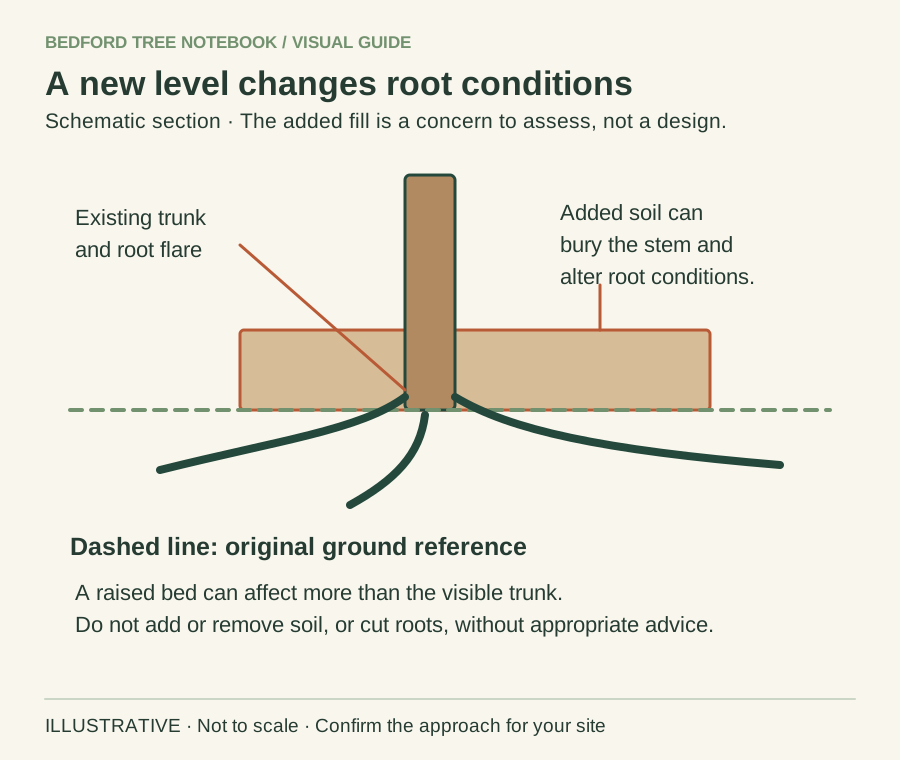
- Check the original planting level and any recorded changes before altering a new garden.
- A gap around the trunk alone does not establish that a raised bed is safe for all roots.
- Ask about the actual proposal before adding fill, removing soil or changing access over roots.
Background sources: RHS guidance · www.forestresearch.gov.uk
Distinguish newly planted and retained trees
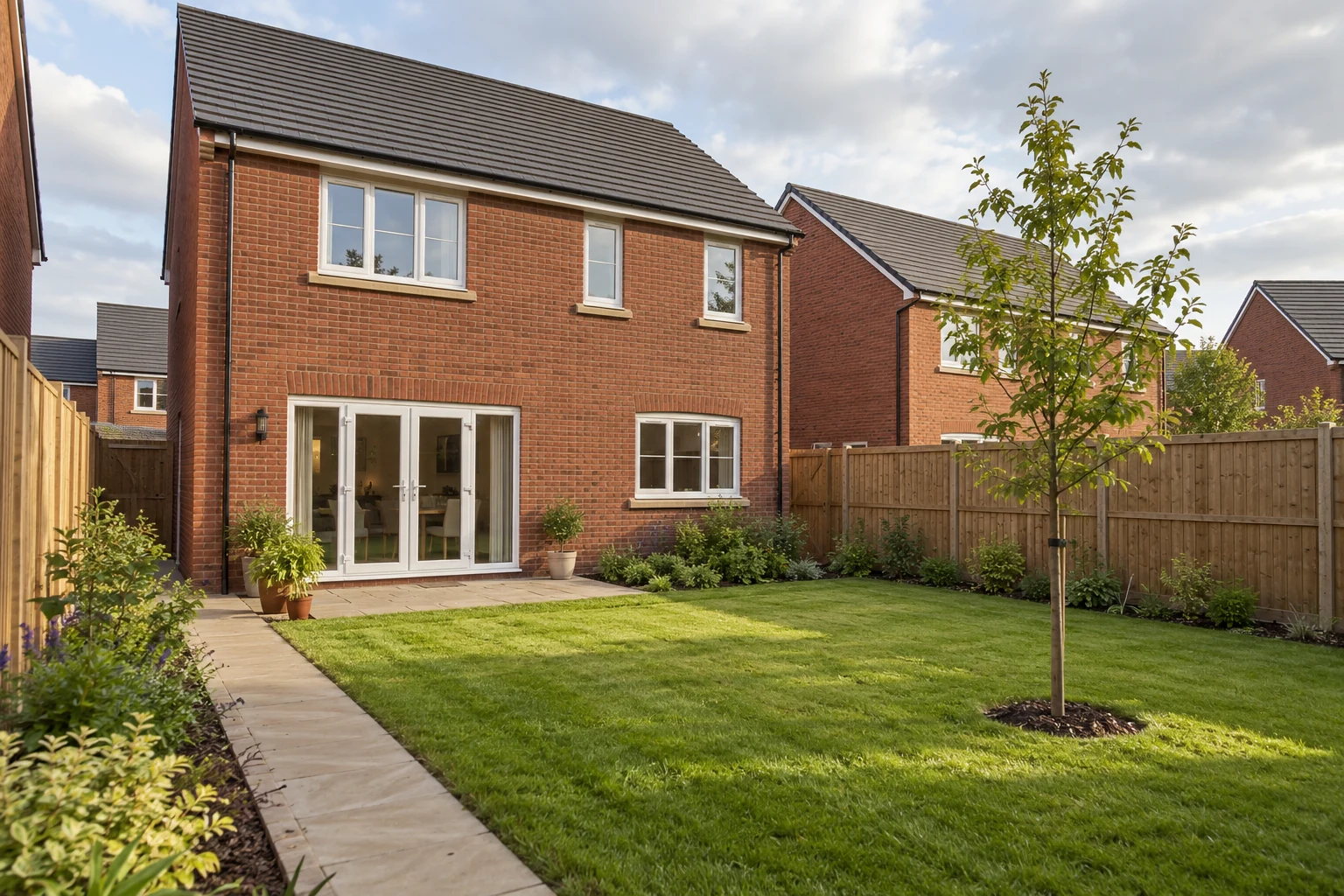
Identify the trees shown on the development plans and compare them with what is present. Ask for clarification if a label, position or species does not match. A mature tree beside the plot may predate the development and belong to another owner; a small tree within the fence may be part of an approved landscape scheme.
Keep those categories separate when seeking advice. Recently planted stock and a retained mature specimen do not have identical care needs or histories. Our young-versus-mature pruning guide explains one important distinction. Do not assume every tree is yours to move, remove or reshape simply because it is visible from the new garden.
Read the actual landscaping and aftercare conditions
Bedford Borough Council's Trees and Development Supplementary Planning Document, adopted in 2024, explains the local policy context for retaining and establishing trees in development. The specific permission and approved documents for your property still matter more than a general summary.
Conditions may address planting, aftercare or replacement, but do not assume one standard period or responsibility applies to every home. Ask the responsible adviser or council to clarify the actual wording. Our planning-conditions guide helps organise that enquiry. Keep promises made during a sales conversation distinct from the documents that define the approved scheme and any obligations.
Clarify who is arranging the care
Ask who is responsible for watering, checking supports, reviewing guards and responding to failure during the relevant handover or maintenance period. That might involve the homeowner, developer, management company or another party, depending on the actual arrangements. Do not infer the answer from who last mowed the grass.
Request a clear contact route for concerns, and retain the response. If the garden is shared or the property is rented, check authority before commissioning changes. A care task being assigned to someone does not necessarily settle every ownership or legal question. Keep the practical action list readable so a missed watering or damaged guard is reported to the right person rather than passed between several businesses.
Understand the rooting environment before altering it
Construction can affect soil structure, drainage and levels, but a newly built garden should not be diagnosed from its age alone. Record standing water, unusually hard ground or other observations and ask for suitable advice. Do not begin deep cultivation around an existing tree simply to investigate what lies below the new lawn.
Forest Research's soil-compaction guidance explains why rooting conditions matter. Specialist remediation examples are not instructions for a homeowner to excavate among retained roots. Our tree concerns after building work guide helps record the history while the appropriate professional decides what investigation or response is justified.
Check planting information and visible establishment concerns
RHS planting guidance places the first root flare at the surrounding soil surface and stresses suitable rooting conditions and aftercare. If the tree appears buried or poorly established, report the concern with safe photographs rather than digging, lifting or trying to reset it yourself. The actual planting and condition should be assessed before corrective work.
Keep any supplier care instructions and report visible damage or changes promptly through the agreed route. A leaning young tree, damaged support and altered leaf colour are observations to describe, not proof of one particular cause. Read tree stakes and ties where support is the concern, and ask what remains appropriate for that individual tree.
Keep watering, mulch and guards as distinct tasks
Early tree care is more than occasionally watering the lawn. Ask for a plan suited to the tree, planting date, soil and weather rather than a fixed universal volume. Mulch can help manage the planting area, but should not become a mound against the trunk or a substitute for checking moisture needs.
Our mulching guide explains the difference between a useful surface treatment and burial. Guards and ties also need review as the tree grows. Use the tree-guard guide to identify what to report, particularly where a material is rubbing or becoming trapped. Do not assume all supplied hardware should stay indefinitely.
Plan garden additions around the trees
A patio, raised bed, garden office or new fence can affect roots, access and future canopy space. Include the trees in the layout before ordering materials. A small tree on handover day can grow into a significant part of the garden, and a retained mature tree may constrain groundworks immediately.
Our garden-office guide illustrates why foundations, services and delivery routes belong in the same discussion. If a proposed change depends on moving a tree from an approved position, ask about both horticultural feasibility and the relevant documents first. An attractive supplier drawing does not establish that the tree or planning arrangements can be altered without further advice.
Check boundaries and service information carefully
New fences, utility covers and garden edges help orientate a visit but do not settle every ownership or underground-service question. Obtain the available records and tell a contractor about uncertainties. Do not assume a clear patch beside the house is suitable for digging because the services are not visible.
The underground-services guide explains why existing plans need appropriate interpretation. If a tree sits close to a fence, use reviewing a fence-side tree to prepare the space and ownership questions. Keep the planted-tree plan, title information and service records distinct rather than using one document to answer questions it was not prepared to resolve.
Create a handover record that remains useful
Keep an inventory with the tree identity, location, planting information, responsible contacts and relevant recommendations. Add dated photographs and records of concerns or completed care. If you receive a revised instruction, retain it with the earlier version so the sequence remains understandable.
Our long-term Bedford tree-care guide helps turn that information into practical review points. A new garden should not default to repeated pruning simply because a maintenance visit is convenient. Revisit the plan as the planting establishes and your use of the garden changes, while keeping any permissions and obligations visible alongside the horticultural advice.
Your next step
Start with the planting and handover records, clarify care responsibilities and report establishment concerns through the appropriate route. Seek advice before changing ground levels, moving approved planting or installing structures near retained roots. Keep the tree's immediate needs and future space in the garden plan, with clear records that a later owner or adviser can understand.
Turn the advice into a useful project brief.
Start with the postcode, the work you have in mind and any access considerations.
Prepare your enquiryNo obligation. A site assessment may be needed to confirm the work and price.
Sources & further reading
- Bedford Borough Council: Trees and Development Supplementary Planning Document
- RHS: planting trees and shrubs
- Forest Research: soil compaction, practical considerations
- GOV.UK: Tree Preservation Orders and conservation areas
Sources checked 31 October 2026. How we prepare guidance.