
In this guide Show sections
General guidance, not a professional assessment. Confirm site-specific advice and current requirements before work.
Planning tree work in Bedford or nearby?
Start with the postcode, the work you have in mind and any access considerations.
Prepare your enquiryNo obligation. A site assessment may be needed to confirm the work and price.
Before you make arrangements
Identify the tree as accurately as you can and explain its planting and pruning history if known. Do not invent an age from trunk size alone. Our when-to-prune guide introduces timing questions, while this guide helps you prepare a stage-specific brief for an appropriately experienced professional.
Young and mature trees
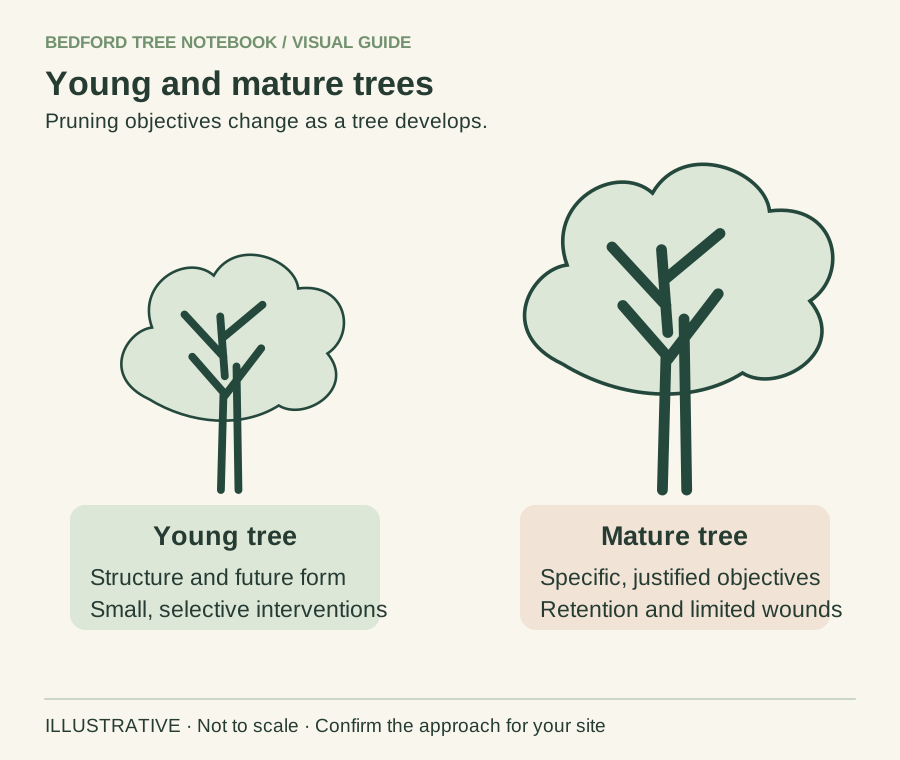
- Age is one factor alongside species and condition.
- Avoid applying a young-tree approach to a mature specimen.
Background sources: RHS guidance · Greater Cambridge Planning guidance
Begin with the purpose of the work
Explain why you are considering pruning. A newly planted tree with an awkward shape, a branch obstructing a route and a mature tree with a suspected defect are different concerns. The professional needs to understand the objective before proposing the operation.
Ask whether pruning is needed at all and what benefit the recommendation is intended to provide. A request for routine cutting can otherwise become detached from the tree's condition and natural form. The pruning-versus-removal guide helps keep options open where the issue is broader. Avoid treating the absence of a previous pruning visit as evidence that a tree is overdue for a large intervention.
Understand the role of formative attention
RHS guidance describes formative pruning as attention to the developing structure of young trees where appropriate. That does not mean every young tree requires the same cuts or an automatic annual treatment. Ask about the actual species, form and establishment stage.
A homeowner can contribute the planting date, supplier information and photographs showing growth over time. Ask what the professional wants to achieve and whether later review is recommended. If you are buying a replacement, our small-garden tree guide helps connect eventual form with the initial selection. Choosing an appropriate tree and planning suitable early care are related decisions, rather than relying on repeated pruning to correct a poor fit indefinitely.
Explain the history of a mature tree
Provide earlier reports, permissions and photographs if available. Tell the professional about known previous reductions, damage or management, but distinguish records from guesses. A mature tree's current appearance may reflect several past operations that are not obvious from one recent image.
Our permission-records guide helps organise that history. Ask whether the proposed work responds to a specific current objective or is part of an established management plan. Do not assume that a treatment used many years ago should simply be repeated. The professional should consider the actual tree and explain the recommendation and its limitations, including what the work cannot establish about future condition.
Keep species and timing in the decision
Pruning timing depends on more than whether the tree is young or mature. Ask for advice suited to the species and intended operation, and raise any uncertainty about identification before a date is treated as final. A general seasonal rule should not replace that discussion.
For productive trees, see fruit-tree specialist advice. For evergreen size control, use evergreen reduction and regrowth. These guides help distinguish questions rather than provide universal schedules. Ask the contractor to explain why its proposed timing suits the work. Keep wildlife and required permissions in view as separate planning considerations, even where the horticultural timing appears convenient.
A hypothetical two-tree garden
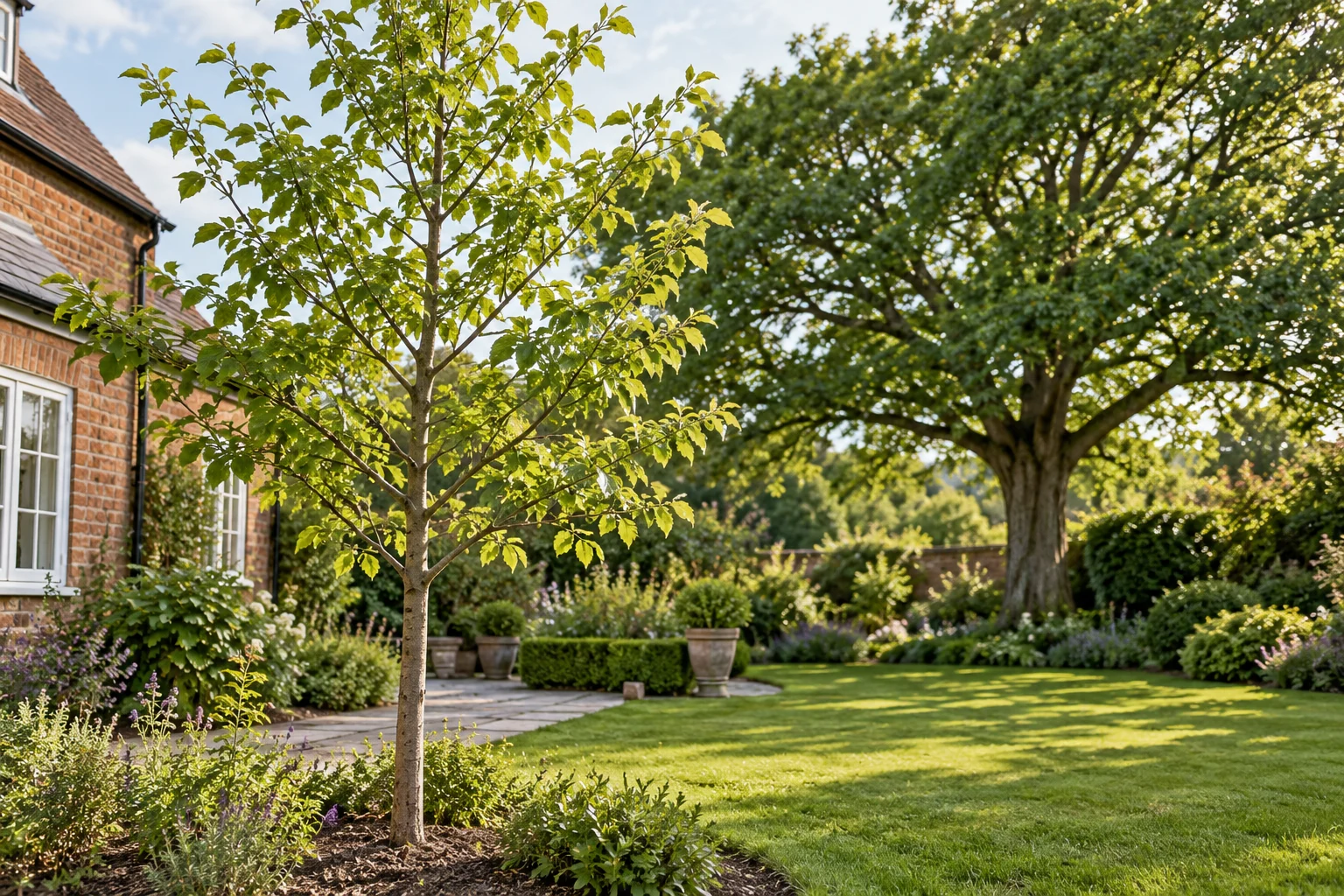
Imagine a homeowner has a recently planted ornamental tree near a path and a large established tree behind the patio. The initial request is to prune both to make future maintenance easier. A professional may need to discuss developing form for one tree and a specific clearance objective for the other.
This hypothetical example does not prescribe an operation or establish that either tree needs work. It shows why combining trees in one visit should not produce one generic specification. Give each tree its own identifier, objective and relevant history. The final quotation can then distinguish the recommendations rather than promise the same treatment merely because the trees share a garden and a booking date.
Avoid using size as the whole specification
A phrase such as “take some off” leaves the intended operation unclear. Ask the contractor to describe the proposed work in terms appropriate to the tree and objective. The reduction-versus-thinning guide helps with common terminology, but the professional must connect the term to the particular tree.
Discuss what the result may look like and what future care may be needed. Do not assume a severe cut provides a permanent size solution, or that a young tree should be shaped to mimic a heavily managed mature specimen. A clear specification describes the operation and reason without turning an attractive photograph from another garden into a biological promise.
Consider the household and working area
Explain routes, nearby structures, pets and any limits on access. A young tree may be physically accessible while a mature crown requires a very different work plan. The homeowner's role is to provide accurate information and follow site instructions, not select the contractor's equipment or method.
Use garden preparation to agree what can be moved safely. If a branch concern appears immediate, keep people away and seek appropriate assessment rather than waiting for a routine maintenance appointment. The fact that a tree is young does not make every operation suitable for an untrained person, and maturity does not automatically mean a large amount should be removed.
Ask what happens after this visit
Keep any aftercare or review recommendation with the work record. Ask which changes the professional wants you to report and what future work, if any, is being anticipated. Avoid treating a visit as a guarantee that the tree will never need further attention.
The completion checklist helps you compare the agreed scope after the area is safe. For a young tree, record the purpose of formative work so later advisers understand the intended development. For a mature tree, retain the specific operation and any follow-up advice. A useful history supports future decisions far better than a note stating only that the tree was “trimmed” in a particular year.
Your next step
Give each tree a separate objective and relevant history, then ask for a recommendation suited to its stage and species. Use the project planner to organise the enquiry and confirm the final specification, timing and follow-up with the professional before booking. Age and size inform the conversation; they do not determine a universal treatment.
Young-tree visits are also a chance to review stakes and ties, which can need attention independently of pruning.
For a fruiting apple tree, use preparing an apple-tree specialist brief to describe crop, structure and previous management alongside the pruning objective.
Turn the advice into a useful project brief.
Start with the postcode, the work you have in mind and any access considerations.
Prepare your enquiryNo obligation. A site assessment may be needed to confirm the work and price.
Sources & further reading
Sources checked 31 October 2026. How we prepare guidance.