
In this guide Show sections
General guidance, not a professional assessment. Confirm site-specific advice and current requirements before work.
Planning tree work in Bedford or nearby?
Start with the postcode, the work you have in mind and any access considerations.
Prepare your enquiryNo obligation. A site assessment may be needed to confirm the work and price.
Before you make arrangements
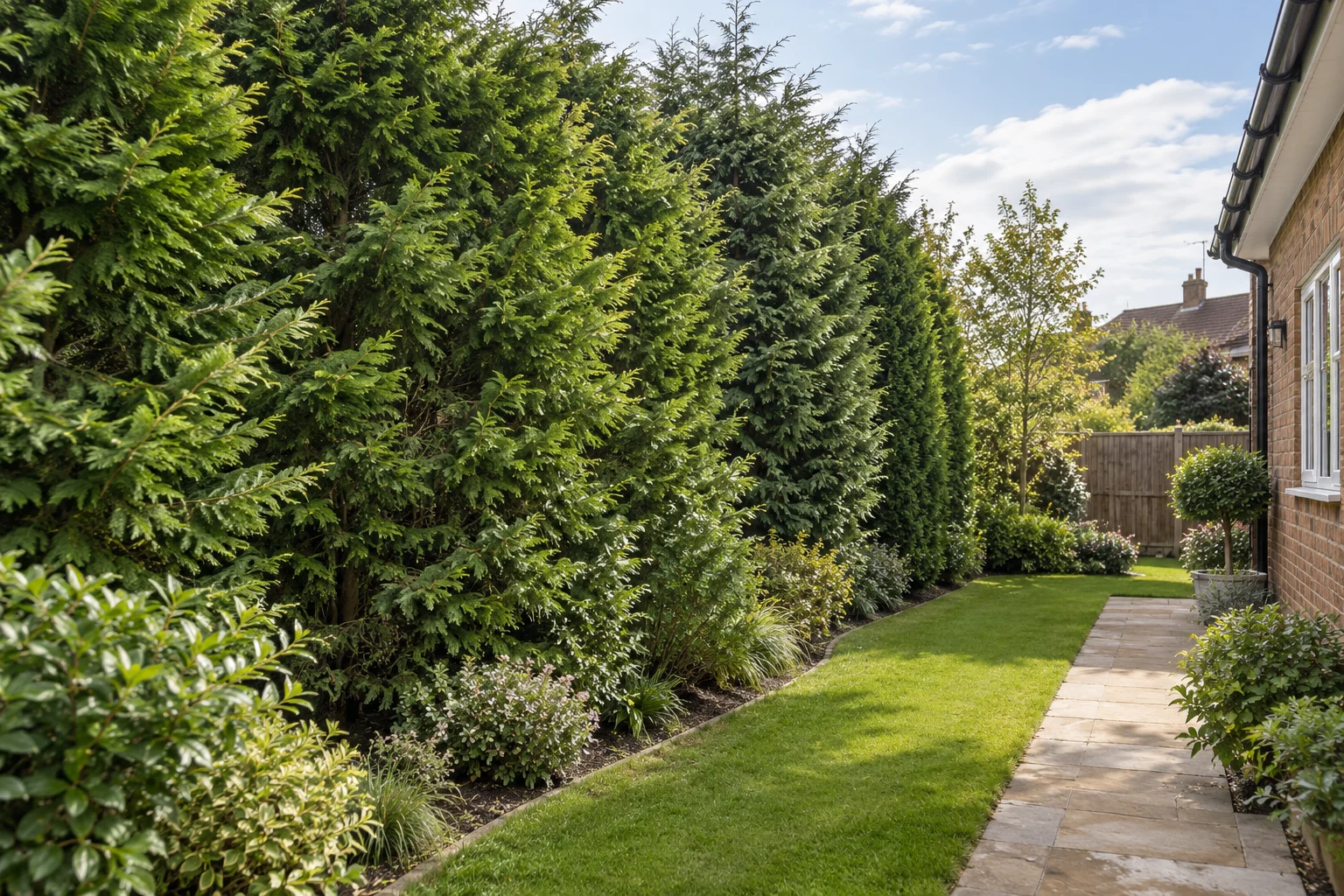
Photograph the whole feature and the area you hope to change. Explain whether the aim concerns height, width, light, access or a particular branch. Use hedge trimming versus reduction if it is a hedge; a large tree and a maintained boundary may need different specifications even when both remain green through winter.
Agree the finished hedge
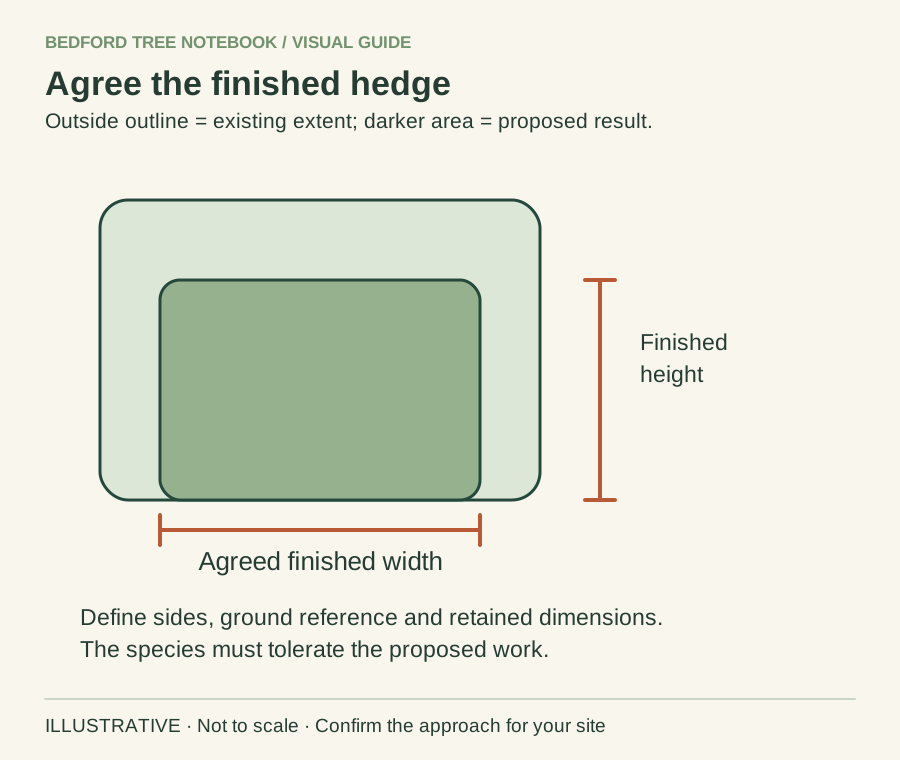
- Agree height, width and which sides are included.
- Check species-specific regrowth before any major reduction.
- Check for active nests; calendar timing alone is not enough.
Establish which plant is being discussed
Give the species or cultivar if you know it, and say when identification is uncertain. A contractor may need a closer professional inspection before recommending the work. Do not choose a method solely because another garden's evergreen responded well to it.
RHS guidance notes important limits to regrowth from old wood in many conifers, with exceptions that require proper identification. Keep that factual point as a reason to ask better questions, not as a complete pruning prescription. An individual tree's condition and previous treatment also matter. If you have old photographs or planting information, include them so the professional can understand the history rather than infer everything from the current outer foliage.
Separate the height and width objectives
Explain which part of the feature causes difficulty and what space is needed. Lowering the top, narrowing one face and removing an isolated branch are different operations. Ask whether the desired result is achievable without an unacceptable or unsuitable outcome for the plant.
Our finished-hedge dimensions guide helps translate a boundary objective into a clear brief. For a tree, read large tree in a small garden before assuming every size concern needs the same treatment. A quotation should make the intended operation clear enough that the contractor and household share an expectation, including where a biological limitation means the requested dimensions are not recommended.
Ask what the visible finish will be
Discuss whether the proposed operation will expose bare areas and what, if any, recovery the professional expects. Ask for an honest explanation of uncertainty rather than a promise that the plant will quickly look dense again. The desired finished appearance should be part of the decision before work is accepted.
A photograph of another hedge can illustrate a preference, but it cannot establish what your plant can deliver. Explain if privacy is essential at a particular window or boundary. Ask whether a different approach, staged plan or replacement discussion is appropriate. The purpose is to understand the trade-off, not to pressure a contractor into guaranteeing an appearance that depends on the species, condition and growing circumstances.
Review previous cuts and maintenance
Tell the professional about earlier reductions, bare patches, storm damage or other changes you know about. Keep records separate from assumptions: “previous owner said it was reduced” is useful context but not a precise specification. A historic photograph may help show the earlier shape.
Read pollarding versus topping if a severe proposal is being described with reassuring terminology. A label does not make an operation suitable for an evergreen. Ask why the recommendation fits this plant and what future care it creates. Repeating an earlier cut without reassessing the objective may simply reproduce an unresolved maintenance problem rather than produce a sustainable garden arrangement.
A hypothetical privacy-screen decision
Imagine a homeowner wants a tall evergreen boundary narrowed substantially so a path can be used more easily. The outer foliage looks dense, but the household has not considered what lies beneath it. Before accepting the reduction, the homeowner asks the professional about species, the likely finish and the privacy effect.
This hypothetical example does not establish that a particular cut is possible or impossible. It illustrates why the result should be discussed before the contractor begins. If a requested finish is unsuitable, the household can consider other options with appropriate advice. That is preferable to discovering afterwards that a wider route has been created at the cost of a screen the household expected to remain visually unchanged.
Keep permissions, wildlife and neighbours separate
Check ownership and any applicable tree controls before deciding the scope. If work requires access through a neighbour's land or concerns a shared boundary, arrange that explicitly. A neighbour's agreement to a preferred height does not replace other required checks.
Use shared-boundary tree work for practical arrangements and active bird nests for wildlife questions. Do not assume that dense foliage conceals nothing relevant or that a calendar date is sufficient clearance. Ask how the professional will handle a finding that changes the work plan, and keep the quotation's change arrangements understandable before a date is fixed.
Compare reduction with longer-term options
If the requested work cannot achieve a satisfactory result, ask what alternatives deserve consideration. The answer may involve a different operation, revised garden use or a separate replacement discussion. Do not treat removal as the inevitable next step without assessing its suitability and required authority.
Our replacement planting guide helps structure a later choice. If privacy is the main purpose, describe where screening is actually needed and what growing space is available. A new plant's size on delivery should not distract from its eventual form and care. A long-term decision is easier when the original benefit and the reason for concern are both recorded clearly.
Make the quotation reflect the limits
Ask the contractor to identify the plant or section, operation, intended dimensions where appropriate and material handling. Record any explanation about the expected appearance and future management. Avoid treating a verbal caution as unimportant if it materially affects the result you are buying.
Use the quotation checklist to compare proposals. Different businesses may recommend different scopes, so align the intended outcome before comparing totals. If you remain uncertain about a substantial irreversible change, seek appropriate further advice. A considered specification gives you a basis for reviewing the finished work without turning a general hope about regrowth into an unsupported guarantee.
Your next step
Identify the evergreen, define the specific space problem and discuss the likely finish before agreeing a reduction. Carry those details into the project planner and ask for a written recommendation. Where the desired result is unsuitable, settle the alternative plan before booking rather than relying on an assumption that bare areas will recover.
Where brown foliage prompted the enquiry, conifer hedge brown patches explains why diagnosis and the cutting proposal should remain separate.
Turn the advice into a useful project brief.
Start with the postcode, the work you have in mind and any access considerations.
Prepare your enquiryNo obligation. A site assessment may be needed to confirm the work and price.
Sources & further reading
Sources checked 31 October 2026. How we prepare guidance.