
In this guide Show sections
General guidance, not a professional assessment. Confirm site-specific advice and current requirements before work.
Planning tree work in Bedford or nearby?
Start with the postcode, the work you have in mind and any access considerations.
Prepare your enquiryNo obligation. A site assessment may be needed to confirm the work and price.
Before you make arrangements
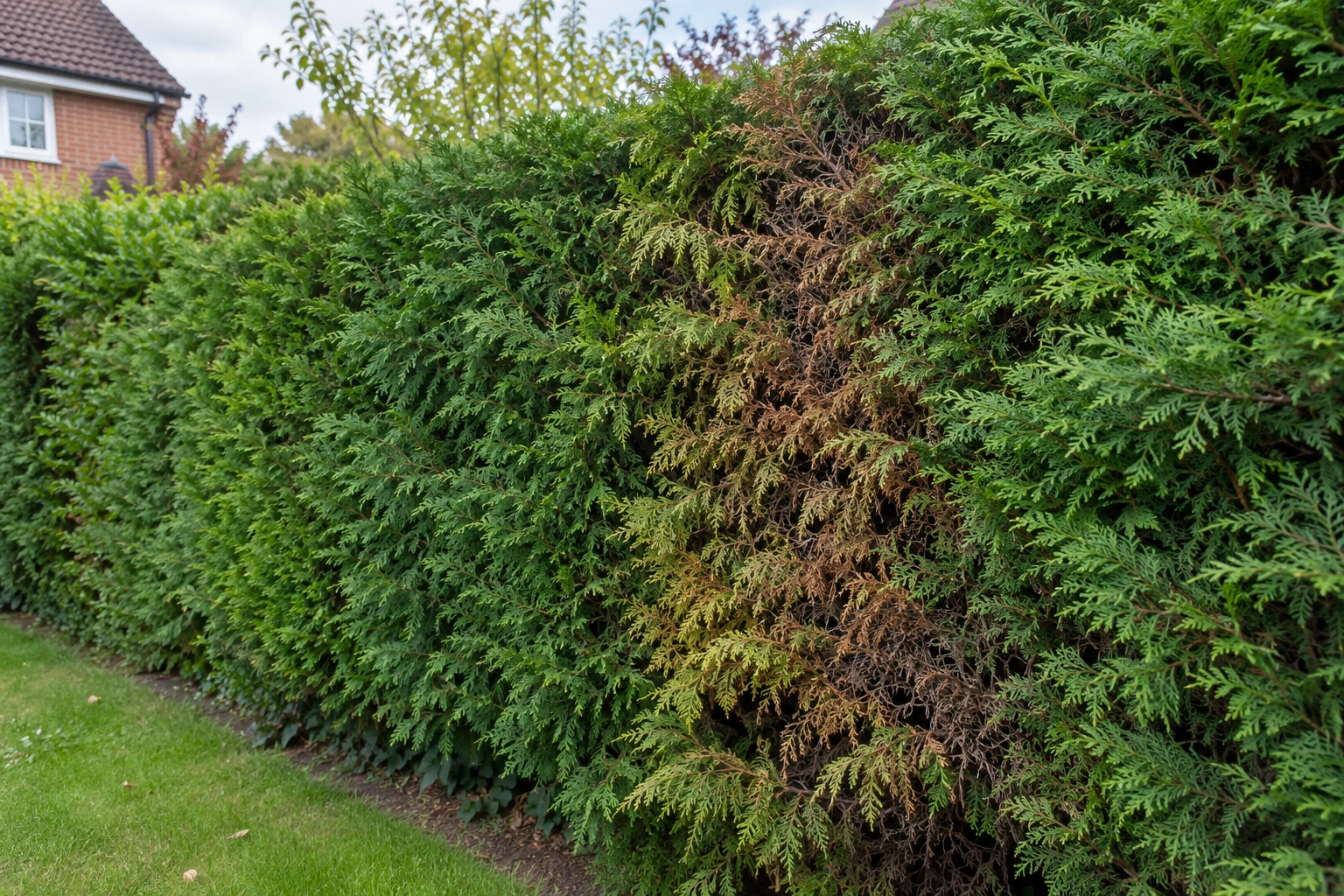
Photograph the whole hedge and the affected area from safe, accessible ground. Note when the patch appeared and what work or weather preceded it. Do not make trial cuts, strip bark or apply a general treatment simply because another hedge online looked similar.
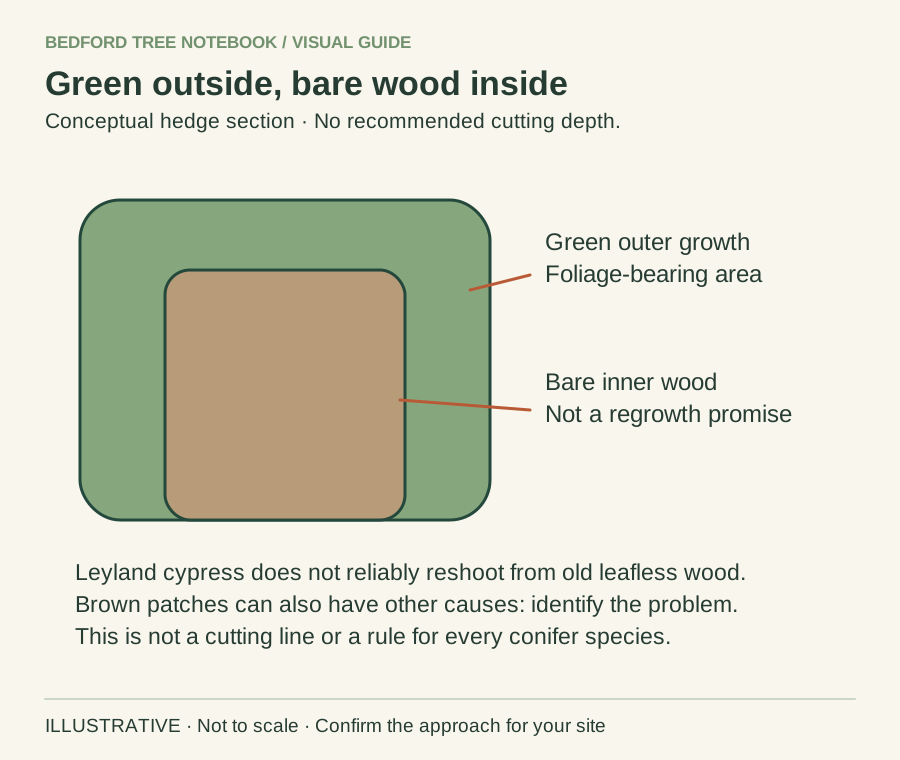
Green outside, bare wood inside
- Identify the hedge species before discussing reduction.
- Do not assume bare Leyland cypress wood will return to a green screen.
- Brown patches may involve pests, growing conditions or previous cutting; the cause needs assessment.
Background sources: RHS guidance · RHS guidance
Confirm the plants and pattern of the change
Ask for the conifer to be identified if you are unsure. A mixed boundary may contain several species, and their capacity for regrowth is not identical. Record whether browning affects one plant, several adjacent plants, a particular side or scattered patches along the hedge.
The RHS guide to conifer brown patches describes the range of possible causes. Use it to understand why a single symptom is not a diagnosis, rather than matching the nearest photograph and deciding on a remedy. Our mixed-boundary hedge guide helps organise the plant and location information before a professional visit.
Build a useful timeline
Write down when you first noticed the change, whether it developed quickly and whether older photographs show the same area. Include trimming dates, changes to watering or drainage and any excavation or building work nearby. Distinguish what you remember confidently from an approximate date.
This history can help a professional compare possible explanations. A patch noticed after trimming was not necessarily caused by that visit, just as an insect seen on a branch is not automatically the main cause. Keep invoices and specifications if previous work is relevant. Avoid changing the affected area before advice unless an appropriate professional has explained why a particular action is justified.
Consider growing conditions without assuming one cause
Dry conditions, waterlogging, exposure and other site factors can affect plants differently. Tell the adviser about changes on both sides of the hedge where known, including paving or ground levels. Do not assume all Bedford properties share the same soil or that recent rain proves the roots have had suitable moisture.
Read waterlogged gardens and tree concerns if persistent wet conditions are part of the history. If the issue followed prolonged dry weather, explain that too. The useful question is how the actual plants and rooting environment relate to the symptoms, not which weather event provides the easiest explanation.
Keep trimming history in the assessment
Over-enthusiastic cutting can expose old bare wood, and many conifers have limited ability to regenerate a green face from it. Ask whether the present outline and previous cuts constrain the options. A further reduction should not be sold as a universal way to remove a brown patch.
Our overgrown Leylandii guide explains one common situation. Do not generalise its advice to every evergreen species, or assume a staged approach guarantees recovery. Ask the professional to distinguish living foliage that may develop from an area where the desired regrowth is unlikely. That distinction should be clear before a finished width or height is promised.
Yew is a notable exception to the limited old-wood regrowth of many conifers. That exception helps explain why identifying the hedge matters: a technique discussed for yew should not become a default repair for Leylandii or another unidentified conifer. The condition causing browning and the plant's capacity to regenerate are separate questions.
Ask when specialist diagnosis is worthwhile
Some cases may require closer identification or advice beyond a routine cutting quotation. Ask what can be established during the proposed visit and what remains uncertain. If testing or specialist advice is recommended, clarify its purpose and how it could change the management decision.
Avoid buying a broad pesticide, fungicide or feed as a substitute for that question. A treatment needs to be justified for the identified problem and used within the appropriate guidance. This article does not recommend a chemical product or application method. If you are asked to supply samples or photographs, follow the relevant professional's instructions rather than cutting material from height or spreading potentially affected debris around the garden.
Separate plant condition from boundary arrangements
A hedge may be shared, stand in a neighbour's garden or be accessible only from the other side. Confirm who can instruct assessment and work, and explain any limits on access. A visible brown face does not give you automatic authority to enter land or remove plants.
Our shared-boundary guide helps prepare the discussion. If neighbouring planting or recent works might be relevant, keep the enquiry factual rather than assigning blame. Ask the adviser what information would help and which observations are still uncertain. A cooperative record of changes is usually more useful to the assessment than competing diagnoses based on appearance alone.
Discuss realistic outcomes before accepting a repair promise
Ask whether the recommendation is to observe, adjust care, manage retained growth, investigate further or replace an affected section. Clarify what improvement is reasonably expected and over what reviewable period, without treating that as a guaranteed recovery date. Some bare areas may remain visible despite appropriate management.
The finished hedge-dimensions guide helps distinguish an outline specification from a plant-health outcome. If replacement is proposed, consider the gap, retained roots, neighbouring plants and establishment needs. A price for removing one plant does not necessarily include preparing and establishing a replacement boundary, so keep those stages explicit.
Keep wildlife and permission checks separate
A brown section may still be part of habitat used by birds or other wildlife. Discuss the appropriate checks before cutting or removal, and do not disturb the hedge to prove it is clear. A proposed horticultural timing is not an ecological permission.
Use the active-nest guide for background, and ask about any relevant tree or site controls in the actual circumstances. The word “dead” should not be used casually to bypass checks. If the hedge contains trees, or the legal position is unclear, seek advice from the responsible council or appropriate specialist before the work specification is treated as authorised.
Record the decision and follow-up
Keep the professional's findings, uncertainties and recommendations with dated photographs. If observation is advised, ask which changes should prompt another contact and how to document them. If work is proposed, obtain a clear written scope, waste arrangements and explanation of what remains outside the contractor's service.
Our quotation checklist helps compare practical proposals. At handover, distinguish completed cutting from any continuing condition review. A neater hedge does not establish the cause of the original browning, and the absence of an immediate visual improvement does not automatically show that an assessed management recommendation was wrong. Compare the result with the actual objective and recorded limitations.
Your next step
Prepare a timeline and clear photographs, then ask for species-aware assessment before choosing cutting or treatment. Keep causes, regrowth limits and desired appearance separate in the discussion. Agree a realistic recommendation with any necessary follow-up, check ownership and wildlife, and avoid promises that an unidentified brown patch can always be repaired by reducing the hedge further.
Turn the advice into a useful project brief.
Start with the postcode, the work you have in mind and any access considerations.
Prepare your enquiryNo obligation. A site assessment may be needed to confirm the work and price.
Sources & further reading
- RHS: conifers with brown patches
- RHS: renovating overgrown hedges
- Natural England: wild birds, protection and licences
- Bedford Borough Council: protected trees
- RHS: Leyland cypress pruning
- RHS: improving health of declining trees and shrubs
Sources checked 31 October 2026. How we prepare guidance.