
In this guide Show sections
General guidance, not a professional assessment. Confirm site-specific advice and current requirements before work.
Planning tree work in Bedford or nearby?
Start with the postcode, the work you have in mind and any access considerations.
Prepare your enquiryNo obligation. A site assessment may be needed to confirm the work and price.
Before you make arrangements
Record the hedge's length, approximate dimensions, affected sides and access restrictions from safe ground. Do not climb or make trial cuts. Our hedge trimming versus reduction guide explains the difference between maintaining an outline and attempting a substantial change.
Green outside, bare wood inside
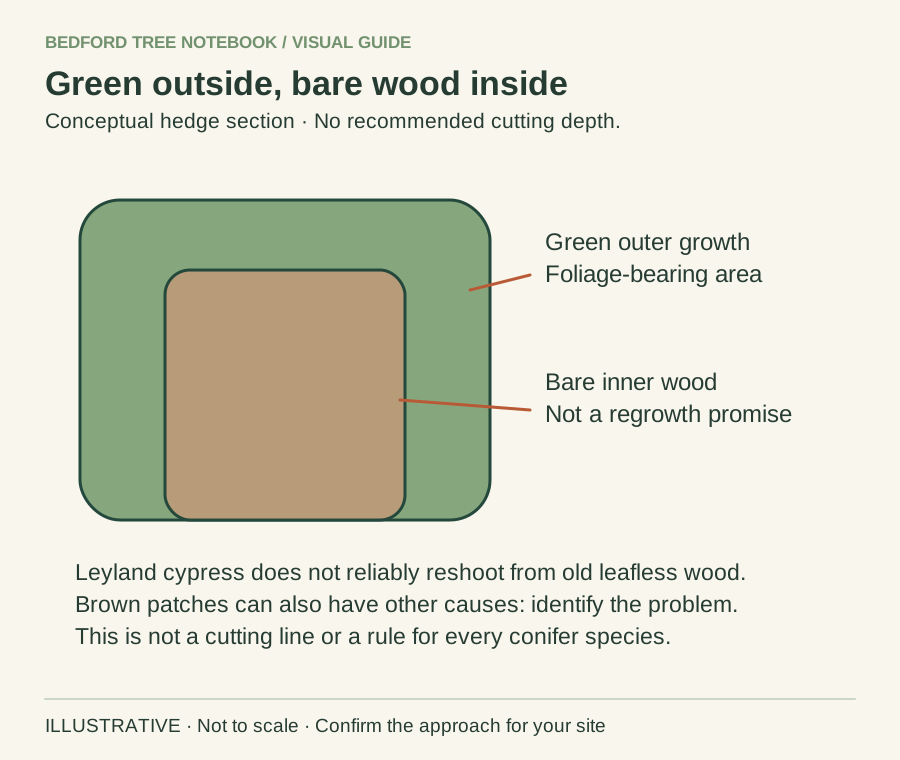
- Identify the hedge species before discussing reduction.
- Do not assume bare Leyland cypress wood will return to a green screen.
- Brown patches may involve pests, growing conditions or previous cutting; the cause needs assessment.
Background sources: RHS guidance · RHS guidance
Confirm what plants make up the hedge
A hedge described as Leylandii may contain other conifers, replacement plants or mixed sections. Ask the professional to identify the relevant plants and explain how their characteristics affect the proposal. Advice suitable for one conifer should not be copied to every evergreen hedge.
Our mixed-hedge planning guide helps organise that information. Note sections that differ in colour, growth or previous treatment. If there are already bare patches, include them in the initial enquiry rather than assuming they will be concealed by reduction. A clear record helps distinguish the limitations of the existing hedge from the expected effects of the proposed work.
Understand the limits of cutting into old wood
Most conifers do not readily replace green growth after a cut exposes old bare wood, and Leylandii should not be treated like a shrub that can simply be reduced hard and regrown. The RHS conifer guidance explains why trimming history and retained foliage matter.
Ask the contractor to show, in an understandable specification, what finished outline is feasible and which faces may remain bare. Do not accept a promise of full recovery without an explanation relevant to the plants. A slightly smaller hedge with retained green foliage and a much narrower brown-sided hedge are different outcomes, even if the headline work description sounds similar.
RHS specifically warns that Leyland cypress will not regrow from old, leafless wood. Yew is an important contrasting conifer with different regenerative capacity; advice about renovating yew should not be used to promise a green result from a hard Leylandii reduction. Ask for the likely appearance to be explained before accepting the finished dimensions.
Separate height, width and affected sides
Define the desired result with an agreed ground reference and clear identification of each face. Reducing height alone may leave an inconvenient width; reducing both sides to a preferred boundary line may expose bare interior growth. Ask what is achievable before treating your ideal dimensions as an instruction.
The finished hedge-dimensions guide includes a useful visual explanation. If neighbouring ground levels differ, discuss how measurements will be described. Do not rely on “fence height” where fences step, lean or change along the boundary. The written proposal should make the expected finished hedge understandable from both gardens before either party arranges work.
Distinguish appearance concerns from plant health
If parts of the hedge are brown, sparse or declining, tell the professional before asking for a reduction. Several causes can produce similar appearances, including growing conditions and earlier cutting. A more severe cut should not be assumed to cure an unidentified problem.
Read brown patches in conifer hedges to prepare a history of the change. Ask whether assessment is needed before the final operation is specified. Avoid buying a universal feed or treatment on the basis of a photograph alone. The objective is to understand what can be retained and managed, not to hide a diagnosis question within a standard hedge-cutting visit.
Compare retention, staged work and replacement honestly
Ask the professional to explain the practical options and their limitations. In some situations, a suitable retained outline may be possible; in others, the desired result may be incompatible with the existing plants. Staging work can help with some management objectives, but it is not a guarantee that bare old wood will regenerate.
If replacement is considered, discuss removal, stumps, soil preparation, boundary arrangements and establishment of new planting. Our replanting near a previous stump guide covers some of those questions. Compare complete projects rather than treating a removal price as the full cost of achieving a new, established boundary.
Discuss neighbours and access before booking
Confirm ownership and which sides you are authorised to have worked. Agree any access through neighbouring land, and explain shared paths, fragile structures or gardens below the hedge. A contractor needs the actual working context, not only a photograph of the green face visible from your lawn.
The shared-boundary guide helps prepare that discussion. Where a high-hedge dispute exists, seek advice through the appropriate current process rather than assuming a particular height is automatically unlawful or that you may instruct work on someone else's plants. Keep the practical quotation and any neighbour-dispute advice separate so one is not mistaken for authority to proceed.
Check wildlife and other applicable controls
A dense evergreen hedge can provide nesting habitat. Discuss appropriate checks before work and do not part the hedge or remove material yourself to establish whether it is occupied. A preferred month or a previous quiet inspection does not automatically clear a later visit.
Our active-nest guide provides the background. Ask the responsible council or adviser about any relevant tree, site or other controls where the hedge contains trees or the circumstances are uncertain. Do not assume that the word “hedge” answers every permission question. The actual plants, setting and proposed operations need consideration before work is instructed.
Include waste, access and the finished site
A major reduction can produce a large volume of material and require different handling from a light trim. Ask how the team will reach the hedge, protect surfaces and move arisings. Identify which waste is removed and whether any material will remain temporarily on either side of the boundary.
Use the waste-scope guide to avoid an undefined “clear up included”. If removal is proposed, ask separately about stumps, root limitations and reinstatement. Make sure a quotation describes the final agreed site condition rather than ending the scope as soon as the visible hedge has been cut down.
Agree future maintenance before choosing the result
Ask what care the retained or replacement boundary will need and whether you can realistically arrange it. A design that quickly recreates an inaccessible oversized hedge may not solve the original problem. Consider suitable mature dimensions, working access and your priorities for privacy, light and planting diversity.
The long-term care guide helps turn those choices into a record. Keep the specification and any agreed neighbour arrangements for later visits. A good decision is one whose limitations and continuing responsibilities you understand, not simply the largest immediate reduction offered by the first contractor available.
Your next step
Request an assessed proposal that identifies the plants, feasible finished dimensions and likely appearance. Compare retention and replacement where appropriate, and agree ownership, access, wildlife checks and waste handling before booking. Do not rely on staged cutting or a promise of regrowth to overcome old-wood limitations that have not been addressed in the advice.
Turn the advice into a useful project brief.
Start with the postcode, the work you have in mind and any access considerations.
Prepare your enquiryNo obligation. A site assessment may be needed to confirm the work and price.
Sources & further reading
- RHS: conifers with brown patches
- RHS: renovating overgrown hedges
- Natural England: wild birds, protection and licences
- Bedford Borough Council: protected trees
- RHS: Leyland cypress pruning
Sources checked 31 October 2026. How we prepare guidance.