
In this guide Show sections
General guidance, not a professional assessment. Confirm site-specific advice and current requirements before work.
Planning tree work in Bedford or nearby?
Start with the postcode, the work you have in mind and any access considerations.
Prepare your enquiryNo obligation. A site assessment may be needed to confirm the work and price.
Before you make arrangements
Identify every operation in the job and the material it is likely to produce. Ask the contractor to confirm what is removed, retained or separately priced. Do not assume the expression “all waste” includes excavated soil, an old fence or material left by another business. Keep the quotation checklist alongside the disposal discussion.
Three different material streams
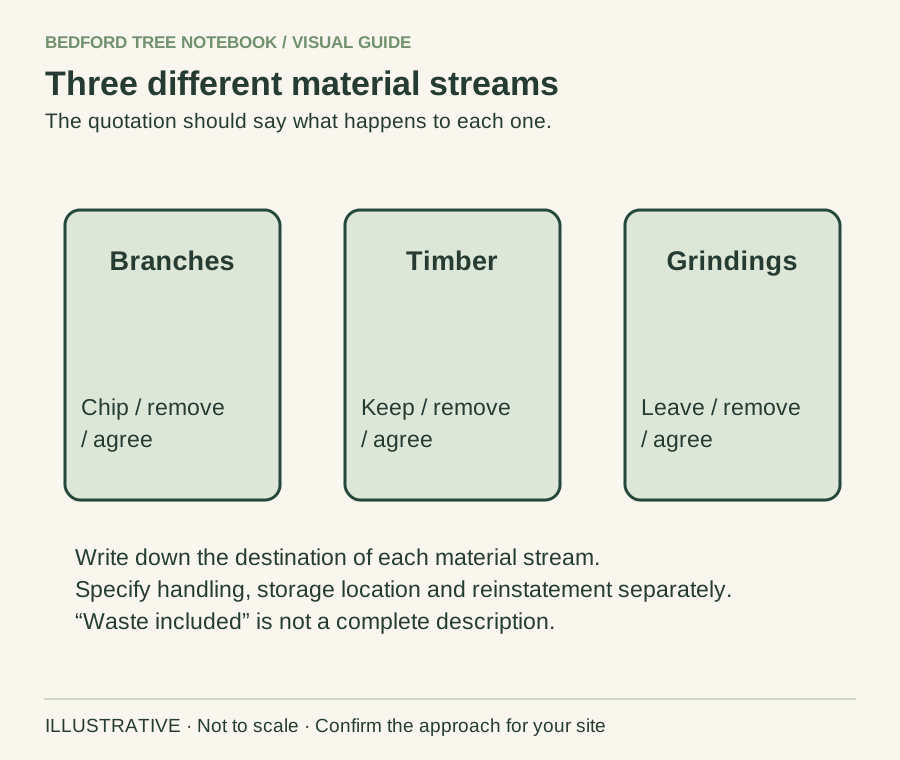
- Identify which materials are kept and which leave the site.
- Agree where retained material will be left.
- Check whether clearing and reinstatement are separate items.
Separate branches, timber and stump material
Start with ordinary descriptions rather than a single clearance label. Ask about small branches and foliage, larger sections of timber and anything produced by stump work. If you want logs retained, say where and in what condition. If the stump is staying, that should be explicit even when the rest of the tree leaves the site.
Read does felling include stump removal? before asking for an empty finished space. Felling, grinding and reinstatement are different operations. A contractor can remove the crown and stem exactly as quoted while leaving a stump you expected to disappear. The answer is a more precise scope, not a disagreement about what “tidy” ought to mean.
Define the area to be cleared
Show where the tree stands and where material will travel or be loaded. Include paths, a shared drive and any neighbouring land used with permission. Ask whether final clearing covers only the immediate work area or also the agreed handling route.
A clean-up description should be realistic for the surface. Gravel, a planted border and a paved patio present different finishing questions. Explain the standard you need without assuming every small fragment can be removed from every surface. Our garden preparation guide helps you identify items to move and areas needing protection. Record any limitations so the end-of-visit discussion can refer to a shared expectation rather than an undefined promise.
Check responsible disposal arrangements
Ask the business how removed material will be handled and what waste-carrier registration or other authorisation is appropriate to its activities. Contractor-generated arisings should be considered against GOV.UK business-waste guidance, rather than assuming household disposal arrangements apply. The Environment Agency register provides a way to check relevant registration details. Keep the business identity and any reference with the job record.
Do not offer a contractor access to household recycling facilities on the assumption that trade-generated material can be taken there under your household entitlement. Ask the facility or council about its current rules if a separate disposal arrangement is proposed. Your enquiry should make the intended route clear without trying to prescribe the contractor's entire operating system. Where the position is uncertain, settle it before accepting the clearance scope.
Plan for narrow or indoor access
Material handling can be a significant part of a rear-garden job. Describe the whole route, including doorways, corners, steps and surfaces, so the contractor can decide how material would leave. Do not assume that a machine fitting through one gate establishes the rest of the method.
Our access-through-the-house guide covers additional household arrangements. Ask how floors and walls would be protected and who handles final cleaning. If a route depends on a neighbour's permission, confirm that permission separately. Changes in access can affect the quotation, so tell the business promptly if a previously available drive or doorway can no longer be used.
A hypothetical clearance mismatch
Imagine a homeowner asks for a conifer to be removed and receives a brief offer stating “cut down and clear”. The contractor's written notes say the timber remains in the rear corner. The homeowner instead expects a clear border for planting. Neither expectation should be left to a conversation at the end of the visit.
Before accepting, the homeowner can ask for the destination of every material group to be stated: branches removed, timber removed or retained in an agreed place, stump treatment separately described. This hypothetical example does not establish a usual Bedford inclusion or price. It shows why the finished garden needs to be part of the brief, especially when a later landscaping stage depends on the space becoming available.
Treat retained material as an intentional choice
Keeping timber or woodchip can be useful where you have an appropriate purpose and enough space, but do not agree simply because it seems an easy saving. Ask about volume, placement and whether the material needs further processing. A pile that blocks a path or planting area can create another job.
The keeping logs guide helps define a timber arrangement. For grinding material, use what happens to stump grindings. Ask about suitability if disease or contamination is suspected; do not assume every material can safely be reused in the same way. Record who is responsible for any further movement after the contractor leaves.
Agree exclusions and changed quantities
Ask how the quotation handles material outside the original scope, such as an additional tree or waste already present in the garden. Point out existing piles before the visit and label them in your photographs if needed. A team arriving to tree debris from an earlier job may otherwise misunderstand what it has been asked to remove.
If you add work, ask whether removal is included in the revised price. Do not assume the first clearance agreement automatically covers every later request. Keep the changed description and cost together. A short written confirmation can distinguish an agreed extra operation from an informal suggestion made while walking around the garden.
Review clearance when the area is safe
Wait until the contractor releases the working area, then compare the result with the scope. Look at the agreed material destinations, access route and any retained timber. If something is unclear, ask for an explanation before characterising it as incomplete work.
Use the end-of-visit checklist to record an outstanding point. Photograph a concern from a safe position and keep the wording specific: for example, branches remain on the paved route that the quotation says will be cleared. A factual description is more useful than “the garden is a mess”. Keep any agreed return visit or follow-up action with the invoice and original quotation.
Your next step
Before accepting a proposal, ask for a simple material-and-destination list. Make sure it covers the final operation, not only the tree cutting. Carry those requirements into your project brief and retain the contractor's written confirmation so clearance can be checked against something concrete.
Turn the advice into a useful project brief.
Start with the postcode, the work you have in mind and any access considerations.
Prepare your enquiryNo obligation. A site assessment may be needed to confirm the work and price.
Sources & further reading
- GOV.UK: disposing of household waste responsibly
- Citizens Advice: before you get work done on your home (England)
- GOV.UK: business and commercial waste responsibilities
- Environment Agency: public registers
Sources checked 31 October 2026. How we prepare guidance.