
In this guide Show sections
General guidance, not a professional assessment. Confirm site-specific advice and current requirements before work.
Planning tree work in Bedford or nearby?
Start with the postcode, the work you have in mind and any access considerations.
Prepare your enquiryNo obligation. A site assessment may be needed to confirm the work and price.
Before you arrange the work
Explain that the indoor route is the only route available, if that is the case. Photograph entrances, turns and steps without including private paperwork or people. Do not promise that machinery or branches can pass through simply because a person can.
Measure the whole access route
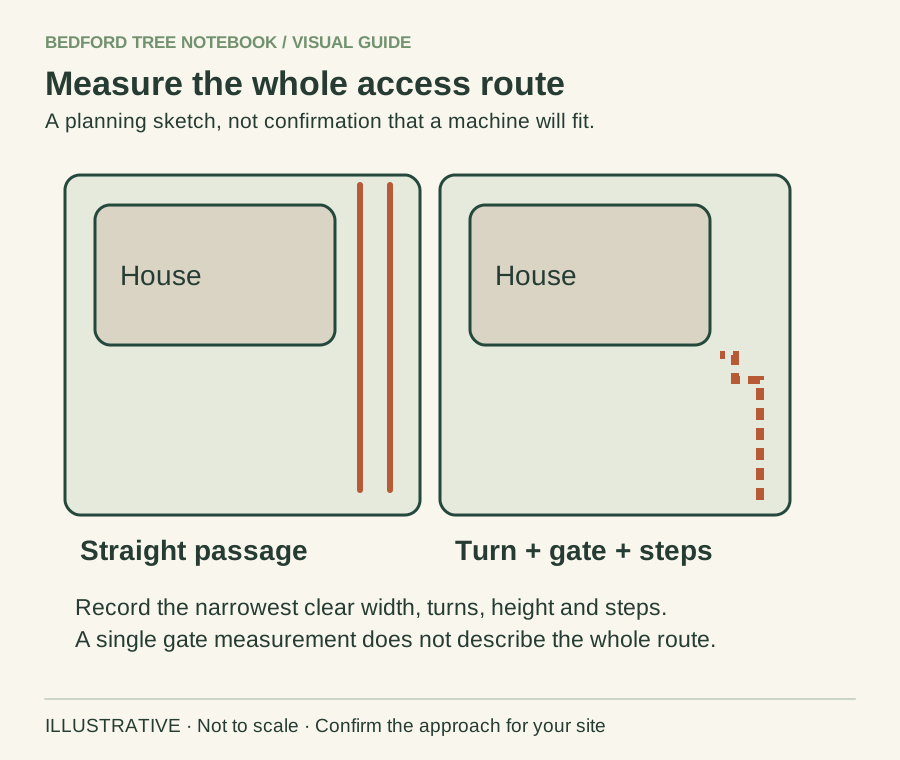
- Measure the narrowest clear width and overhead clearance from a safe position.
- Note corners, steps, slopes and the route through the house where applicable.
- The contractor must assess the actual equipment route.
Record the route rather than one doorway
Measure usable doorway widths, tight turns and changes in level from safe positions. Mention glazed doors, narrow halls, delicate flooring and any room that cannot be used. The contractor needs the complete route from its parking position to the work area.
Use the narrow garden access guide alongside this one. Ask the contractor to confirm suitability rather than choosing equipment based on an online width specification.
Agree protection and household arrangements
Discuss floor and wall protection, which doors need to stay open and where residents can safely remain. Plan for children and pets before arrival. Tell the business if this route is also the home’s only practical exit, so that access and emergency arrangements can be considered.
The garden preparation checklist covers movable items outside. Indoors, remove fragile belongings only when it is safe and practical; ask who is responsible for protection and cleaning.
Specify what happens to material
A tree being removed from the garden does not automatically mean every piece of timber will be carried through the home. Agree how material will leave, what can remain and how the final condition will be checked. If the route makes an intended operation impractical, ask for alternatives and a revised scope.
Photograph relevant existing damage before the visit and keep the agreed arrangements with the quotation. Use the end-of-visit checklist to review the route once the contractor says it is safe.
Measure the usable route at its tightest points
Record the route with doors open only as far as they can safely open in normal use. Mention handles, radiators, turns and thresholds that reduce clearance. A doorway’s quoted frame width is not always the usable opening. Include any change of level and the space available to turn between the entrance and garden.
Measurements are information for the contractor, not a homeowner’s approval of a machine route. Ask which points it needs to inspect and whether an assessment visit is required. Do not remove a door, handrail or fixture in anticipation of equipment unless a suitable arrangement has been expressly agreed. Where access would require an alteration, identify who can authorise and carry it out. Our narrow-access guide helps keep a full route description together. Send a small sequence of labelled photographs rather than a single wide image that conceals the difficult turn behind the camera.
Agree practical protection rather than a vague promise
Ask which floors, walls, door edges and fittings are included in the proposed protection. Record who supplies and installs it, who removes it and what cleaning is included afterwards. Mention loose flooring, recently decorated walls, delicate glazing or other existing issues that the contractor should assess before agreeing a method.
Do not assume that a particular sheet, board or covering is suitable simply because it is available at home. The business should explain its proposed arrangements and limitations. Photograph relevant existing condition before work, keeping the images focused on surfaces rather than personal possessions. If a protection assumption changes, ask for the quotation to reflect that before accepting. A clear written description helps both parties understand what “leave tidy” means indoors. It also distinguishes ordinary dust or debris cleaning from repair or redecorating, which should not be silently included or excluded through an informal reassurance.
Plan household use and essential access
Explain who will be at home, which rooms are occupied and whether the indoor route is also needed to reach an exit, kitchen or bathroom. Tell the contractor about children, pets and any mobility or access needs that affect the practical plan. Share only the information needed to arrange the visit; a detailed personal history is not required.
Ask where occupants should remain while equipment or material is moved, and how access will be coordinated when someone needs to leave. Do not walk through a controlled work route to collect a parcel without first following the agreed process. If the arrangements would make ordinary household use impractical, discuss another date or method before booking. Preparing the garden covers outdoor preparation, but an indoor route needs this additional conversation because it forms part of the occupied home. A suitable plan should account for that rather than treating the house as an empty passageway.
A hypothetical materials-handling comparison
Imagine a rear garden with no side gate and a narrow hallway as the only entrance. One quotation assumes material will remain in the garden, while another includes taking the agreed arisings through the house. The difference is more than the label attached to the same tree operation: it changes handling, protection and the finishing condition.
The homeowner should ask both businesses to describe the same intended result before comparing prices. If retained timber is acceptable, specify where and what further handling would be your responsibility. If removal is required, ask whether the route and method have actually been assessed. Do not assume branches can simply be carried intact around a tight corner, or propose cutting arrangements indoors yourself. This hypothetical comparison explains a scope question, not a recommended method. The contractor needs to judge what is practical and suitable; the homeowner needs to make the required finish and the available access clear.
Make the indoor handover check specific
After the business releases the route, compare the agreed protection, clearing and cleaning with the written scope. Check the doors and surfaces included in the before-work record from an ordinary safe position. If something concerns you, identify the location and describe what you observed rather than making an immediate assumption about the cause.
Ask whether a later collection or follow-up will require indoor access again. Record how that appointment will be arranged and whether the same protection applies. Keep the quotation, dated photographs and any response together if a concern needs further discussion. The completion checklist helps distinguish a question about the tree operation from one about access or household surfaces. Avoid using an unresolved indoor cleaning item as a substitute for recording the actual concern, or signing a blanket statement that does not reflect your understanding of the completed work and any agreed next action.
Your next step
Ask for written confirmation of the access assumptions before accepting a quotation. Notify the business if a door, room or route will no longer be available on the planned date.
Turn the advice into a useful project brief.
Start with the postcode, the work you have in mind and any access considerations.
Prepare your enquiryNo obligation. A site assessment may be needed to confirm the work and price.
Sources & further reading
Sources checked 31 October 2026. How we prepare guidance.