
In this guide Show sections
General guidance, not a professional assessment. Confirm site-specific advice and current requirements before work.
Planning tree work in Bedford or nearby?
Start with the postcode, the work you have in mind and any access considerations.
Prepare your enquiryNo obligation. A site assessment may be needed to confirm the work and price.
Before you start
Confirm that the scope, visit arrangements and necessary permissions have been addressed before treating a date as final. If the tree’s condition has changed since the quotation, tell the business before the visit. Do not clear beneath a suspect branch simply because that is where the team is expected to work.
Coordinate the whole project
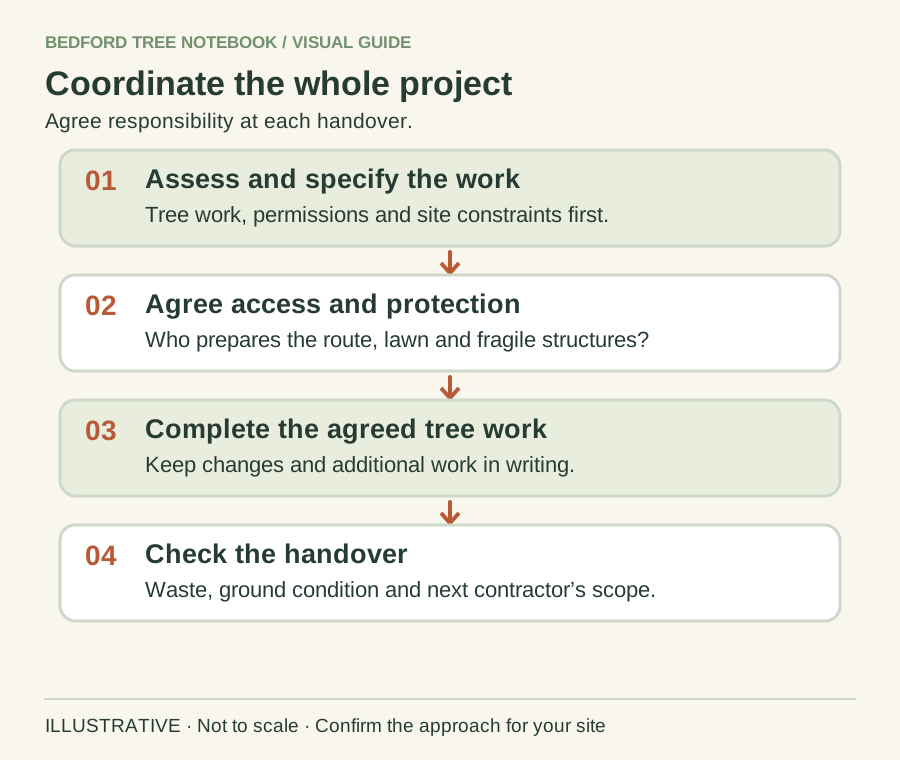
- Set the order and responsibility for each phase.
- Do not carry out hazardous preparation yourself.
- Check ground preparation separately before follow-on landscaping.
Agree the access and arrival arrangements
Give the contractor an accurate description of gates, turns, steps and parking restrictions. Say which entrances are shared and who else needs to use them. Do not promise road space or access over neighbouring land that you cannot authorise.
If you have already used our narrow-access guide, send the same notes to the people organising the visit. Ask who will contact you if the plan needs to change and whether you need to be at the property when the team arrives.
Move ordinary belongings only where it is safe
Ask which small items should be moved from the proposed access and working areas. Garden furniture, toys, loose pots and washing can be straightforward to relocate when the area is safe. A shed, heavy planter or fixed greenhouse is a different matter and should be included in the site discussion.
Do not climb, cut branches or dismantle structures in anticipation. If the business needs an alteration, agree who undertakes it and who is responsible for putting things back. An assumption made on the morning of the job can complicate both the work and the price.
Identify what must stay protected
Point out planting, surfaces, boundaries and objects you want retained. Tell the contractor about known underground services, drainage covers and overhead lines. Do not cover up features to make the garden appear clearer.
Take a few ordinary photographs of the relevant areas beforehand if that is safe and useful to both parties. This is a record of the starting condition, not a substitute for agreeing suitable protection or making assumptions about the capacity of a lawn, patio or drive.
Plan for people and pets
Discuss which parts of the property will be unavailable during the work. Arrange a safe alternative route for household members and visitors, and keep children and pets away from the operation. Mention if an animal’s normal route or enclosure is close to the proposed working area.
The contractor needs to set the working arrangements. A homeowner’s rope across a path does not establish a safe exclusion zone. If a shared route cannot be managed as first expected, raise that before the team starts rather than improvising around it.
Confirm clearance and material storage
Ask where equipment and material will go, and revisit what is to be removed or retained. If you are keeping logs, agree a practical location and the condition in which they will be left. For stump work, decide whether grindings remain, are moved elsewhere or leave the site.
Read what happens to stump grindings if another garden project follows. A space cleared of branches is not necessarily ready for turf, planting or paving.
Keep the paperwork and a final check simple
Have the agreed scope, any relevant decision and the contractor’s contact route to hand. If you discover that the work requested differs from the written quotation, resolve it before cutting starts. Use the quotation checklist to identify the item that needs changing.
At the end, review the agreed result with the business: which work is complete, what remains and whether a follow-up visit is included. Keep the invoice and any revised scope with the original quotation, rather than relying on a conversation you may remember differently later.
Use a simple preparation responsibility list
Split the preparation note into what you will do and what the contractor will do. Your list might include securing pets, moving light garden furniture and providing an agreed gate key. The contractor’s list might include specified surface protection or managing the work area. Do not put technical safety tasks into the homeowner column just to make the list look complete.
Ask about an item if responsibility is unclear. A statement to have the site ready is too broad where access depends on heavy objects or another person’s land. Keep the final list with the quotation, so the attending team sees the same arrangements you discussed with the business.
Plan ordinary household routines around the work
Consider how people normally use the area during the proposed visit. Children may play by a gate, a dog may use the side passage and someone may need to leave for an appointment. Tell the contractor about those needs early and agree where household members can remain. Do not decide on your own that crossing quickly under a working tree will be acceptable.
If access is shared, read parking and shared routes and notify the relevant occupants. The practical aim is to prevent routine movements becoming an unexpected interruption. Keep the business’s contact number available, but speak to the designated contact rather than approaching someone using equipment.
A hypothetical last-minute change
Suppose scaffolding is installed on the side passage after a tree-work quote is accepted. The original access plan may no longer describe the site. A useful response is to send an updated photograph and ask the contractor to reassess, even if the tree itself is unchanged. Avoid dismantling or moving the scaffolding to preserve the booking.
The same principle applies to a newly laid lawn or a gate that no longer opens fully. Our narrow-access guide helps describe the difference. A revised plan may be inconvenient, but agreeing it before arrival is clearer than expecting the crew to work around an undisclosed restriction.
Prepare for handover as well as arrival
Keep the written scope somewhere accessible so you can use it when the work is finished. Ask who will explain any follow-up, when you may safely use the area and which materials are intentionally staying. Arrange to be available for that conversation or nominate a person who understands the agreement.
Use the end-of-visit checklist to record anything outstanding. If a landscaping or planting stage follows, keep its requirements visible rather than assuming tree-work clean-up makes the whole garden ready. Preparation is most useful when it supports both a controlled visit and an understandable handover to the next part of the project.
Putting it into practice
Keep the agreed work and contact details available, then let the contractor manage the operation. If you need to raise a question during the visit, use the method agreed with the team rather than entering the work zone. Check the finished result only when they say the area can be entered.
Agree lawn protection before equipment arrives and retain the end-of-visit checklist for handover.
Before preparing for the working day, consider when a site visit is needed before quoting so access assumptions can be assessed.
For an unfamiliar overgrown plot, setting neglected-garden priorities helps establish the assessment and records before arranging clearance.
Turn the advice into a useful project brief.
Start with the postcode, the work you have in mind and any access considerations.
Prepare your enquiryNo obligation. A site assessment may be needed to confirm the work and price.
Sources & further reading
Sources checked 31 October 2026. How we prepare guidance.