
In this guide Show sections
General guidance, not a professional assessment. Confirm site-specific advice and current requirements before work.
Planning tree work in Bedford or nearby?
Start with the postcode, the work you have in mind and any access considerations.
Prepare your enquiryNo obligation. A site assessment may be needed to confirm the work and price.
Before you make arrangements
Describe the objective, address and access before asking whether a visit is necessary. Mention known changes, nearby structures and any uncertainty about the tree. The Bedford enquiry checklist helps assemble those details without climbing, measuring from unsafe positions or trying to diagnose the tree yourself.
A useful ground-level photo brief
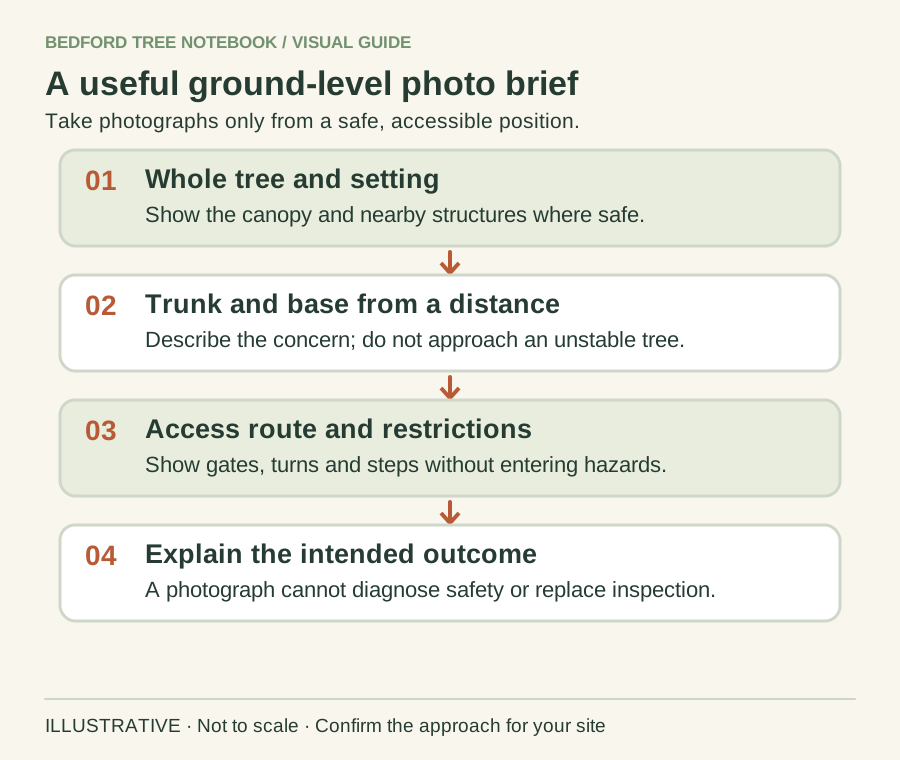
- Stay on safe, accessible ground.
- Do not climb or enter a potentially dangerous area for a better picture.
- Describe what you want to achieve, not an assumed diagnosis.
Know what an initial photograph can contribute
A wide view can show the tree's relationship to the garden, while an access photograph can show a gate, passage or step. These images are useful context for deciding the next conversation. They are less useful when cropped so tightly that the contractor cannot see where the tree stands or what surrounds it.
Ask the business what it needs before sending a large collection of images. Provide clear descriptions rather than repeated views of the same feature. Do not include people, private documents or neighbouring interiors unnecessarily. If a photograph would require entering a hazardous area, explain the limitation instead. An incomplete image is preferable to taking a risk to improve a remote enquiry.
Identify uncertainties that affect the operation
The contractor may need to see the tree to recommend an appropriate operation rather than simply price the one you suggested. A request to reduce a tree can originate from shade, roof contact, a possible defect or garden redesign; those are different briefs.
Our removal-or-pruning guide helps you explain the objective before choosing a treatment. Ask whether the business is visiting to prepare a work quotation, provide a professional assessment or undertake both under clearly stated terms. A sales or quotation visit should not be assumed to include a written specialist report suitable for an insurer, planning application or dispute. Establish what output you need before arranging attendance.
Show the complete practical route
A tree can be visible from the road while the useful working entrance is behind the house. Tell the business about the whole route, including parking, shared drives, turns, level changes and any indoor section. Ask which details can be confirmed from your information and which require inspection.
Use narrow-access measurements to provide dimensions safely. Do not remove a gate, dismantle a fence or promise neighbouring access to make a provisional route seem workable. If access depends on another person's agreement, record that as outstanding. A visit can then address the actual constraints rather than assume a route that will not be available on the day.
Ask whether the visit has a charge
Clarify whether the appointment is a quotation visit and whether a fee applies. If the business proposes paid advice, a survey or a report, ask for the scope, charge and intended deliverable before agreeing. The word “visit” does not itself explain the commercial arrangement.
Keep this discussion separate from whether the eventual tree work is suitable. You may need a consultant's opinion before choosing a contractor, or a contractor may need an ordinary site visit before offering a defined price. Our surgeon-or-consultant guide helps frame that distinction. Avoid assuming either that every visit must be free or that paying for a visit guarantees a particular recommendation or quotation.
Prepare the documents that matter
Have any relevant permission, tree schedule, planning condition or previous report available. Explain what each document relates to and whether the tree numbers match the current layout. A contractor should not have to guess which of several trees an old email concerns.
The permission-records guide provides a practical filing approach. Do not hand over unrelated personal information to make the folder look complete. Share the relevant decision and specification, then ask whether something else is needed. If you are a tenant, agent or family member arranging the visit, make clear who can authorise work and who will accept the quotation. That prevents a useful inspection becoming an assumed instruction to proceed.
A hypothetical remote-pricing limitation
Imagine a homeowner sends a photograph of a garden stump and asks for a fixed price. The image shows the stump clearly but not a narrow rear entrance, a turn beside a conservatory or a buried-service concern. The contractor asks to inspect before confirming the scope.
The useful response is to explain those constraints and arrange an appropriate assessment, rather than treat the request as an unwillingness to quote. This is an illustrative example, not a statement that every stump needs a visit. Another simple and accessible job might be handled differently by a business using sufficient information. The decision belongs to the professional considering the particular work, and the eventual offer should say what it relies on.
Agree what follows the appointment
Ask when you should expect the written recommendation or quotation and how outstanding questions will be answered. If the contractor identifies a permission issue or recommends another professional, record the next step rather than forcing an immediate work date.
Read quotes versus estimates before comparing an early indication with a later final offer. If the visit changes the proposed operation, ask for the documents to be updated consistently. Keep a short note of the tree identification, intended result and practical assumptions. A clear follow-up is more useful than a remembered figure discussed while standing in the garden, especially when several household members are involved in the decision.
Keep booking and assessment distinct
An appointment to look at the garden is not the same as booking tree work. Confirm which appointment you are arranging, what access is required and whether you need to be present. Ask the business how it handles cancellations or access problems under its terms.
If the tree's condition changes materially before the visit, notify the contractor and seek appropriate advice rather than relying on the original routine arrangement. For an immediate hazard, keep people away and use an appropriate urgent route; a lead-generation form should not be assumed to provide emergency response. Keep the enquiry factual, and avoid repeatedly entering an affected area to collect more evidence for a visit that has not yet happened.
Your next step
Prepare a concise brief and ask the contractor what it can confirm remotely, what needs a visit and what that appointment will deliver. Keep the final written scope and price after the inspection. The project planner can organise your information, but it cannot replace professional judgement about the site.
If you cannot attend, use planning an unattended assessment visit to agree access, scope and the report-back arrangements.
Turn the advice into a useful project brief.
Start with the postcode, the work you have in mind and any access considerations.
Prepare your enquiryNo obligation. A site assessment may be needed to confirm the work and price.
Sources & further reading
Sources checked 31 October 2026. How we prepare guidance.