
In this guide Show sections
General guidance, not a professional assessment. Confirm site-specific advice and current requirements before work.
Planning tree work in Bedford or nearby?
Start with the postcode, the work you have in mind and any access considerations.
Prepare your enquiryNo obligation. A site assessment may be needed to confirm the work and price.
Before you make arrangements
Ask whether the professional is willing to attend without you and what they need to inspect. Confirm whether the appointment is an assessment, quotation visit or actual work. These are different arrangements. Our site-visit guide explains why a few photographs or an accessible gate may not be enough for every kind of commission.
A clear handover for an assessment
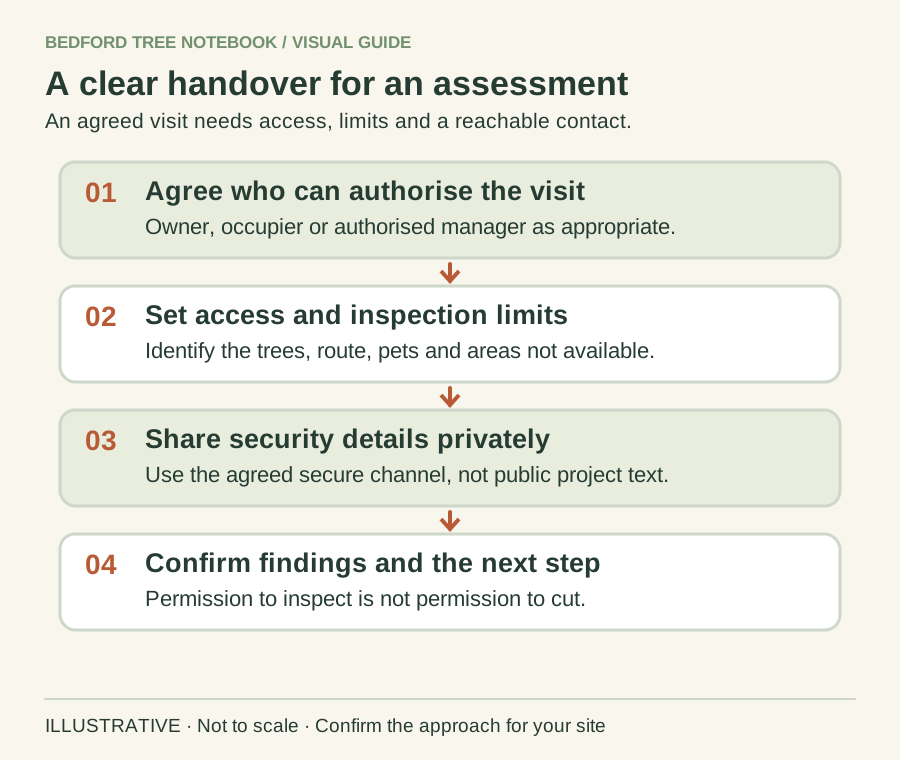
- Agree access explicitly with the relevant owner and occupier.
- Keep keys, alarm details and gate codes out of public descriptions and photographs.
- Provide a reachable authorised contact and arrange a fresh visit if safe access or scope is unclear.
Background sources: GOV.UK guidance · National Tree Safety Group guidance
Make the purpose of the visit explicit
Tell the business what question you want answered: condition, a particular concern, suitable pruning options or the information needed for a work quotation. Provide the reason for the request and any deadline arising from a property transaction or another project. Do not leave the assessor to infer your objective from a short calendar entry.
Our consultant and contractor comparison helps select the type of service being commissioned. Clarify what output is included and whether a written report will follow. If you need information for an insurer, surveyor or planning enquiry, confirm those requirements before booking so an unattended visit is not purchased for a purpose it cannot fulfil.
Identify the correct trees
Use a labelled plan or wide photographs to distinguish the tree or group concerned. Say which boundary, structure or garden area provides the reference. A description such as “the tree at the back” can be ambiguous when the professional arrives by another entrance or several neighbouring gardens contain similar specimens.
The tree-location-plan guide shows how identifiers connect a plan with a written question. Include existing reports and specify which tree they concern. Do not attach a diagnosis to the label unless it is a documented finding. The assessor should be able to locate the intended specimen without entering land you have not authorised them to access.
Agree the exact access route
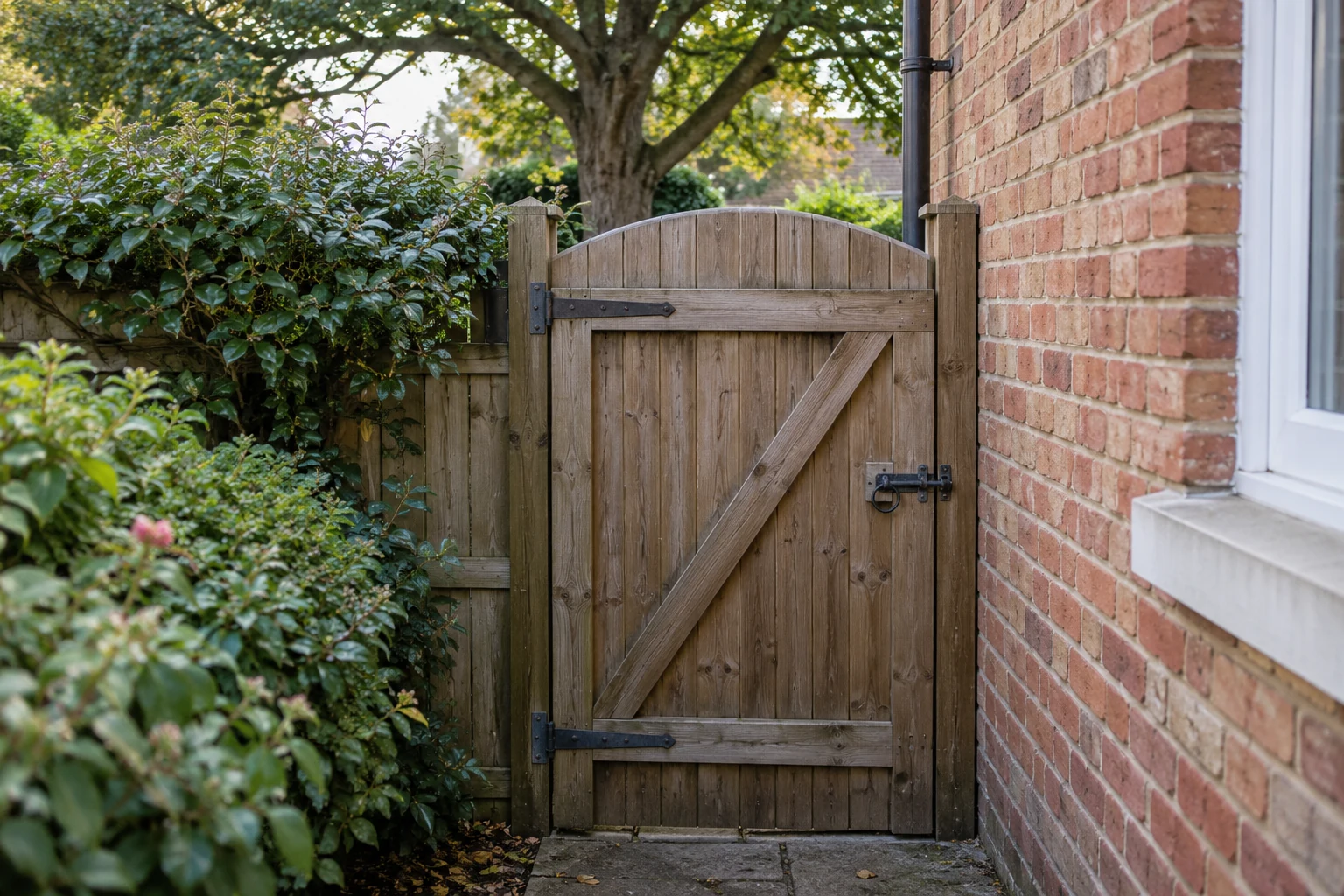
Describe how the professional reaches the garden and which areas they may enter. Mention steps, turns, locked gates, shared passages and any route through the house. The access-route guide helps prepare practical details without suggesting that every visit requires machine access.
If a route crosses neighbouring or shared land, establish the necessary permission rather than assuming the assessor can follow an open path. Give a clear arrival contact and instructions for an access problem. Ask the business to confirm the arrangement, including what they will do if the route is blocked. An unlocked gate should not be interpreted as permission to enter unrelated areas of the property.
Keep security information private
Agree a suitable way to handle any key, gate code or alarm arrangement with the chosen business. Do not place sensitive access details on a public tree plan, website form intended for general project information or message circulated to several prospective contractors. Share only what is needed for the agreed visit.
If a third party is providing access, confirm that they understand the appointment and have authority to do so. State who will secure the property afterwards and how you will know the visit has finished. Avoid hiding keys or publishing instructions in a way that creates a separate security problem. The contractor’s willingness to attend does not replace your own arrangements for access and property security.
Tell the assessor about hazards and limitations
Mention dogs, other animals, damaged surfaces, fragile structures and known restrictions before arrival. If the tree appears unstable, do not prepare the site by approaching it or moving hazardous material. Explain the concern so the professional can decide what access and assessment are appropriate.
Read assessment signs and overhead cable considerations where relevant. Make inaccessible areas visible in the brief rather than assuming they can be ignored. If the professional cannot inspect an important part of the tree or setting, ask them to record that limitation and explain what further arrangements would be needed. Do not encourage them to improvise entry. The HSE tree-work safety resources provide background for the professional’s planning; they do not turn access instructions into a method statement.
Separate assessment access from work consent
Put in writing whether any physical work is authorised. For an assessment-only appointment, make clear that cutting, excavation or a different investigation requires a separate agreed instruction. A general request to “sort it out while you are there” can create uncertainty about the service, price and permissions.
The quotation checklist helps turn a later recommendation into a defined job. Tree-protection and wildlife checks remain relevant if work is proposed. Use Bedford TPO checks for the starting records, but do not assume permission has been established simply because a professional can enter the garden. Access authorisation and regulatory clearance answer different questions.
Provide a realistic communication window
Agree how the professional can contact you if a key question arises and whether you will be available during the appointment. If you cannot respond, state what should happen rather than leaving the business to make decisions outside the agreed scope. A different person may need authority to answer practical access questions.
Ask how the findings will be delivered and when you can expect a follow-up conversation. If the assessor identifies a concern requiring prompt action, clarify the communication arrangements as part of the commission. An unread email is not a useful handover. Do not assume a report will automatically be sent to an insurer, landlord or neighbour unless that recipient and purpose have been agreed.
Understand when an attended visit is better
Some questions depend on a conversation about the garden, previous events or intended changes. If the professional needs you to identify disputed features or explain an evolving project, an attended appointment or separate discussion may be more useful. Ask before treating unattended access as a way to compress every stage into one visit.
Where another person owns or manages the tree, make the authority position clear first. Our landlord and agent guide helps coordinate that chain. An assessor should not be left between competing instructions from household members. If the brief changes, confirm it with the business rather than expecting a neighbour opening the gate to relay a technical work request accurately.
Review the output before booking work
After the visit, check that the report or proposal identifies the correct tree, answers the commissioned question and lists any access limitations. Ask about unclear recommendations, further investigation or review triggers. A quotation is not necessarily an independent assessment of every concern you intended to raise.
If work follows, agree a separate written scope and the appropriate permissions and access arrangements. Keep the original assessment with the final instruction so its reasoning is not lost. Record who secures the property and handles changes for the work visit too; an earlier assessment arrangement should not automatically be reused for a team, machinery and material removal without checking what the new job requires.
Your next step
Agree the purpose, trees, access, security and communication arrangements directly with the business before the appointment. Keep assessment-only authority clear, then review the findings before booking any operation. If the job develops into work, use garden preparation and the quotation checklist to create a fresh, complete handover.
Turn the advice into a useful project brief.
Start with the postcode, the work you have in mind and any access considerations.
Prepare your enquiryNo obligation. A site assessment may be needed to confirm the work and price.
Sources & further reading
- HSE: tree-work safety topics
- Bedford Borough Council: protected trees
- GOV.UK: TPOs and trees in conservation areas
Sources checked 31 October 2026. How we prepare guidance.