
In this guide Show sections
General guidance, not a professional assessment. Confirm site-specific advice and current requirements before work.
Planning tree work in Bedford or nearby?
Start with the postcode, the work you have in mind and any access considerations.
Prepare your enquiryNo obligation. A site assessment may be needed to confirm the work and price.
Before you arrange the work
Do not approach, touch or attempt to identify a line by handling it. Never assume a cable is safe because of its appearance, height or apparent insulation. Keep away from damaged or fallen lines and seek the appropriate emergency help.
Show what is around the tree
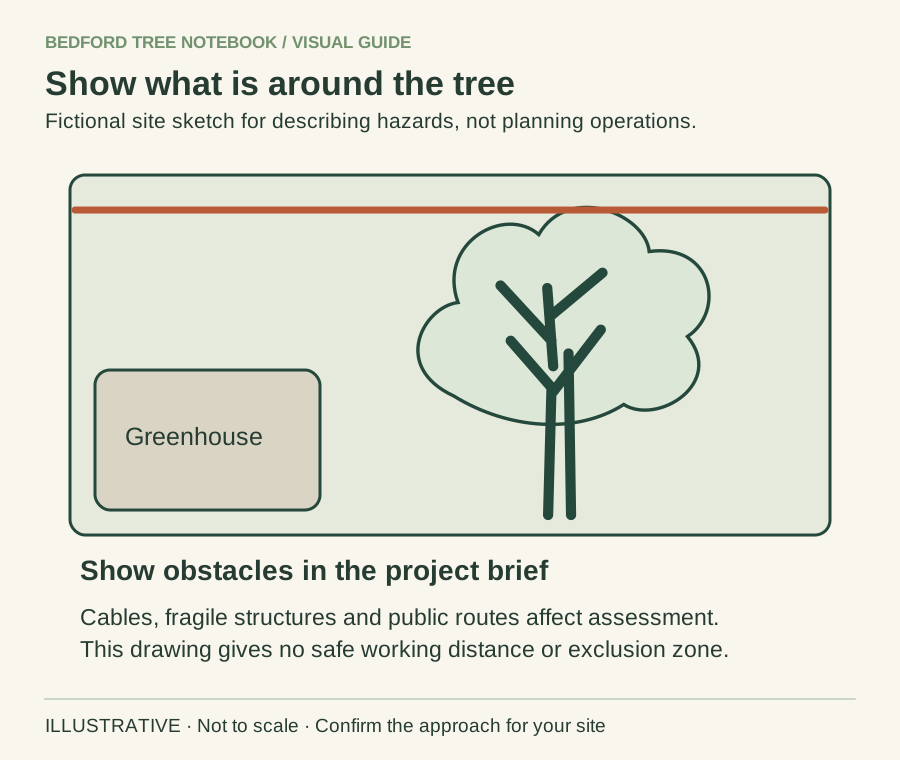
- Describe overhead lines and fragile structures before a visit.
- Do not approach lines or enter a work area to obtain a photograph.
- Qualified contractors and the relevant network operator determine arrangements.
Describe the position from a safe place
State whether the line crosses the tree, runs beside it or passes over the proposed vehicle route. A wide photograph from an already safe position is more useful than trying to get a close-up. Mention poles or equipment that you can see without approaching them.
The rural enquiry guide helps explain long entrances and multiple work areas. Urban gardens can also have overhead services; do not leave the issue out because the job appears small.
Let the contractor arrange the assessment
HSE identifies overhead electricity lines as a serious tree-work hazard. The contractor must consider the work and, where required, coordinate with the line owner or network operator before proceeding. Do not treat a general distance found online as a homeowner’s clearance to work.
Ask who will make the necessary contact, what information is needed and whether the quotation depends on further arrangements. A visit or proposed date may need to remain provisional.
Include the entire operation
Branches, equipment and vehicle movements can all matter. Explain where material would be loaded and whether a line crosses an entrance away from the tree itself. The professional assessment needs that wider picture.
Read parking and shared access when preparing the route. Do not move a line, raise it with a tool or try a small amount of pruning to help the contractor. If the site changes or a line is damaged, stop relying on the earlier plan and seek appropriate advice.
Include lines away from the tree itself
The first enquiry should describe the route to the work as well as the crown. A line may cross a driveway, gateway or loading position some distance from the tree. Explain that relationship so the contractor can consider the complete operation, including equipment movements and material leaving the site.
Take any photograph from an ordinary safe position without moving towards a line for a clearer view. If you cannot show both the tree and the crossing, say so in the caption. Do not use a pole, tape, drone or raised object to measure a distance. The purpose is to flag the issue, not undertake a safety survey.
Avoid assumptions about what a cable carries
A homeowner may believe a line serves a telephone connection or only a small outbuilding. Tell the contractor what you know and what you are assuming, but do not treat that belief as verification. Appearance, apparent insulation and the size of a building are not a reliable basis for deciding that a line is safe to work near.
If you have documents identifying infrastructure, provide them without interpreting them beyond your knowledge. The contractor should explain what competent advice and coordination it needs. A reassuring description from an informal conversation is not a substitute for assessing the actual line and the proposed activity.
A hypothetical rural entrance problem
Imagine a tree stands in an apparently open part of a larger garden, but the only vehicle entrance passes beneath an overhead line. An enquiry focused exclusively on the tree could miss the restriction. A wider route photograph and a sentence explaining the crossing give the contractor a much better starting point.
This hypothetical example does not establish what equipment could pass or what arrangements would make the job possible. The rural-property enquiry guide helps describe other entrance details, including gates and surfaces. Keep the booking provisional until the business has assessed the relevant constraints and explained any further coordination that is needed.
Ask who will organise the next conversation
If advice from a line owner or network operator is needed, agree who will contact it and what information the homeowner should supply. Ask whether that coordination is included in the proposal and whether it could affect the work date. Do not assume an initial site visit means the necessary arrangements are already complete.
Keep the response with the tree-work record and make the open issue obvious in subsequent messages. If the contractor changes, provide the same information to the replacement business rather than assuming the first firm’s discussion transfers automatically. Each business needs to understand what it is taking responsibility for before planning its operation.
Keep the quotation conditional where appropriate
A quotation can explain that the method or date depends on further assessment. Read that qualification carefully and ask what decision remains outstanding. It is better to understand a limited proposal than mistake an early figure for confirmation that the whole site is ready for work.
Use the quotation checklist to record access assumptions and separate responsibilities. Avoid selecting a contractor simply because its brief message mentions no complication; it may not yet have the information another business has requested. Comparable proposals should be based on the same photographs, route description and disclosure of the overhead-line concern.
Tell the business if something changes
Report an altered access route, new scaffolding, changed loading position or newly noticed line before the appointment. Those details can matter even when the tree and requested pruning remain unchanged. Ask the contractor to confirm whether the original plan still applies.
For buried infrastructure, our underground-services guide covers a separate issue that can exist on the same site. Do not treat an overhead-line discussion as an all-services clearance. If a line is damaged or fallen, keep away and seek the appropriate emergency assistance; do not approach it to take a photograph or investigate whether it is live.
Keep the homeowner’s role practical
Your useful contribution is an accurate location, known information, clear access photographs and timely communication. You are not expected to calculate a safe working distance or decide whether a particular operation can be carried out with lines energised. Ask the business to explain its planning process in terms you can follow, while leaving technical controls to competent professionals.
Before work, confirm that the attending team knows about the line and the agreed arrangements. Follow instructions about remaining outside the working area. At completion, retain any relevant handover information for later work on the property, without treating it as permanent clearance for a different contractor, route or operation.
Your next step
Keep the line issue visible in the written brief. Confirm with the contractor that required assessment and coordination have been completed before a work date is treated as ready to proceed.
Turn the advice into a useful project brief.
Start with the postcode, the work you have in mind and any access considerations.
Prepare your enquiryNo obligation. A site assessment may be needed to confirm the work and price.
Sources & further reading
Sources checked 31 October 2026. How we prepare guidance.